The Diary Game: Peanut Class With Students At Apex Catering Academy
Hello everyone, I hope you guys are doing well? By the grace of God I'm also doing well. Today at Apex Cakes, Catering and Craft Academy, it was all about one of the most loved snacks in Nigeria - PEANUT! Also called Coated Peanut, Burger Peanut, or Peanut Burger. If you have ever tasted that crunchy, milky, sweet and addictive little snack that you can't stop eating once you start, then you know why today's class was so important for our students.
At Apex, we don't just teach cakes and pastries, we teach our students how to make profitable, fast-selling snacks that can become a real business on its own. Peanut is one of those products. With just groundnuts, flour, sugar and eggs, you can start a business with small capital and make good profit. And that is exactly what we taught today. Let me take you through our class with the pictures.
The Preparation Stage - Where The Magic Begins
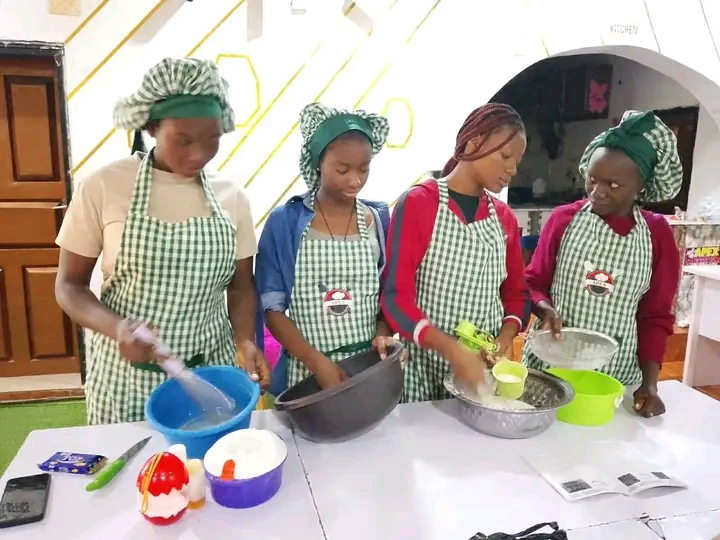
As you can see in Picture 1 and Picture 2, our students were fully kitted in their green and white checkered aprons and chef caps, ready for business. On the table in front of them were all the ingredients well arranged - bowls of flour, sugar, beaten eggs in a blue bowl, vegetable oil, flavour, and of course, the star - the raw groundnuts.
In the first picture, you can see four of our students standing around the table. One student is whisking the eggs with sugar, another is holding a sieve with flour, another is adding flour gradually, and the fourth is watching carefully. This is how we teach at Apex, everyone participates. No one is a spectator.
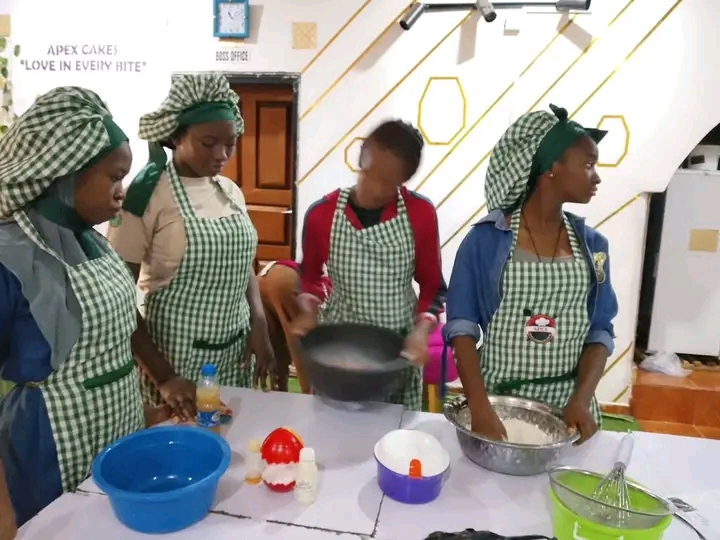
The second picture shows a different angle. You can see the motto on the wall behind us: "APEX CAKES - LOVE IN EVERY BITE". That is not just a motto, that is our teaching philosophy. We teach with love. The first step of peanut making is the most delicate. You need to mix your eggs, sugar, a pinch of salt, milk flavour and a little oil together until the sugar dissolves. In another bowl, you have your flour mixed with a little baking powder. Then you have your clean, dry groundnuts in a bigger bowl. The secret of good peanut is in the coating. You don't just pour everything at once. You have to be patient.
We taught our students the traditional hand-coating method which is still the best method for small scale production. You sprinkle a little bit of the egg mixture on the groundnuts, shake the bowl in a circular motion so that all the groundnuts get wet, then you sprinkle the flour mixture and shake again. You repeat this process - egg, flour, shake, egg, flour, shake - until each groundnut has grown from a small nut to a big, round, well-coated ball.
In the picture, you can see one of our students shaking the black bowl vigorously. That shaking is a skill on its own. If you don't shake well, your peanut will be flat on one side. If you shake too hard, the coating will peel off. Our students learned how to shake with the right rhythm. It was fun to watch them laugh as they tried to master it. This process takes time and teamwork. One person sprinkles the liquid, another sprinkles the flour, and another shakes. That is why you see them working together in groups. At Apex, we believe in teamwork.
The Coating - The Most Satisfying Part
After about 30-40 minutes of continuous coating, we arrived at the stage shown in Picture 3.
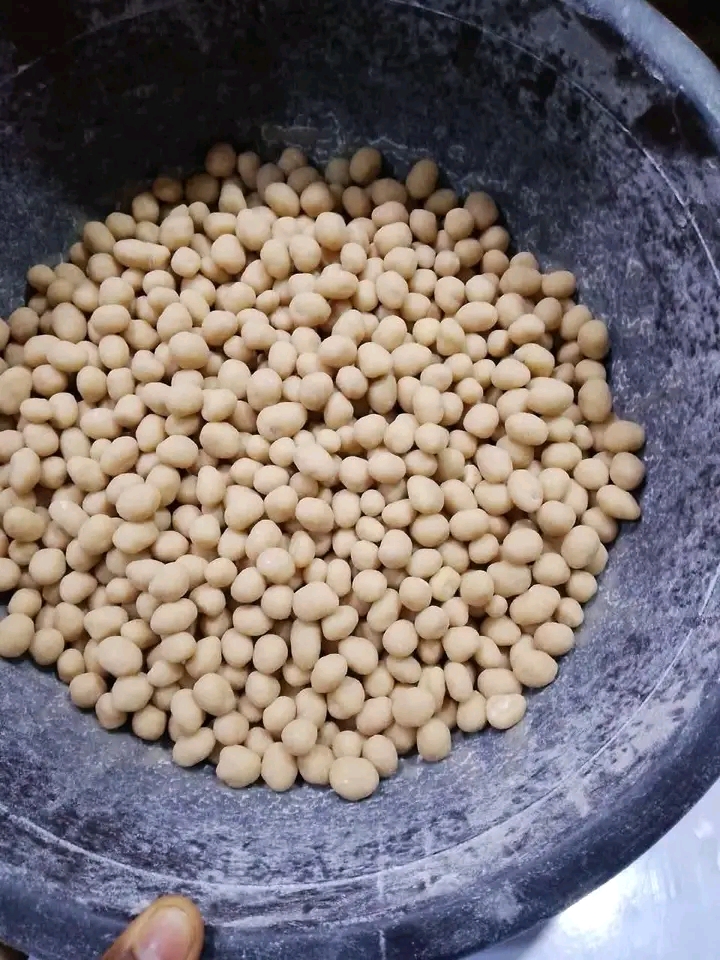
Look at that bowl! A beautiful black bowl filled with perfectly coated raw peanut. Each piece is round, smooth, and coated evenly. This is the result of patience and proper technique. When you see peanut like this before frying, you know it is going to come out crunchy. Our students were so excited when they saw this. For many of them, this was their first time making peanut from scratch. They had always bought it from the market, but now they know the secret behind it. One of our students said, "Ma, so this is how they make this thing we love so much? It looks so easy but I can see it needs patience."
Exactly! Peanut business looks easy, but it needs patience, neatness and precision. If your egg mixture is too much, your peanut will clump together. If your flour is too much, your peanut will crack when frying. We taught them the perfect measurement: for every 1 cup of groundnut, you need about 2 cups of flour, 1/4 cup of sugar, 1 egg, and a pinch of salt. But we also taught them how to scale it up for commercial quantity.
The Frying - Where It Turns To Gold
Now comes the part that everybody loves - frying. Picture 4 and Picture 5 show the frying process. We poured enough vegetable oil into a deep blue non-stick pan and allowed it to heat up on medium heat. The mistake many people make is to fry peanut on very high heat. When you do that, the outside will get brown quickly but the inside, close to the groundnut, will still be raw and soft. So we teach low to medium heat frying.
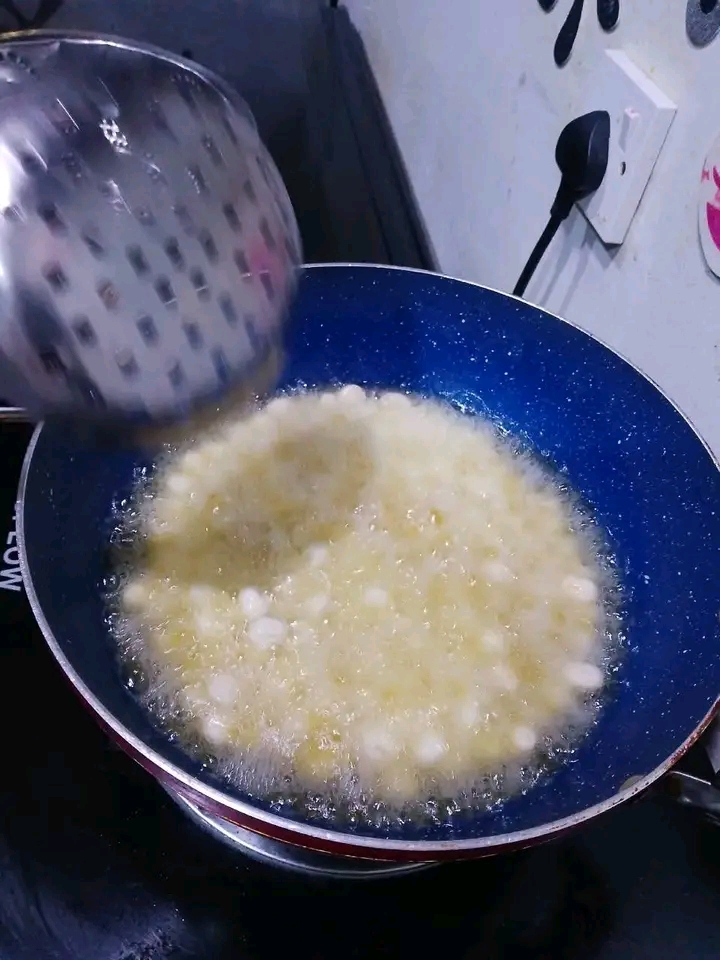
As you can see in Picture 4, once the oil was hot, we gently poured the coated peanut inside. You can see the oil bubbling and foaming around the peanut. That foaming is normal, it is because of the eggs and sugar. We taught our students to stir continuously but gently with a perforated spoon so that the peanut does not stick together and fries evenly.
The aroma at this point was heavenly. The whole academy was smelling like milky vanilla and fried groundnuts. Everyone from other departments came to peep into the kitchen. After about 8-10 minutes, the color started changing from white to light cream, then to golden brown. That is the perfect color you are looking for. You don't want dark brown because it will taste bitter.
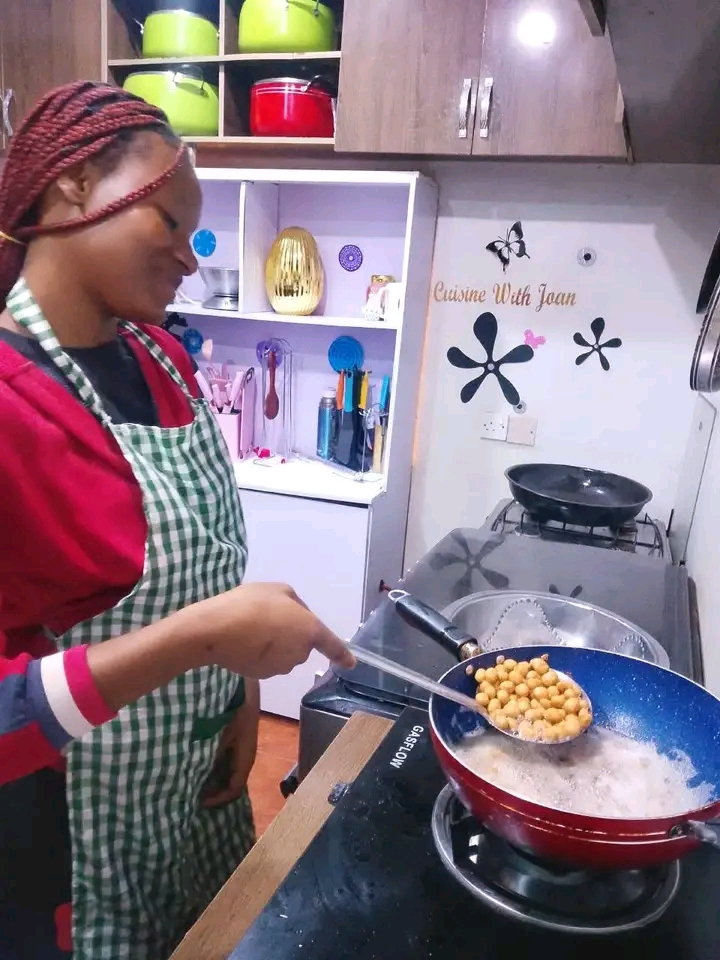
In Picture 5, you can see one of our students, smiling with so much joy, lifting a scoop of perfectly fried, golden brown peanut from the hot oil. Look at that color! Uniform, crunchy, beautiful. She was so proud of herself, and rightly so. She had just made her first batch of commercial peanut. We then poured the fried peanut onto a flat tray lined with tissue to drain the excess oil and allowed it to cool completely. Peanut becomes crunchier as it cools. When it is hot from the oil, it is still a bit soft.
*Why Peanut Class Is So Important
You may be wondering, why do we take peanut so seriously?
At Apex Catering Academy, our goal is not just to give you a certificate, it is to give you a source of income. Peanut is one of the most profitable snacks in Nigeria right now.
- Low capital to start: With N5,000 you can buy groundnuts, flour and sugar and start.
- Long shelf life: If well fried and well stored in an airtight container, peanut can stay crunchy for up to 3 weeks.
- High demand: Kids love it, adults love it. It is sold in schools, traffic, supermarkets, offices.
- Easy to package: You can package in small nylon, bottles, or ziplock and brand it.
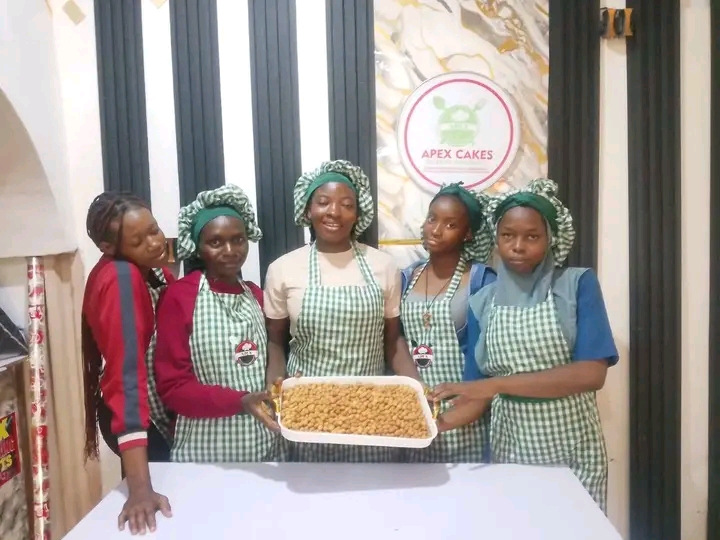
During the class, we also taught them costing and pricing. We showed them how to calculate how much they spent on 1kg of groundnut and how much profit they will make if they sell in N100, N200 and N500 packs. Many of them were shocked to see that the profit margin is over 60%.
By the end of the class, each student went home with a pack of peanut they made themselves. That is our method - you learn, you do, you take it home. If you are in Uyo and you want to learn how to make commercial peanut that stays crunchy, tastes milky, and doesn't peel off, come to Apex Catering Academy. Our doors are always open.
And to our amazing students in today's pictures, I am so proud of you. You all did excellently well. Your peanut came out perfect. Now go and turn this skill into money.
Thank you for reading. ❤️❤️❤️
 |
|---|