Building Software in 2026, Apparently Still Requires Punch Cards
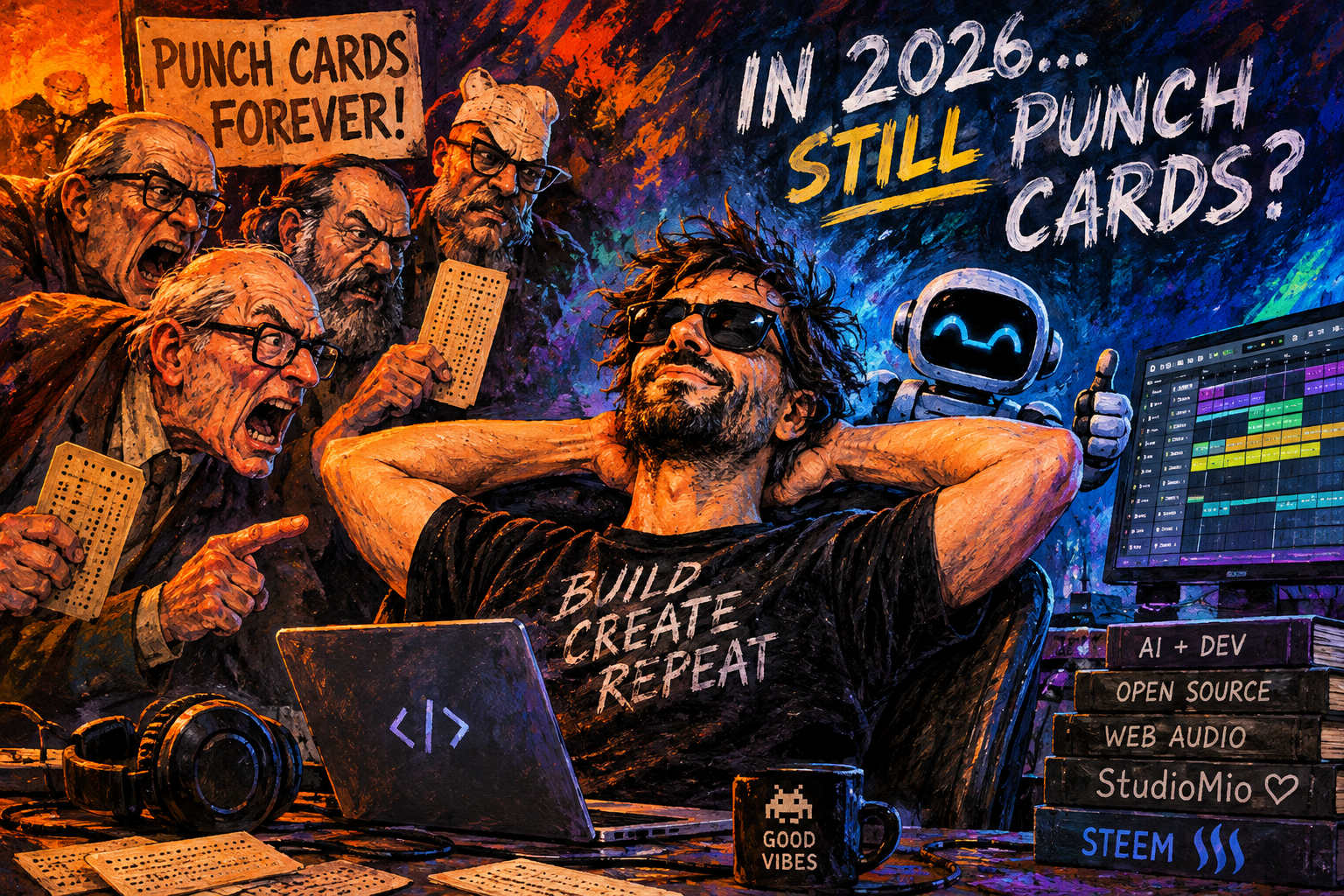
I've had an interesting couple of days on Reddit.
I shared a project I've been working on called StudioMio, an experimental DAW built with TypeScript, Web Audio API and Electron. It's an open-source project, developed with extensive AI assistance, and something I've been building because I love programming and making music.
I wasn't trying to compete with Ableton, Reaper or Bitwig. I wasn't announcing the next revolution in digital audio. I simply wanted to build something of my own, experiment with audio technologies, create instruments and effects, and see how far I could push the Web Audio API.
I also wanted to share it with people who might be interested in the experiment.
Well, things got interesting.
Welcome to the AI witch hunt
Some reactions were genuinely useful. People pointed out technical limitations, missing documentation, licensing issues, audio backend restrictions, performance concerns and things that could be improved.
Fair enough. That's exactly why you share open-source software.
I listened, took notes, fixed things and thanked people who invested their time in reviewing the project.
But there was another kind of reaction.
Some people seemed more interested in dismissing the project because AI was involved than actually understanding what had been built. Apparently, using Claude means you're no longer allowed to call yourself a developer. Your architecture decisions don't count, debugging doesn't count, integration doesn't count, testing doesn't count.
Someone basically reduced the entire project to "Claude made a DAW".
Another person questioned whether I even made music. Someone else suggested my replies were obviously AI-generated.
At that point I started wondering whether I had accidentally walked into a convention of professional punch-card operators.
You know, the traditional craftsmanship of manually entering every single zero and one. No shortcuts. No modern tools. Just you, a stack of cards and the satisfaction of knowing that every line of code has personally suffered.
Apparently that's the only legitimate way to create software nowadays.
Then something rather nice happened
I decided to write a second post to clarify why I had shared StudioMio in the first place.
And the atmosphere changed completely.
People started sharing their own experiences with AI-assisted development. Experienced developers explained how AI is already becoming part of their everyday workflow. Others offered encouragement, technical suggestions and even opportunities for collaboration.
One developer introduced me to Jig, an interesting project exploring a web-native plugin format for audio software. That's exactly the kind of conversation I was hoping to have when I first published StudioMio.
Another person wrote something that genuinely made me laugh:
"I'm sure all their software is handcrafted using punch cards made from traditional paper."
I literally fell off my chair.
And honestly, that comment perfectly captured the absurdity of the situation.
Here's what I actually think
AI isn't going to make every developer brilliant overnight. It doesn't magically produce good architecture, reliable software or finished products.
You still need to understand what you're building. You need to make decisions, evaluate results, integrate components, debug failures, test things and take responsibility for the final result.
AI is a tool. A very powerful one, but still a tool.
What has changed is the amount of work one person can realistically attempt.
Projects that would previously have required a team, a much larger budget or months of development can now become accessible to someone working independently.
And I find that incredibly exciting.
I'm a developer, but I'm also a musician and a creative person. I don't particularly care about winning arguments over how many lines of code I personally typed.
I care about what I can imagine, build, experiment with and share.
StudioMio is one example. I've got other projects, other ideas and plenty of things I'd like to explore.
Some will work, some will fail, and some will probably turn into something I hadn't even imagined when I started.
That's the fun part.
A small message to the punch-card enthusiasts
You don't have to like AI. You don't have to use it. You can prefer writing every line of code yourself, and there's absolutely nothing wrong with that.
But dismissing someone else's work simply because they use different tools is a pretty strange hill to die on.
Technology has always changed the way we create things. Programmers once argued about high-level languages, then IDEs, then frameworks, then automated testing.
Now we're arguing about AI.
Meanwhile, some of us are just having fun building things.
So I'll keep experimenting, keep learning, keep breaking things and hopefully keep making useful software.
And if that's cheating, I guess I'll keep cheating. 😂
For anyone interested, here are the two Reddit threads:
- The original StudioMio post
- My follow-up clarification
And of course, here's the project:
StudioMio on GitHub
Keep building. Whatever tools you use.
Building an open-source DAW with TypeScript and Web Audio API is a serious undertaking. Using AI tools for assistance alongside manual integration and debugging makes complete sense for solo developers tackling complex audio backends.