Blockchain Security Audits and Smart Contract Vulnerabilities
Blockchain technology has altered the way people view money, business, ownership and digital transactions. It enables individuals to conduct transactions without relying on a central authority, like a bank or government, every time. The smart contract is a crucial component of most blockchain systems. Smart contracts are pieces of computer code that are embedded in a blockchain and automatically execute some action when a certain condition is fulfilled. Smart Contracts can indeed bring about quicker, simpler transactions, but they can also have significant security flaws. This is why blockchain security audits are very important. I think it's important for any project to understand what vulnerabilities lie in a smart contract and to test them out before they go live, to avoid significant financial losses and to prevent the user from getting hacked.
A blockchain security audit is a meticulous audit of a blockchain project, particularly its smart contracts, to identify security vulnerabilities. Security experts analyze the code and search for any errors they can exploit. The primary objective is to recognize issues in time for criminals to find and exploit. An audit may include reading the source code, running tests on the contract, examining the design of the contract, and attempting various attacks on the contract. The auditors can also review the interactions between the smart contract and other smart contracts, wallets, or blockchain applications. In a nutshell, a security audit is the equivalent of inspecting locks, doors, windows and other elements of a home before people move in.
Smart contracts are powerful because they can automatically perform actions. This same feature can be hazardous if there is a coding error, however. A smart contract on a blockchain is a type of contract that cannot be easily or readily modified, unlike ordinary software. When a serious error is found after funds are placed in the contract, rectifying the issue could prove challenging. Therefore, security testing prior to deployment is most critical.
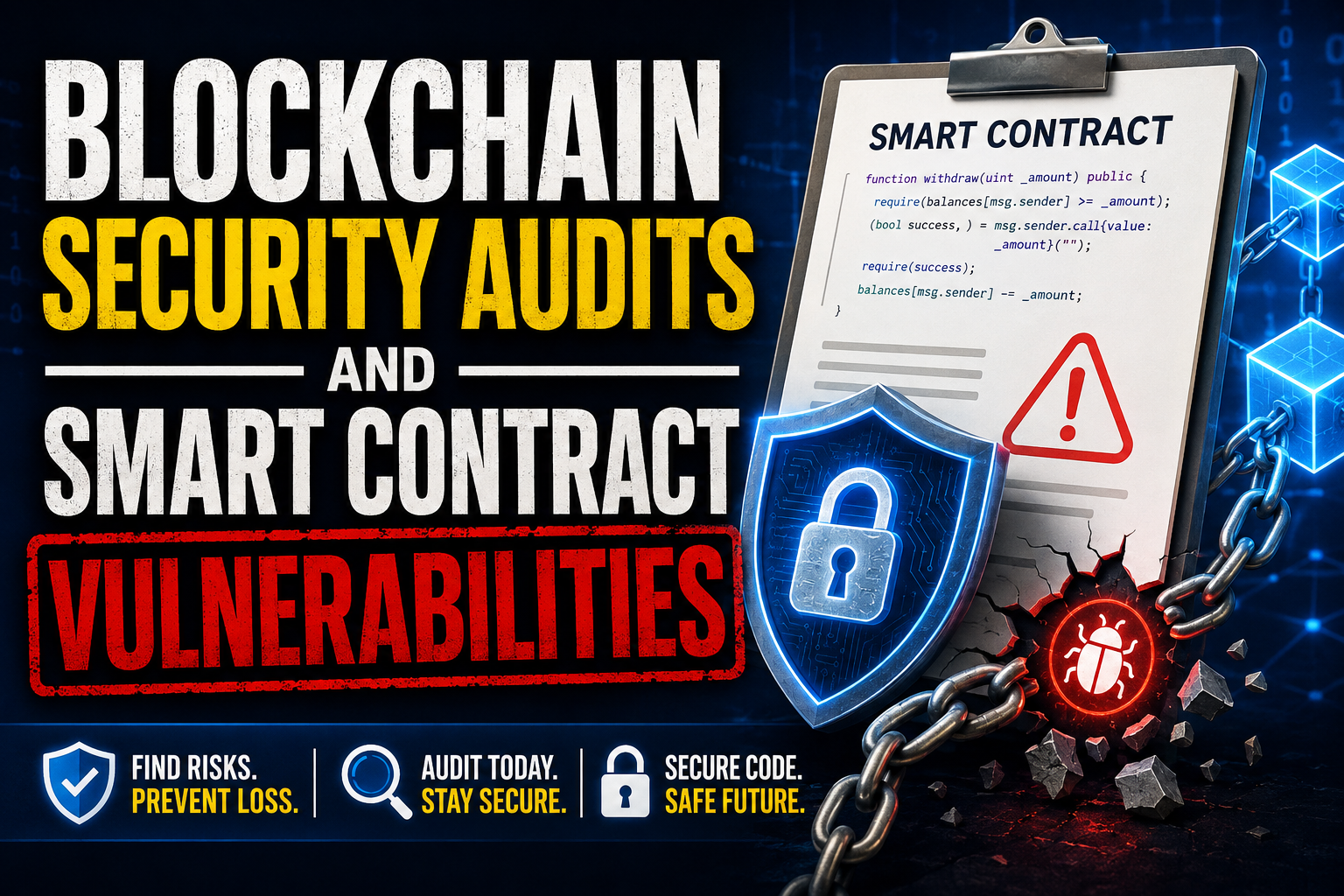
A reentrancy is a common vulnerability of a smart contract. This occurs when a contract transfers funds to another contract without correctly updating its records. The receiving contract may make another call back to the original contract prior to the first call being fully completed. This may enable the attacker to be able to withdraw money over and over again. One of the famous security issues with smart contracts is reentrancy, which could result in significant financial losses. A competent audit should review that contracts are strictly governed by safe patterns from such an attack.
Another significant weakness is the weak access control. Many smart contracts have specific functionalities that are reserved for specific individuals – typically an administrator. An attacker could take control of key portions of the contract if the programmer does not properly limit these functions. For instance, an attacker might alter vital settings, make new tokens, or withdraw money. One of the most critical parts of an audit in my opinion is access control, even if you get one thing wrong with your access control you have a lot of power within your hands.
Integer problems can indeed pose security issues. Numbers are frequently associated with smart contracts, such as tokens, balances and payments. Numbers which exceed the limits of the code's accuracy can cause unexpected results. Integer Overflow/Underflow were particularly problematic in older smart contract systems. Some of these risks can be mitigated with modern programming tools; however, software developers must still pay close attention to coding and testing their programs.
The other issue is the lack of input validation. The data in smart contracts is fed by users and other smart contracts. The contract may not be written to correctly check this information, in which case the attacker could supply unexpected information that would cause an incorrect behavior of the program. For instance, an attacker could supply abnormal numbers or transaction information which would trip up the regular logic of the contract. Auditors therefore check various inputs and observe the reactions of the contract.
Another key challenge with DeFi applications is price manipulation. A large number of smart contracts rely on external data, known as oracles, to get their pricing data. If the information from an oracle is false or manipulated, the smart contract can make a wrong decision. An attacker can exploit it in the following ways: borrowing more than they ought to, dealing at an unfair price and withdrawing money from a platform. Therefore, auditors should look at the smart contract as well as the systems delivering information to the smart contract.
Typical stages in a good blockchain security audit. The first step is for auditors to analyse the project and grasp its functions and goals of the smart contract. They then thoroughly inspect the source code. They employ automated security technologies to detect common issues, but automated security isn't sufficient, nor is it an effective standalone strategy. Some vulnerabilities rely on the business logic of the project and require human auditors. Once vulnerabilities are identified, auditors test and validate issues. Lastly they write a report detailing the vulnerabilities and how to address them. Once the changes have been made by the developers, another review can be conducted to verify the issue(s) have been addressed.
It's also worth to keep in mind that a security audit does not imply that a smart contract is 100% secure. An audit can help to minimize risks, but it won't provide absolute certainty that all possible risks have been identified. New attack methods may emerge and after an audit, changes to a project may create new issues. Hence, blockchain projects need to keep their systems under surveillance following deployment. The developers should also implement secure coding practices, regularly test, and act promptly when new threats are identified.
Hi @adese,
🎲 SteemLudo is waiting for new players!
Play SteemLudo, challenge real players using STEEM, and earn up to 1.9× STEEM rewards when you win your matches.
Want more rewards?
Share your SteemLudo gameplay experience by making a post on steem and receive handsome rewards with a guaranteed vote.
🎁 Invite more players with your invitation code and earn up to 110 STEEM!
🎮 Play Now: https://www.steemx.org/ludo
💬 Join Discord: https://discord.gg/JyW7v8STG
https://x.com/i/status/2087960349404479669
https://coinmarketcap.com/currencies/pussfi/
https://x.com/i/status/2082974918300541265