My HashNet Journey – Part 2: Understanding HashNet Hardware Mining
In Part 1, I shared how my interest in HashNet started after attending a meeting with Ian Issa in Fredrikstad, Norway, on September 22, 2026.
Two days later, I purchased my first $150 hardware package.
Since then, I have spent quite some time exploring the platform, following my mining rewards, and learning more about how the system works.
Today, I want to share some of what I have learned.
Mining Without Equipment at Home
One of the things that caught my attention was the possibility of participating in cryptocurrency mining without having to purchase and operate mining equipment at home.
Traditional mining requires specialized hardware, electricity, cooling, maintenance, and technical knowledge.
With HashNet, the company says it handles these operations.
As a participant, I don't have to run mining machines at home, and I don't receive a separate electricity bill.
However, electricity and maintenance still cost money, and understanding how those expenses affect actual mining profitability is important.
HashNet Mines More Than Bitcoin
Something interesting about HashNet is that its platform is not limited to Bitcoin.
According to my dashboard, the mining system supports several cryptocurrencies:
- Bitcoin (BTC)
- Bitcoin Cash (BCH)
- Zcash (ZEC)
- Dogecoin (DOGE)
- Litecoin (LTC)
- Kaspa (KAS)
The platform also displays an Auto-Optimised mining system, which appears designed to select mining opportunities across different cryptocurrencies.
Some currencies may be actively mined while others are on standby.
This is how the platform presents its mining activity. I have not independently verified the underlying mining operations.
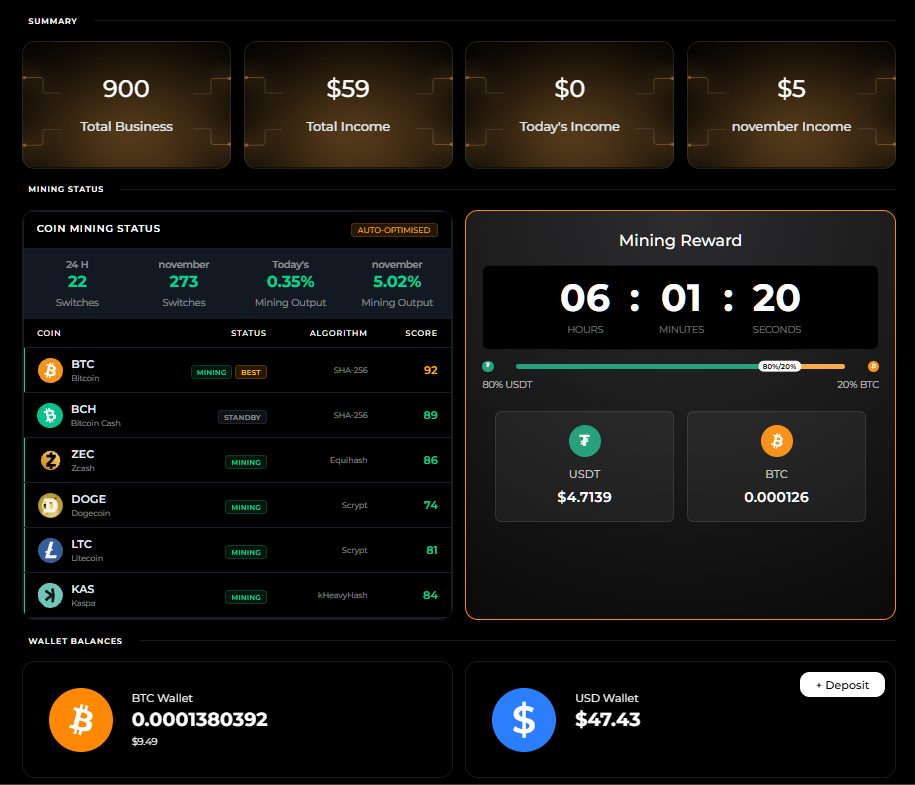
My HashNet dashboard showing the supported cryptocurrencies, mining status, and reward distribution.
Starting With a $150 Hardware Package
When I joined HashNet, I decided to start with the minimum hardware package of $150.
My idea was simple: start small, learn how the platform works, and follow the results before making any further decisions.
According to the hardware model presented by HashNet, the main conditions include:
| Hardware model | Details |
|---|---|
| Minimum package | $150 |
| Mining reward settlement | Every 8 hours |
| Illustrative monthly mining return | 5%–7.4% |
| Maximum credited rewards | Up to 5 times the package price |
| Maximum package lifetime | 4.5 years |
For a $150 package, the advertised maximum credited rewards would be $750.
This is an earning limit, not a guaranteed payout.
What Could a $150 Package Generate?
Let's use a simple example with a hypothetical monthly mining return of 5%.
| Period | Calculated mining rewards |
|---|---|
| 1 month | $7.50 |
| 6 months | $45.00 |
| 12 months | $90.00 |
| 24 months | $180.00 |
These figures assume a constant monthly return without reinvestment or interruptions. They are only illustrations, not actual earnings or guaranteed future results.
The real outcome depends on whether the platform can generate and distribute the rewards over time.
Mining Rewards in BTC and USDT
Another feature I have been exploring is the possibility of choosing how mining rewards are distributed.
For example, my dashboard currently shows:
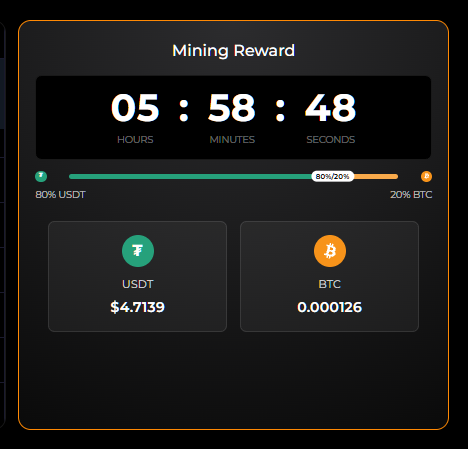
80% USDT / 20% BTC
This allows me to follow rewards in both a dollar-pegged cryptocurrency and Bitcoin.
I find this flexibility interesting, especially when considering whether to withdraw rewards or use them for additional hardware purchases.
However, the allocation shown on the dashboard does not by itself verify the source of the mining income.
Reinvesting Mining Rewards
One of the features that interests me most is the possibility of reinvesting mining rewards.
Instead of withdrawing everything, rewards can potentially be accumulated and used to purchase additional hardware packages.
For example, once enough rewards have accumulated to cover a new $150 package, another purchase may be possible.
Each new package has its own earning limits and lifetime.
Over time, this could increase the number of active packages without requiring additional money from outside the system.
Of course, reinvesting also means leaving more money exposed to the platform rather than taking it out.
My Personal Experience So Far
I started with HashNet in September 2026, so I am still learning.
I have been following the mining rewards shown in my account, studying the compensation plan, and discussing the system with other members.
What I find interesting is not only the mining concept itself, but also the opportunity to share experiences and help others understand how it works.
At the same time, I know that rewards displayed on a dashboard are not the same as independently verified mining profits or confirmed withdrawals.
For me, the important thing is to continue learning and see how the project develops over time.
What Comes Next?
In Part 3, I will take a closer look at HashNet's newer Machine Lease model.
This model starts at $250 per package and has an 18-month contract period.
I have already spent time studying different reinvestment scenarios, and I will share some of those calculations in the next article.
I will also explain the difference between projected earnings, reinvestment, and money actually withdrawn.
Have you ever tried cryptocurrency mining, either at home or through a hosted mining platform? I would be interested to hear about your experience.
This article reflects my personal experience and understanding of HashNet. The mining returns mentioned are illustrative figures based on the platform's stated model, not independently verified performance. Financial risks include the possibility of losing the entire amount invested. This is not financial advice.
To be continued – Part 3: Exploring the HashNet Machine Lease Model
Useful links:
HashNet.club – Community Guides and Tools
👉 Join HashNet Mining Network on Discord
Learn • Mine • Earn BTC • Connect • Build


I wish you success in this endeavor!
I wonder, can the terms of an offer be changed unilaterally? For instance, I once encountered a situation where, in order to receive a certain number of tokens daily and use tipping commands, I was required to hold—let’s say—5x coins. After some time, however, they changed the terms, and to access those same features, I suddenly had to hold 100x coins in staking—even though the price of the coins hadn’t changed at all, lol. Also, are you able to terminate the contract if you wish to do so, while keeping losses to a minimum?
0.00 SBD,
1.87 STEEM,
1.87 SP
Thank you, my friend!
You raise some very good questions.
According to HashNet's hardware model, owners have the possibility of selling their mining hardware positions on an open marketplace.
This could provide a way to exit before the hardware reaches the end of its lifespan. However, finding a buyer and recovering the original purchase price are not guaranteed.
Regarding changes to existing agreements, I still want to confirm exactly what protections apply.
I appreciate your questions, as these are important things to understand before getting involved.
Thank you again for your support!
Me quedó dando vueltas el dato de los pagos cada 8 horas y ese 5–7.4% mensual que mostrás en la tabla. ¿Ya te tocó cobrar algún ciclo o todavía estás en fase de observar el dashboard? Te pregunto porque con esos números conviene seguirle la ruta al detalle antes de meter más presupuesto.
Thank you for sharing on steem! I'm witness fuli, and I've given you a free upvote. If you'd like to support me, please consider voting at https://steemitwallet.com/~witnesses 🌟
thank you