What Hive Gets Right About Rewards (And What It Still Gets Wrong)
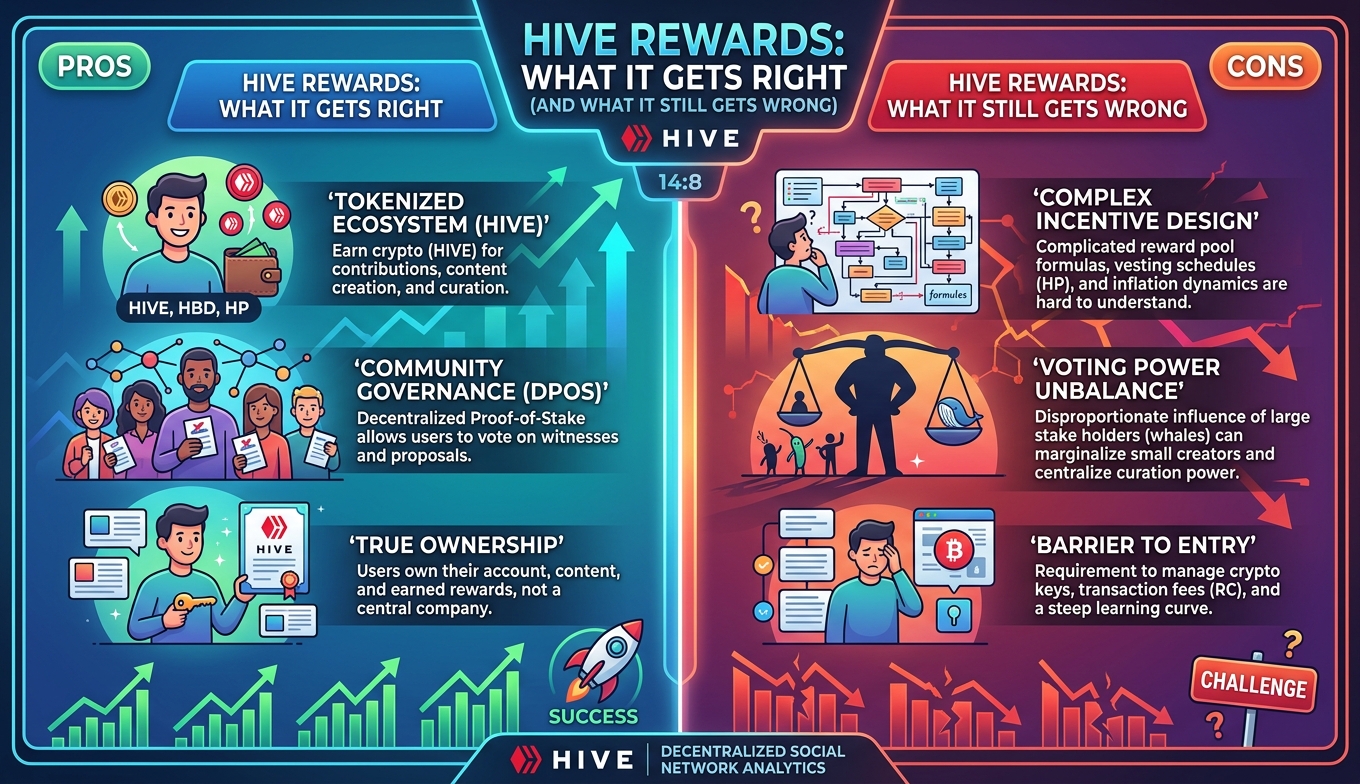
Most social platforms pay you in dopamine and nothing else. Hive is one of the few that actually pays you — and after using it, I think that single design choice explains almost everything good and bad about this place.
What It Gets Right
It prices attention instead of pretending attention is free.
On every other platform, your writing, your curation, your time reading someone else's post — all of it generates value that a company quietly captures. Hive is one of the only places that routes a meaningful share of that value back to the people creating and curating it. Whatever else is wrong with the system, that starting principle is correct.
Curation rewards make good discovery profitable, not just altruistic.
Upvoting isn't just a courtesy here — it's an economic act. That changes behavior. People who are good at finding undervalued content early have a real incentive to keep doing it, instead of the "like and move on" behavior every other feed trains into you.
No platform toll.
There's no ad auction deciding who sees your post, no algorithm quietly throttling reach until you pay for boosted distribution. The economics are transparent even when they're imperfect — you can see exactly where a payout came from.
What It Still Gets Wrong
Stake-weighted voting concentrates influence exactly where it shouldn't.
The more Hive Power you hold, the more your vote is worth — which means the reward system disproportionately rewards whoever already has the most stake, not necessarily whoever produces the best writing. In practice, a handful of large accounts can outweigh hundreds of smaller, genuinely engaged readers. That's not a curation market. That's a plutocracy with better branding.
New accounts are structurally invisible.
A brand-new writer with excellent work and zero stake will often earn less from a strong post than an established account earns from a mediocre one, simply because their vote weight — and their followers' vote weight — is negligible. The system rewards existing capital more reliably than it rewards existing quality. That's backwards for a platform trying to attract new voices.
Reward pool volatility undermines the whole pitch.
Token price swings mean the same quality of work can be worth wildly different amounts month to month, for reasons that have nothing to do with the writing itself. It's hard to build a sustainable creator economy on a currency this volatile, no matter how good the underlying incentive structure is.
My Actual Position
I don't think the answer is abandoning stake-weighted rewards entirely — some weighting toward proven, invested community members makes sense, or the system becomes trivially gameable. But the current balance leans too far toward capital and not far enough toward merit. A hybrid model — where reputation earned through consistent, well-received output carries real curation weight independent of token stake — would fix the part of this system that currently pushes new, talented writers out the door before they ever get a fair look.
Hive proved that paying creators directly is possible at scale. It hasn't yet proven that it can pay the right creators consistently. Those are two different problems, and only one of them is solved.
I'm three posts into this platform and already have opinions about how to fix it — take that as either confidence or naivety. Curious where the long-time Hive users here disagree with me.
— northsignal