How to Reduce Slab Waste and Lower Material Costs in Stone Countertop Fabrication
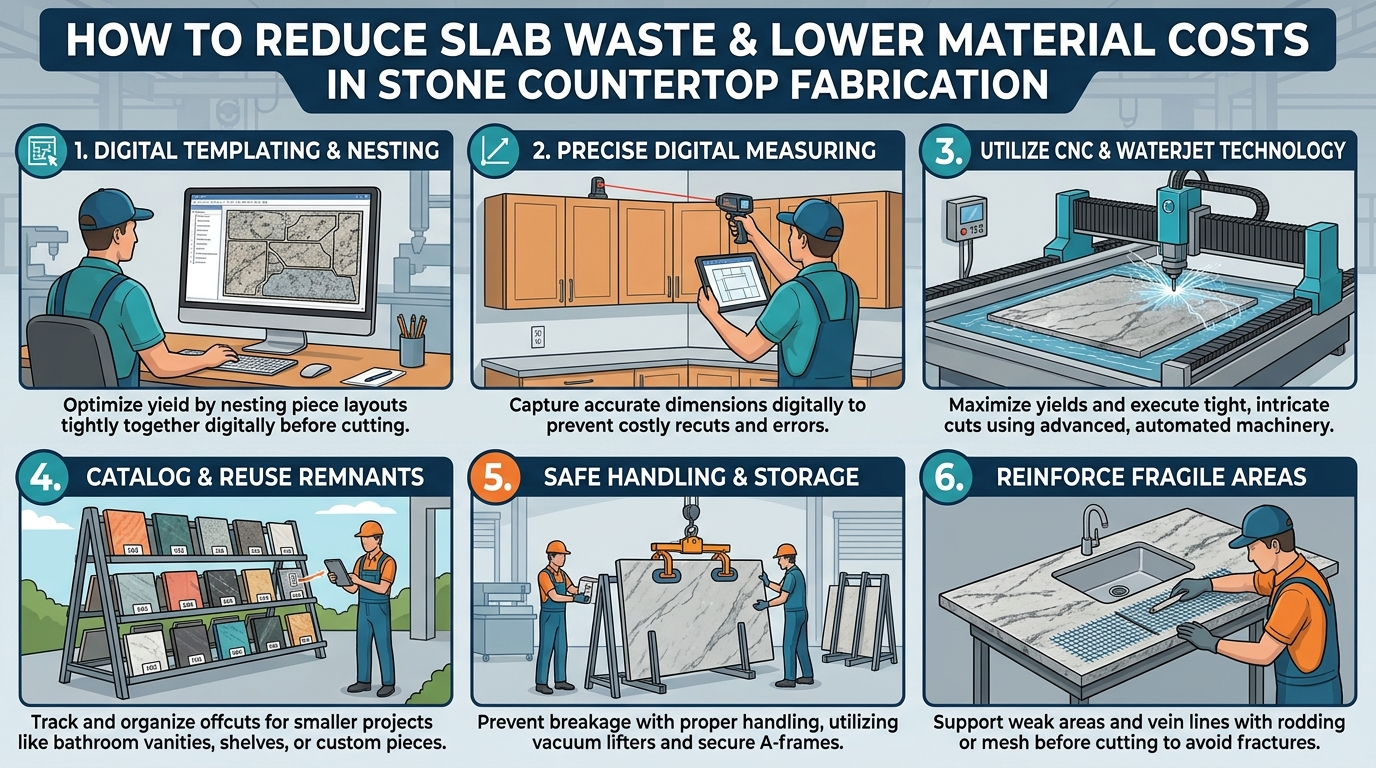
Managing material costs is one of the most critical factors determining profitability for stone fabrication shops. Whether working with natural granite, quartzite, marble, or engineered quartz, the physical stone itself represents a massive percentage of total job expenses. When high-value slabs are cut inefficiently, the resulting drop-off waste drains profit margins that cannot easily be recovered through labor markup alone.
For growing custom shops, learning how to systematically minimize slab waste without sacrificing quality or customer design preferences is an essential operational goal. SlabWise provides digital nesting and layout tools designed to help countertop fabricators optimize slab utilization and track material yield across custom jobs. By implementing simple, structured approaches to quoting, digital templating, batch processing, and remnant management, fabricators can stretch raw inventory further and significantly reduce overhead.
Understanding the True Cost of Slab Offcuts
Many shop owners calculate job profitability strictly based on square footage pricing. However, stone slabs are purchased as whole units, not partial cuts. If a kitchen design requires 45 square feet of stone, but the job layout forces the shop to purchase two full 60-square-foot slabs (120 square feet total), the shop pays for the unassigned 75 square feet regardless of whether it is used.
Slab waste typically occurs in three main forms:
Unusable Offcuts: Small, awkwardly shaped pieces cut away from sink holes, cooktop cutouts, or tight corners that are too small for future projects.
Vein Misalignments: Excess material scrapped because grain or movement patterns do not line up cleanly across seam lines.
Unplanned Remnant Pile-Up: Full or half-slabs stored in the yard without proper inventory tags, eventually breaking, weathering, or becoming forgotten capital.
By identifying where stone is discarded, shops can make practical workflow adjustments before raw material ever touches a bridge saw or waterjet.
Step 1: Standardize Digital Templating and DXF Cleanup
The process of reducing material waste begins long before the first saw blade drops. Precision measurement at the jobsite prevents costly recuts and emergency material orders mid-project.
Digital laser templates allow technicians to capture exact walls, out-of-square corners, and edge dimensions. However, raw digital files often contain extra points, overlapping lines, or open geometry loops that lead to inaccuracies during processing.
Key Practices for Pre-Cut Digital Validation:
Clean Up CAD Geometry: Verify that all perimeter lines form closed loops before transferring files to CAM software.
Standardize Overhangs and Radii: Ensure standard cabinet overhangs (typically 1.5 inches) are applied uniformly across the digital template.
Verify Cutouts Early: Double-check sink, cooktop, and faucet cutout specs against exact manufacturer cutout sheets before finalizing the nested layout.
Setting strict quality control checks for incoming digital templates keeps dimensions reliable, ensuring that tight material nesting plans hold up during physical cutting.
Step 2: Implement Multi-Job Batch Nesting
The traditional approach to countertop production involves processing one project at a time. A single job is mapped onto a dedicated slab, the pieces are cut, and whatever leftover stone remains is tossed into the remnant rack or garbage hopper.
Multi-job batch nesting changes this dynamic by grouping distinct jobs that share the same material color and thickness onto shared slabs. By nesting vanity tops, backsplashes, or smaller island pieces from Job B onto the open spaces of Job A's primary slab, shops dramatically boost total slab yield.
Best Practices for Batch Nesting:
Group Schedules by Color: Hold off on cutting short-run standard colors (like common whites or black granites) until two or three small orders can be batched together.
Fill Open Gaps with Standard Inventory: If a slab still has usable open space after layout, nest standard 21-inch vanity tops or windowsill strips into the remaining area to build up turn-key inventory.
Rotate Pieces Intelligently: When working with non-directional, solid, or consistent tight-grain patterns, rotate smaller pieces by 90 or 180 degrees to fit tight contours.
Step 3: Account for Vein Direction and Flow
While batching maximizes square footage usage, patterned materials—such as veined quartzites or bold marble patterns—require careful aesthetic planning. Forcing a piece into a tight space strictly to save material can result in mismatched seams that the customer will reject, leading to a complete remake and double the material waste.
Rules for Handling Patterned Slabs:
Book-Match and Flow Lines First: Always set the primary kitchen island and main seam layouts along the dominant vein direction first.
Utilize Visual Slab Mapping: Project or overlay digital templates directly onto photographic images of the physical slab to verify that vein transitions match naturally across seams.
Reserve High-Movement Offcuts for Matching Backsplashes: Use the perimeter offcuts immediately adjacent to a countertop cut for full-height backsplashes to maintain visual continuity without starting a new slab.
Step 4: Organize and Re-Use Remnants Systematically
A remnant is only valuable if the shop knows it exists and can locate it quickly. Unorganized stone yards often accumulate hundreds of partial slabs that end up damaged, overgrown, or overlooked when new quotes are generated.
Building an Operational Remnant System:
Define a Minimum Size Threshold: Establish a rule for what constitutes a reusable remnant versus scrap (for example, any piece larger than 24 inches by 36 inches).
Label Immediately After Cutting: As soon as a slab leaves the saw table, wipe down the offcut, apply a durable barcode or identification label, and log its length, width, and exact color name.
Incentivize Remnant Sales: Encourage sales teams to push existing remnant inventory for small projects like powder room vanities, fireplace hearths, or laundry tops by offering flexible pricing on pre-owned pieces.
Regularly auditing inventory racks prevents unused stone from sitting indefinitely and ensures that valuable offcuts turn back into liquid cash.
Step 5: Maintain Saw Blades and Tooling
Even the most optimized digital nested layout cannot prevent material loss if shop machinery causes edge blowout, stone fracturing, or excessive kerf deviation. Tooling wear directly impacts yield quality.
Match Blades to Material Types: Using a hard-bond granite blade on ultra-compact porcelain or delicate marble can trigger stress fractures across the entire slab.
Monitor Feed Rates and Water Flow: Cutting too quickly strains the saw motor and blade core, causing micro-fractures along cut lines that lead to unexpected breakage during handling or edge profiling.
Dress Blades Regularly: Keep diamond segments sharp to ensure clean, crisp cuts that do not require excessive edge grinding or manual correction later.
Key Operational Takeaways for Waste Reduction
Eliminating unnecessary slab waste requires establishing clear accountability across every operational stage in the shop.
In pre-production, the primary target is maintaining clean CAD vector lines with zero open perimeters to guarantee that measured dimensions match machine cuts exactly. During nesting, floor managers should prioritize multi-job batching by combining smaller vanity cuts or backsplashes onto primary kitchen slabs whenever identical material runs exist.
When handling veined or patterned materials, maintaining precise vein alignment across seams prevents costly customer rejections and remakes that destroy raw material margins. Out in the yard, implementing digital barcode tracking ensures partial offcuts are logged into inventory immediately so they can be resold before new slabs are purchased.
Finally, consistent saw blade dressing, proper water lubrication, and feed-rate adjustments eliminate edge blowouts and stress fractures right at the saw table. Taking a structured, digital-first approach to slab planning allows stone fabrication shops to protect their margins, lower overall material consumption, and run cleaner, more predictable production lines.