Community-Led ICOs in 2026: The New Model for Token Fundraising
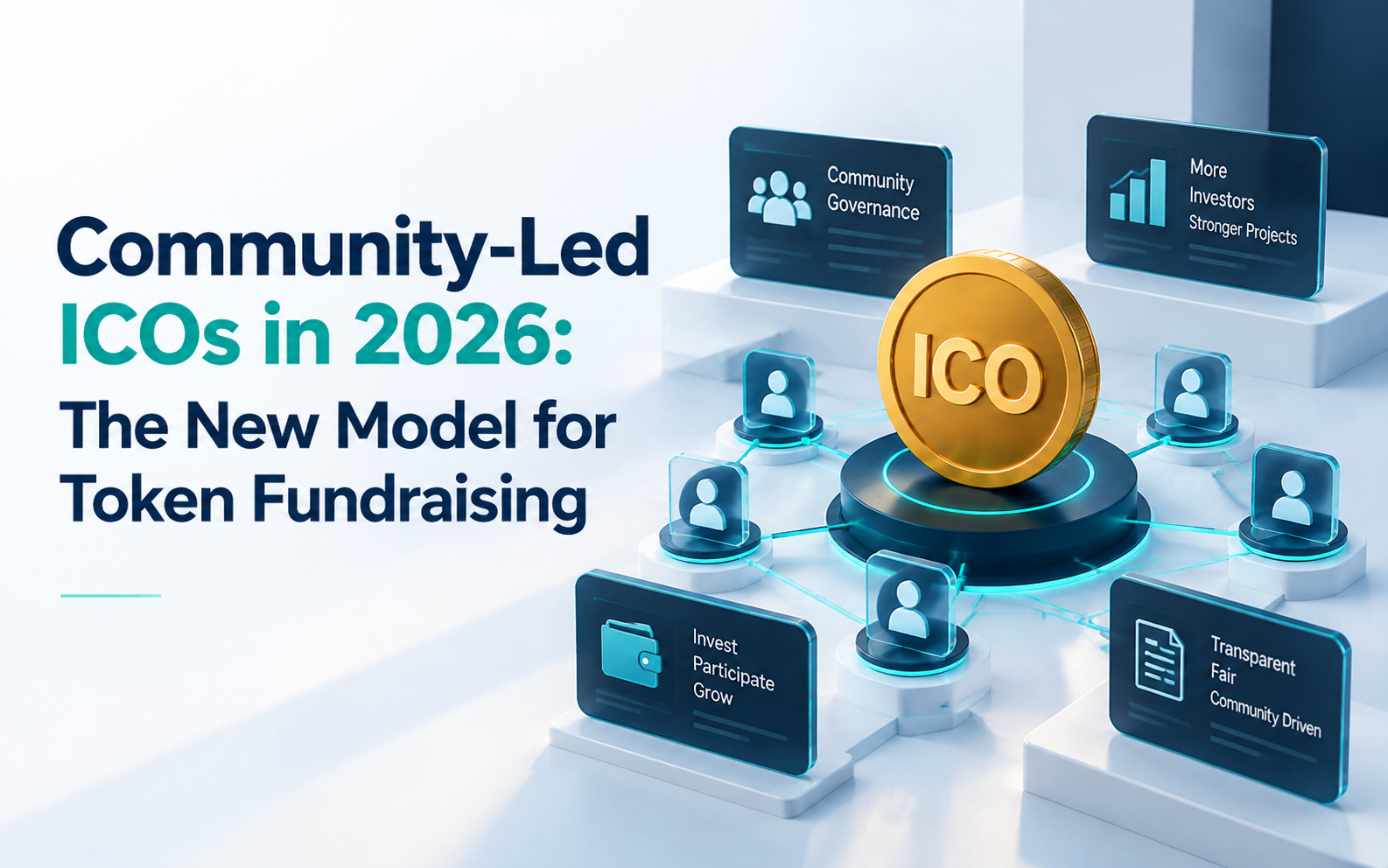
The ICO model is changing. In earlier crypto cycles, token fundraising could be driven heavily by market excitement, speculative narratives, influencer reach, and large online communities. In 2026, those factors still matter, but they are increasingly being combined with something more difficult to manufacture: genuine community participation.
A community-led ICO is not simply a token sale promoted through Telegram, Discord, X, or other social platforms. It is a fundraising model in which the community becomes part of the project's broader development and market-entry strategy. Members can contribute feedback, test products, participate in governance discussions, educate other users, create ecosystem content, and become early adopters.
This shift is particularly relevant as investors become more selective. Crypto fundraising is increasingly competing for capital based on product quality, transparency, utility, execution, and credibility rather than attention alone. For founders, this means an ICO development strategy must consider both the technology behind the token sale and the community infrastructure surrounding it.
Why Community Is Becoming More Important to ICO Fundraising
A token project can attract thousands of followers without having thousands of genuine supporters. Follower counts, engagement numbers, and social-media impressions can be inflated or disconnected from actual product demand. A community-led model attempts to close this gap by connecting fundraising with participation.
The difference becomes particularly important after the ICO. A project that raises capital from people who have little connection with its product may struggle to create sustained demand once the initial excitement fades. A project that has spent months building a community around an actual product can enter its token launch with a group of potential users, contributors, testers, and advocates.
This does not mean community participation automatically makes a token valuable. Rather, it can provide evidence that a project has an identifiable audience and that people are willing to interact with its ecosystem beyond purchasing the asset.
The broader investment environment supports this more selective approach. In its 2026 outlook, CoinShares highlighted the increasing convergence of public blockchains, regulated capital, and real-world assets. That suggests the digital-asset market is moving toward applications and infrastructure with more identifiable economic functions rather than relying exclusively on speculative narratives.
From Audience Building to Community Ownership
The most important change is the move from audience acquisition to community participation.
Traditional crypto marketing often follows a relatively simple sequence: attract followers, generate hype, promote the token, and convert attention into contributions. A community-led ICO reverses some of that thinking. The project first gives people meaningful reasons to participate and then develops fundraising around an existing relationship.
Consider a decentralized infrastructure project preparing for an ICO. Instead of waiting until the token sale to build awareness, the project could release developer tools, invite early users to test the network, organize technical discussions, collect product feedback, publish governance proposals, and reward useful ecosystem contributions.
By the time fundraising begins, the community has already experienced the product and understands why the token exists.
This creates a stronger connection between utility and fundraising. The community is not being asked only to purchase an asset. It is being invited to participate in an ecosystem that the asset helps coordinate.
What Makes a Community-Led ICO Different
A community-led ICO typically combines several layers of participation.
The first is education. Members need to understand the project's product, token utility, supply structure, allocation model, risks, roadmap, and fundraising terms. Education becomes particularly important because unclear token economics can create unrealistic expectations.
The second is product participation. Communities can test applications, provide feedback, report bugs, contribute ideas, or help identify market requirements before the public launch.
The third is governance participation. Depending on the project's structure, token holders or community members may eventually participate in proposals involving treasury use, ecosystem incentives, product priorities, or protocol parameters.
The fourth is ecosystem contribution. Developers, creators, translators, educators, moderators, and other participants can contribute value that extends beyond simply holding tokens.
These layers turn a community from a marketing audience into an ecosystem resource.
Tokenomics Must Support the Community Model
Community-led fundraising cannot work effectively if token economics contradict the project's participation strategy.
Suppose a project promotes long-term community involvement but allocates a very large percentage of tokens to a small group of early investors with short unlock periods. Community members may reasonably question whether the incentive structure supports the project's stated objectives.
A stronger model connects token allocation with the project's actual lifecycle.
Community allocations might support ecosystem rewards, developer grants, contributor programs, user incentives, governance participation, or other clearly defined purposes. At the same time, vesting schedules can reduce the likelihood of large amounts of supply entering the market immediately after launch.
The important point is not that every ICO should follow one specific allocation formula. Tokenomics should reflect the project's business model, user behavior, funding requirements, governance structure, and expected market dynamics.
An ICO development platform can support this architecture by connecting contribution records with token allocation, vesting schedules, wallet addresses, and distribution rules.
Community Does Not Replace Regulatory Responsibility
One of the biggest misconceptions about community-led ICOs is that decentralization or community participation automatically reduces regulatory obligations.
It does not.
The legal treatment of a token depends on the specific asset, transaction, offering structure, jurisdiction, and surrounding circumstances. In the United States, the SEC's April 2026 guidance states that a crypto asset that is not itself a security can still become subject to federal securities laws when offered and sold as part of an investment contract.
The regulatory environment is also evolving. In August 2026, the SEC proposed Regulation Crypto Assets, including proposed exemptions for certain crypto-asset investment-contract offerings of up to $5 million over four years and up to $75 million during a 12-month period. The proposal remains subject to the rulemaking process and should not be treated as current final law.
For projects targeting European markets, MiCA creates another important framework. ESMA's rules require qualifying offers of certain crypto-assets to meet requirements involving legal status, white papers, notification, publication, and marketing communications.
This matters for community-led ICOs because marketing activity can happen long before the fundraising event. A community manager, influencer, moderator, or founder may make statements that create expectations about token value, returns, utility, or future performance.
Community communication therefore needs governance of its own.
Building a Community Around Utility Instead of Speculation
A sustainable community strategy should give people reasons to participate that do not depend entirely on token-price expectations.
For a decentralized storage project, that might mean allowing users to test storage infrastructure and contribute capacity. For a gaming ecosystem, it could involve early gameplay, creator programs, tournaments, or digital-asset utilities. For a DeFi protocol, it could involve testnet participation, developer contributions, educational initiatives, or governance experimentation.
The common principle is simple: the community should have something meaningful to do before and after the ICO.
This is also where community feedback becomes strategically valuable. Founders can identify which product features users actually want, where onboarding fails, which incentives attract useful participants, and which parts of the token model create confusion.
The result is a feedback loop:
Community participation → product feedback → product development → stronger utility → more meaningful token demand.
This is much more durable than simply repeating promotional messages across social channels.
Technology Behind a Community-Led ICO
The ICO platform needs to support this broader model.
A modern platform may include investor registration, wallet connectivity, KYC and eligibility workflows where required, contribution processing, token allocation, vesting, referral or community-program tracking, dashboards, analytics, and administrative controls.
Smart contracts can automate important elements such as token distribution and vesting. But automation does not eliminate the need for testing and security review. Smart-contract vulnerabilities can affect both investor confidence and project finances, making security assessment an essential component of ICO development.
The community layer can also connect with the fundraising platform. For example, verified users might receive access to specific sale phases based on eligibility criteria established by the project. Community rewards could be handled separately from investor allocations, preventing the two mechanisms from becoming confused.
This creates a more structured relationship between community participation and token distribution.
A Better ICO Launch Journey
The community-led approach changes how founders should think about the ICO timeline.
Instead of treating fundraising as the beginning of the project, the ICO becomes one stage in a longer development process.
A practical sequence could begin with product validation and community research. The project can then establish its community channels, publish educational material, develop an early product or test environment, gather feedback, refine tokenomics, complete relevant legal analysis, and build the fundraising infrastructure.
The pre-launch phase should focus on understanding the audience rather than maximizing raw follower numbers.
During the ICO, transparency becomes critical. Contributors should have clear information about sale terms, token allocation, eligibility, vesting, accepted payment methods, and risks.
After the ICO, the project needs to maintain communication. Token distribution, product milestones, treasury updates, exchange plans, governance development, and ecosystem initiatives should be communicated consistently.
This prevents the common situation in which community engagement peaks during fundraising and collapses immediately afterward.
Measuring Community Quality
Community size is one of the least useful standalone metrics.
A project with 500,000 followers may have less meaningful traction than one with 20,000 active users who regularly interact with its product.
Community-led ICOs can therefore track deeper metrics such as:
- Product users generated through community channels
- Testnet participation
- Contributor activity
- Governance participation
- Educational content engagement
- Verified ICO participants
- Community-to-contributor conversion
- Retention after the token launch
- Developer and ecosystem participation
These metrics provide a better picture of whether the community is actually contributing to the project's growth.
The objective should not be to create the largest community possible. It should be to create a community that is relevant to the project's product and capable of supporting its ecosystem.
The New Role of ICO Development Companies
As ICO fundraising becomes more community-driven, ICO development companies need to move beyond basic token creation and sale-platform development.
Founders increasingly need an integrated technical environment that connects tokenomics, smart contracts, fundraising workflows, wallets, investor onboarding, vesting, analytics, security, and community participation.
This does not mean the development company should control the community strategy. Instead, the technology should give project teams the infrastructure needed to execute that strategy reliably.
For example, a project may need separate workflows for public contributors, private investors, ecosystem participants, advisors, and team allocations. Each group can have different eligibility requirements, token quantities, and vesting schedules.
A configurable ICO platform makes these structures easier to manage without rebuilding the underlying system for every fundraising phase.
Where Community-Led ICOs Are Heading in 2026
Community-led ICOs represent a broader shift in how token projects approach fundraising. The community is no longer simply an audience waiting for launch announcements. It can become an early source of product validation, ecosystem activity, governance participation, and market feedback.
But community alone cannot compensate for weak fundamentals. A large community cannot fix poor tokenomics, an unclear product, weak security, inadequate disclosures, or an unsustainable business model.
The strongest ICOs of the next phase are likely to connect these elements rather than treating them independently. Product utility creates a reason to participate. Community creates ongoing engagement. Tokenomics creates an economic framework. Technology provides the infrastructure. Compliance creates clearer boundaries around fundraising and communication.
For founders planning an ICO in 2026, the strategic question is therefore not simply how to attract more contributors. It is how to build a fundraising ecosystem in which contributors understand the project, participate in its development, and have clear expectations about what they are receiving.
Blockchain App Factory supports ICO development with a focus on the technical infrastructure behind modern token fundraising, including token development, smart contracts, fundraising platforms, tokenomics, multi-chain deployment, investor workflows, and launch support. For projects pursuing a community-led model, this infrastructure can provide the foundation needed to connect fundraising with long-term ecosystem development.