Custom vs White-Label ICO Development: Which Approach Fits Your Project?
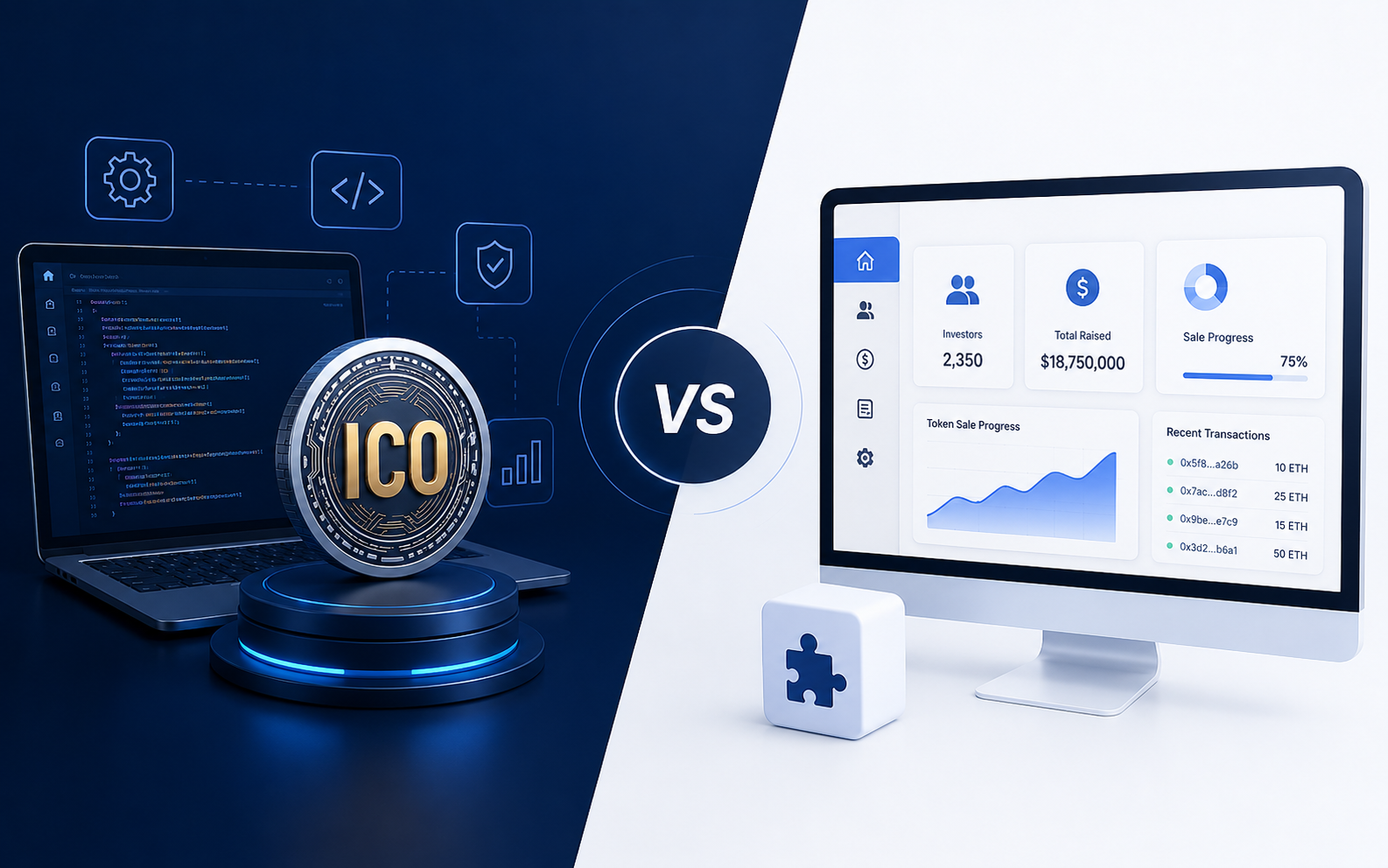
Launching an Initial Coin Offering (ICO) in 2026 involves far more than deploying a token and opening a contribution page. A modern ICO platform needs investor onboarding, token allocation, vesting, payment processing, wallet connectivity, compliance workflows, smart-contract infrastructure, security controls, analytics, and post-sale management.
One of the earliest strategic decisions is whether to build that infrastructure from scratch or start with a white-label ICO platform. The choice affects development time, budget, customization, security responsibilities, scalability, and long-term control.
Neither model is universally better. The right approach depends on the project's operating model, technical requirements, target jurisdictions, expected investor volume, and plans after the token sale.
What Is Custom ICO Development?
Custom ICO development means building the token-sale platform specifically around a project's requirements. The development team designs the architecture, user interface, smart contracts, backend systems, administrative controls, integrations, and workflows according to the project's specifications.
This approach gives the project greater control over how the platform works. A founder launching a highly specialized token sale can define its contribution logic, investor journey, token distribution model, vesting structure, payment methods, and administrative workflows instead of adapting them to an existing platform.
Custom development is particularly relevant when the ICO has requirements that do not fit conventional token-sale infrastructure. For example, a project might need multiple sale rounds with different allocation rules, institutional investor onboarding, complex vesting schedules, multi-chain support, or integrations with proprietary treasury systems.
The trade-off is development complexity. Every custom feature introduces additional design, testing, maintenance, and security requirements.
What Is White-Label ICO Development?
White-label ICO development starts with an existing token-sale platform that has already been developed and can be configured or branded for a new project.
Instead of building the entire infrastructure from the ground up, the project typically customizes elements such as branding, token-sale parameters, pricing, supported payment assets, investor pages, and administrative settings.
This model can shorten the path from planning to launch. It is particularly attractive for teams that want to validate an ICO concept quickly without maintaining a large in-house development operation.
A white-label platform can also provide a predefined architecture for common requirements such as wallet integration, investor registration, token allocation, dashboards, and sale management.
The important point is that white-label does not mean automatically production-ready. The platform still needs security testing, configuration review, compliance planning, smart-contract validation, infrastructure testing, and appropriate customization before handling real funds.
The Biggest Difference: Control vs Speed
The clearest distinction between the two approaches is the balance between control and deployment speed.
Custom development prioritizes control. The project decides how the system should operate and can modify the architecture as its requirements evolve.
White-label development prioritizes speed and reuse. The project starts with existing components instead of recreating standard infrastructure.
This distinction becomes important when evaluating the project's long-term strategy. If the ICO is a one-time fundraising event with conventional requirements, building every component from scratch can create unnecessary complexity. If the token sale is part of a larger ecosystem that will eventually include staking, governance, token-based access, treasury management, or other blockchain products, deeper control over the platform can become more valuable.
Cost and Development Time
Cost is another major consideration, but comparing the two approaches only by initial development price can be misleading.
Custom ICO development usually requires more upfront engineering because the project pays for architecture, development, testing, integrations, security reviews, and infrastructure configuration specifically for its use case.
White-label development can reduce initial engineering requirements because many components already exist. The project instead spends resources on configuration, branding, integration, testing, and deployment.
The actual cost difference depends on the platform's complexity. A simple ICO with standard contribution and allocation rules has a very different development profile from a multi-chain offering with multiple investor categories and sophisticated compliance requirements.
Time should also be evaluated beyond the first launch date. A white-label platform that appears faster initially can become expensive if the project repeatedly needs custom modifications. Conversely, a custom platform can require more time before launch but provide a stronger foundation for future products.
Customization and Feature Flexibility
Customization is where custom ICO development has its strongest advantage.
A custom platform can be designed around specific business rules, including:
- Custom token-sale stages and pricing models
- Advanced investor allocation mechanisms
- Complex vesting and lock-up schedules
- Multiple payment and blockchain integrations
- Specialized KYC and eligibility workflows
- Custom dashboards and reporting
- Proprietary treasury-management processes
- Advanced token distribution logic
White-label platforms are typically strongest when the project's requirements align with the platform's existing capabilities.
This does not make white-label solutions inflexible. Many platforms support branding, configuration, APIs, smart-contract customization, payment integrations, and additional modules. The question is how far those modifications can go before the project effectively begins creating a custom system on top of the white-label foundation.
Security Should Influence the Decision
Security is one area where neither approach should receive an automatic advantage.
Custom development provides complete control over the codebase, but that also means the project becomes responsible for securing more infrastructure. Every custom smart contract, API, authentication mechanism, database workflow, and integration introduces another component that needs testing.
White-label platforms can benefit from established code and repeated deployment experience, but the project must understand exactly what it is inheriting. An existing vulnerability can potentially affect multiple deployments if the underlying platform has not been properly secured.
Smart-contract security is especially important because ICO contracts can control substantial amounts of capital. Chainalysis reported that more than $3.4 billion worth of cryptocurrency was stolen in 2025, highlighting the broader security pressure facing blockchain infrastructure.
Regardless of development model, security should include code review, smart-contract audits, penetration testing, access-control analysis, infrastructure hardening, monitoring, key-management controls, and incident-response planning.
Compliance and Investor Management
Regulatory requirements can also determine which model makes more sense.
Modern token-sale platforms increasingly need identity verification, jurisdiction screening, investor eligibility checks, transaction monitoring, record keeping, and appropriate disclosures.
A white-label solution can be attractive if these workflows are already supported and can be configured for the project's operating markets. This can reduce the amount of infrastructure the project needs to build internally.
Custom development becomes more compelling when compliance workflows need to be tightly integrated with proprietary business processes.
For example, an institution-focused token sale might require different onboarding procedures for individual and corporate investors. A project operating across multiple jurisdictions might also need distinct eligibility rules and transaction controls.
The important point is that software cannot independently determine whether an ICO is legally compliant. Legal classification, offering structure, jurisdiction, and regulatory obligations require professional legal assessment. The platform should then be designed to implement the applicable requirements.
Scalability and Long-Term Ownership
A project's expected growth should play a major role in the decision.
A white-label ICO platform can provide sufficient infrastructure for a focused token sale. But projects planning to turn their fundraising platform into a broader digital asset ecosystem need to consider ownership and extensibility.
Custom infrastructure can provide deeper control over APIs, databases, smart contracts, investor data, integrations, and future modules. This can make it easier to evolve the platform after the ICO.
For example, a project could initially use the system for fundraising and later expand it to support token claims, vesting management, governance participation, staking, treasury reporting, or ecosystem rewards.
White-label platforms can also support expansion, but the project's future options depend on the provider's architecture, licensing model, APIs, customization policies, and access to underlying systems.
A Practical Decision Framework
The decision becomes easier when the project evaluates its requirements against several factors:
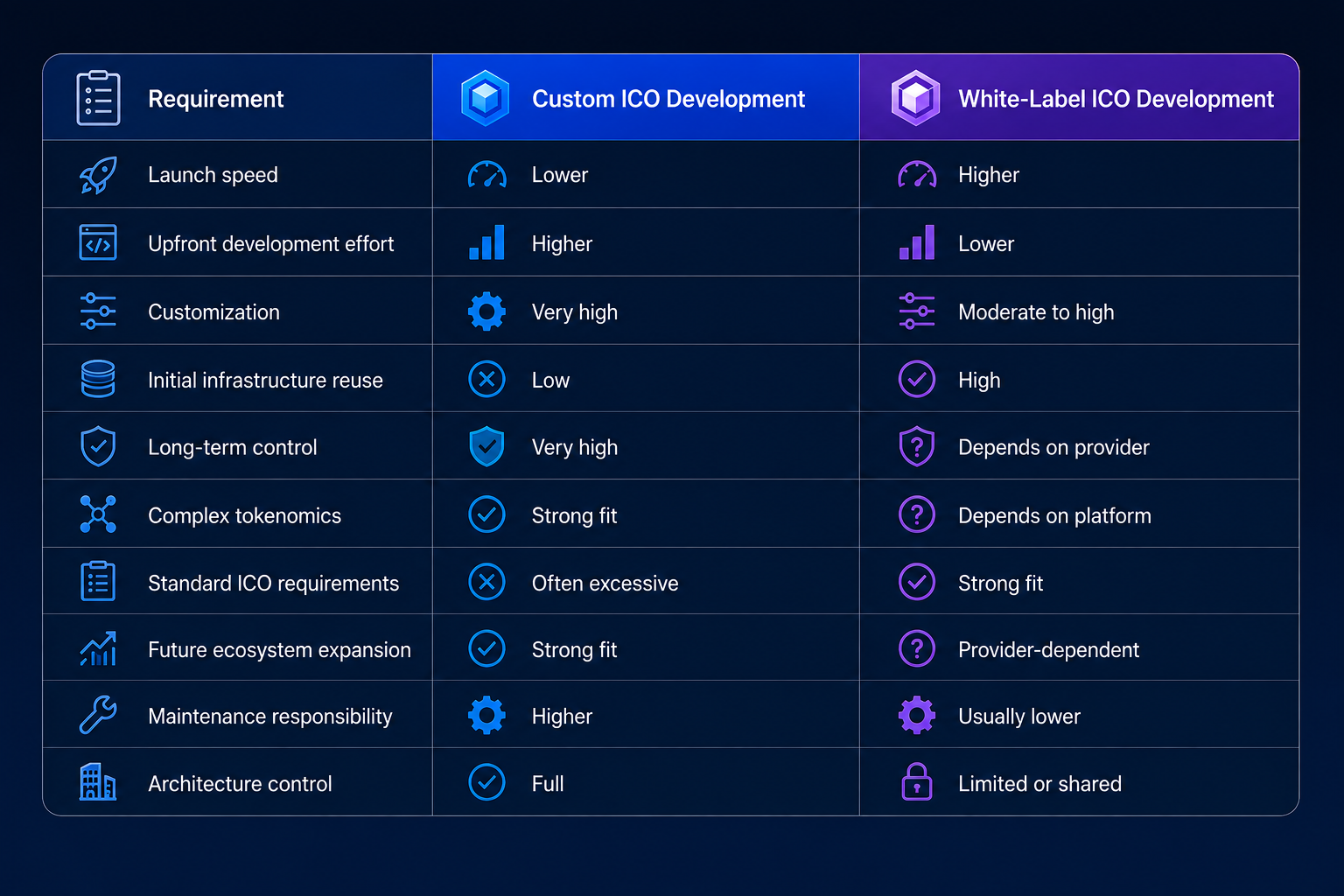
A project should choose custom development when its competitive advantage depends on unique infrastructure, complex tokenomics, specialized investor workflows, or long-term platform ownership.
It should consider white-label development when speed, predictable implementation, standard functionality, and lower initial engineering effort matter more than complete architectural control.
The Hybrid Model Can Be the Strongest Option
There is also a middle path.
A hybrid approach uses a white-label foundation for standardized components while custom-building the areas that differentiate the project. The project might reuse investor onboarding, dashboards, wallet connectivity, and basic sale management while developing custom smart contracts, tokenomics logic, compliance integrations, or treasury workflows.
This model can reduce unnecessary development while preserving flexibility where it matters most.
The success of this approach depends heavily on the white-label provider's architecture. APIs, source-code access, deployment options, customization capabilities, data ownership, upgrade policies, and third-party integrations should be evaluated before making a commitment.
Conclusion
Custom and white-label ICO development solve different problems. Custom development provides greater control, deeper customization, and stronger long-term ownership, but demands more development effort and ongoing technical responsibility. White-label development offers faster deployment and reusable infrastructure, making it suitable for projects with conventional requirements and tighter launch timelines.
The best choice is therefore not based simply on which option costs less. Founders should evaluate the complexity of their tokenomics, investor model, compliance requirements, security expectations, scalability needs, and post-ICO roadmap.
For projects that need a balance between speed and customization, Blockchain App Factory can support ICO platform development around specific business and technical requirements, from token-sale infrastructure and smart contracts to investor management and scalable platform architecture.
The right development model is the one that fits the project's actual operating requirements today while leaving enough room for the token ecosystem it plans to build tomorrow.