What Makes an ICO Technically Ready for TGE in 2026?

A Token Generation Event (TGE) is often treated as the final milestone of an ICO. In reality, it is the point where every major technical component of the token launch has to work together under real market conditions. The token contract, allocation logic, vesting schedules, wallets, claim system, backend infrastructure, investor dashboard, security controls, and exchange or liquidity integrations all need to be ready at the same time.
In 2026, technical readiness means more than having a deployed token contract. Investors expect predictable token claims, transparent allocations, secure infrastructure, and accurate vesting information. Projects also face stronger expectations around disclosures and operational controls. For offerings that fall within MiCA's scope, for example, EU rules require relevant information about the project, token, offering, underlying technology, rights, obligations, and risks to be disclosed in the crypto-asset white paper.
A successful TGE is therefore less about pressing a "launch" button and more about proving that the entire token ecosystem is technically prepared for public use.
TGE Readiness Starts With a Finalized Token Architecture
The first requirement is a token contract whose design matches the project's finalized tokenomics.
This sounds straightforward, but many launch problems originate from mismatches between the token model and the deployed contract. The total supply, decimals, minting permissions, burning rules, transfer restrictions, allocation wallets, and vesting mechanisms must all correspond to the published tokenomics.
Consider a project that announces a fixed supply of 1 billion tokens. If the deployed contract retains unrestricted minting authority, the technical architecture does not fully support the economic promise made to investors. Likewise, if team tokens, treasury allocations, and public-sale tokens are not separated correctly, later transfers can create confusion around circulating supply.
Before TGE, the project should have a definitive token specification covering:
- Total and maximum supply
- Initial circulating supply
- Allocation percentages
- Minting and burning permissions
- Transfer rules
- Treasury allocations
- Investor allocations
- Team and advisor allocations
- Vesting and unlock schedules
- Administrative privileges
The contract should then be tested against this specification rather than being treated as an independent development artifact.
Smart Contract Security Must Be Proven Before Launch
A TGE exposes smart contracts to real assets and real users. That makes security testing one of the most important readiness gates.
A professional audit is useful, but an audit report alone does not make a token launch secure. The development team needs to resolve identified issues, retest fixes, review privileged functions, and verify that the deployed contract matches the audited version.
This matters because crypto infrastructure continues to experience major security incidents. CoinGecko's 2025 annual report recorded more than $2.38 billion in crypto losses from major hacks, including a $1.5 billion theft from Bybit. The report also documented exploits involving smart contracts and administrative privileges.
For an ICO, the security review should extend beyond the token contract. The claim contract, vesting system, sale contract, treasury wallets, backend APIs, administrative dashboard, and authentication infrastructure can all become attack surfaces.
A TGE-ready project should ideally have completed:
Code review → automated testing → unit and integration testing → fuzz testing → external security audit → remediation → regression testing → deployment verification
The objective is not simply to obtain an audit certificate. It is to establish that the exact production configuration has been tested and that no unresolved critical issues remain.
Token Distribution Logic Needs to Match the ICO Allocation
The transition from ICO to TGE creates one of the most sensitive technical processes: converting investor purchases into token entitlements.
Suppose an ICO sells tokens across private, strategic, community, and public rounds. Each group can have different prices, caps, lockups, and vesting schedules.
The platform must calculate these allocations accurately.
This becomes especially important when an ICO is oversubscribed. If a public round receives commitments above its available allocation, the project needs a predefined allocation mechanism. A proportional allocation model, for example, can calculate each eligible investor's final token entitlement based on their accepted contribution.
The allocation engine should also prevent common problems such as duplicate claims, wallet mismatches, incorrect decimal calculations, or investors receiving tokens from the wrong sale round.
This is where blockchain infrastructure and backend systems need to work together. The backend may maintain investor records and allocation calculations, while smart contracts enforce the final distribution and claim rules on-chain.
Both layers must produce the same result.
Vesting Is a Core TGE Component, Not an Afterthought
Vesting frequently determines how much of the token supply actually enters circulation at TGE.
A project may sell 100 million tokens to investors but release only 10% at launch. The remaining tokens could unlock monthly over two years. If the vesting system is poorly designed, investors may receive incorrect balances or be unable to claim tokens at the scheduled time.
A robust vesting architecture needs to account for cliffs, linear releases, periodic unlocks, multiple investor groups, and potentially different schedules for team, advisors, investors, and ecosystem allocations.
For example, an investor could receive:
10% at TGE → 3-month cliff → remaining 90% released monthly over 18 months
The platform needs to calculate the claimable amount at every point in the schedule.
Investors should also be able to see this information clearly. A dashboard that shows total allocation, unlocked amount, claimed amount, locked balance, and next unlock date reduces uncertainty during the launch period.
The Token Claim System Must Be Tested Under Realistic Load
The claim page is often the most visible technical component during TGE.
Thousands of investors can attempt to claim tokens within a short period. This creates a very different environment from ordinary development testing.
The claim system needs to handle wallet connections, transaction generation, blockchain RPC requests, gas estimation, failed transactions, retries, and network congestion.
Load testing should therefore simulate realistic launch conditions.
Developers should test questions such as:
- Can the system handle a sudden increase in concurrent users?
- What happens if the blockchain becomes congested?
- Can users safely retry failed transactions?
- Does the platform prevent double claims?
- Are claim amounts calculated correctly?
- Can users switch between supported wallets?
- What happens when RPC providers become unavailable?
A technically sound claim system should fail safely. A temporary frontend or RPC failure should not compromise investor balances or create duplicate claims.
Wallet and Treasury Architecture Needs Operational Controls
TGE readiness also requires careful wallet management.
Projects often operate several wallet categories, including treasury wallets, liquidity wallets, ecosystem wallets, team wallets, investor distribution wallets, and operational wallets.
These wallets should not all have the same permissions or security model.
Treasury assets can be protected through multisignature wallets and role-based approval processes. Operational wallets can hold only the funds required for specific functions. Private keys should never be embedded in application code or exposed through insecure server configurations.
Administrative privileges also deserve attention.
If one compromised administrator account can mint tokens, change vesting parameters, upgrade contracts, or transfer treasury assets, the system contains a major concentration of risk.
Role-based permissions and multisignature controls can reduce this exposure.
Backend and API Infrastructure Must Be Production-Ready
Smart contracts receive most of the attention during token launches, but the backend can become an equally important failure point.
The backend may manage investor profiles, KYC status, allocation records, referral information, transaction history, notifications, dashboards, and analytics.
If the API becomes unavailable during TGE, investors can lose access to essential information even when the blockchain itself is functioning normally.
Production infrastructure should therefore include monitoring, logging, backups, rate limiting, database protection, failover mechanisms, and secure API authentication.
Critical actions should also generate audit logs.
For example, if an administrator changes an investor's allocation, the platform should record who made the change, when it happened, what changed, and why.
This creates an operational record that can be reviewed when disputes arise.
Compliance and Technical Readiness Are Increasingly Connected
Technical readiness cannot be separated completely from regulatory readiness.
For projects targeting the European market, MiCA provides a clear example. Article 4 sets requirements for certain public offers of crypto-assets other than asset-referenced tokens and e-money tokens, including having a legal entity, preparing and publishing a crypto-asset white paper, handling relevant marketing communications, and meeting offeror requirements, subject to specified exemptions.
The white paper itself needs to provide information about the project, offer, crypto-asset, underlying technology, rights and obligations, and risks. ESMA also notes that relevant white papers must be available in a machine-readable format, with the MiCA technical formatting requirements including iXBRL.
This creates a technical implication for ICO platforms.
The information displayed on the sale platform should not contradict the project's formal documentation. Token supply, sale price, allocation, vesting, eligibility conditions, and other material details need consistent treatment across the investor interface and underlying systems.
Legal compliance remains jurisdiction- and offering-specific, but the platform should be designed so that applicable restrictions can actually be enforced.
Exchange and Liquidity Infrastructure Should Be Ready Before TGE
Another common mistake is treating exchange listing as a post-launch problem.
If a project plans to make the token tradable immediately after TGE, exchange and liquidity infrastructure needs to be prepared before the event.
The team must coordinate token deposits, wallet addresses, trading pairs, circulating supply information, liquidity allocation, vesting restrictions, and the timing of token transfers.
For a DEX launch, liquidity pools and initial liquidity need to be configured carefully. For a CEX listing, technical integration and operational coordination need to happen ahead of the listing window.
The circulating supply presented to investors should also match the actual amount entering the market.
A mismatch between announced circulating supply and on-chain balances can create immediate confusion and damage market confidence.
A TGE Readiness Checklist Should End With a Full Simulation
One of the strongest indicators of readiness is not another isolated test. It is a complete launch rehearsal.
The team should simulate the TGE from beginning to end.
An investor should be able to move through the entire process:
Connect wallet → verify eligibility → view allocation → access claim → submit transaction → receive tokens → view balance → check vesting schedule
At the same time, the operations team should be able to monitor transactions, identify failed claims, respond to support requests, review system alerts, and verify on-chain balances.
The project should also simulate abnormal scenarios.
What happens if the blockchain becomes congested? What if an RPC provider fails? What if an investor sends a transaction from an unsupported wallet? What if the claim contract receives unexpected traffic? What if the dashboard database becomes unavailable?
The purpose of a TGE rehearsal is to expose dependencies before real investors encounter them.
What Actually Defines TGE Technical Readiness in 2026?
A project can be considered technically close to TGE readiness when its major components have moved from development status to verified production status.
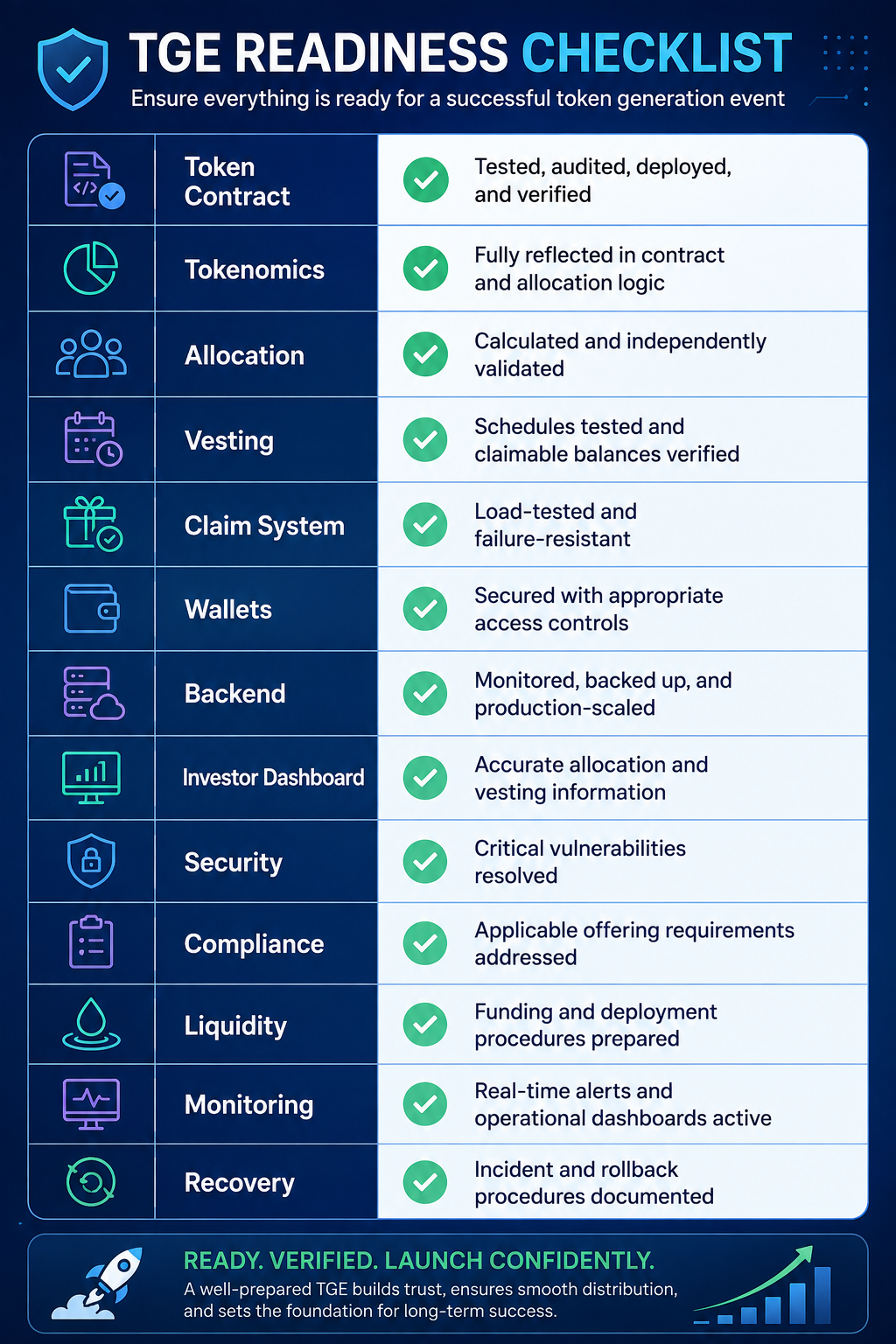
The critical point is that these components are interconnected. A secure token contract cannot compensate for a broken allocation system. A scalable backend cannot compensate for incorrect vesting. An audited smart contract cannot compensate for compromised administrative keys.
TGE readiness is therefore a system-level property, not a single technical milestone.
Conclusion
In 2026, an ICO is technically ready for TGE when its token contract, allocation engine, vesting logic, claim infrastructure, wallets, backend systems, security controls, liquidity setup, and investor experience have been tested as one integrated system. The goal is to make the transition from fundraising to token ownership predictable, secure, and transparent.
For projects preparing for this transition, Blockchain App Factory provides ICO development solutions covering token creation, smart contracts, investor management, vesting, token distribution, and scalable launch infrastructure. A well-engineered TGE foundation helps projects enter the market with greater technical reliability and long-term readiness.