The New ICO Model: How Token Fundraising Is Changing in 2026
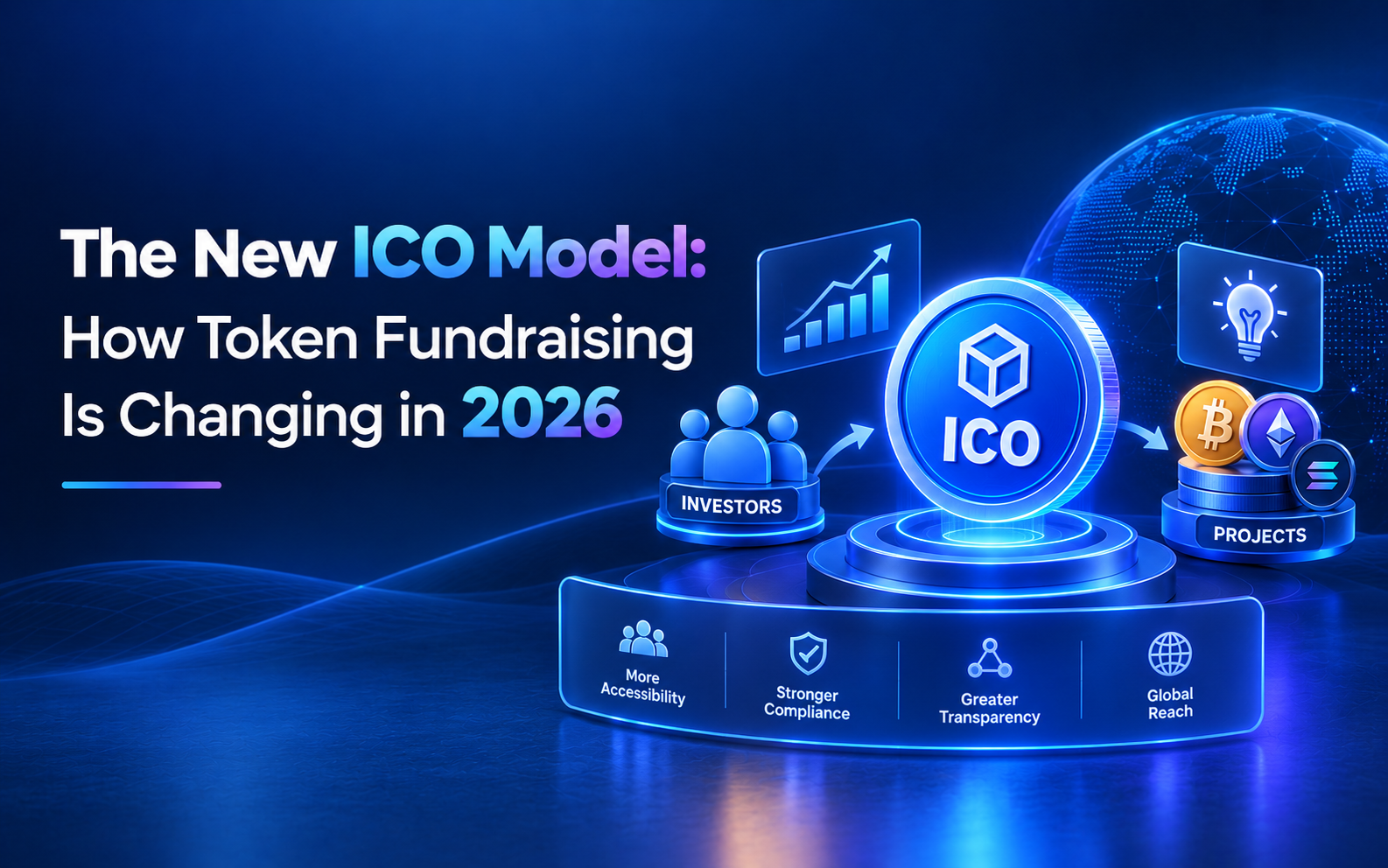
Token fundraising has changed dramatically since the ICO boom of 2017–2018. The original ICO model gave blockchain projects a relatively direct route to global capital. Teams could publish a whitepaper, create a token, build a community, and sell tokens to fund development. That model proved powerful, but its weaknesses became equally visible as speculative launches, weak token economics, limited disclosures, and regulatory uncertainty damaged investor confidence.
In 2026, token fundraising is moving toward a more structured model. ICOs are increasingly being designed around clear utility, identifiable business models, regulatory requirements, investor protections, sustainable token economics, and real-world applications. At the same time, tokenized real-world assets, institutional blockchain adoption, compliant issuance platforms, and evolving securities frameworks are expanding the role of blockchain in capital formation.
The result is not simply a return of the ICO. It is the emergence of a new ICO model where token issuance is treated as part of a broader financial and technology strategy rather than an isolated fundraising event.
Why the Original ICO Model Lost Its Momentum
The first ICO cycle demonstrated how quickly blockchain could democratize fundraising. Projects could reach investors globally without relying entirely on traditional venture capital or public-market infrastructure. Yet the low barriers to entry also created problems.
The ICO market peaked at roughly $7.5 billion in tracked fundraising in 2018 before falling to around $370 million in 2019, according to a 2026 industry analysis of token fundraising. By 2020, only 14 ICOs were recorded in that dataset, raising $55.6 million collectively.
The problem was not blockchain fundraising itself. The issue was the mismatch between easy token issuance and the complexity of building a sustainable business.
Many early offerings placed excessive emphasis on token price appreciation and community growth while providing limited evidence of product-market fit. Investors also had difficulty evaluating token utility, treasury management, supply schedules, development progress, and long-term demand.
As the market matured, ICOs were gradually supplemented by Initial Exchange Offerings and Initial DEX Offerings. These models introduced different forms of distribution and market access, but they did not eliminate the underlying need for stronger project fundamentals.
By 2026, the market has moved beyond asking whether a project can sell tokens. The more important question is whether the token represents a credible economic proposition.
The 2026 ICO Is Becoming a Full Capital-Raising Framework
The biggest change is that token fundraising is no longer primarily about token creation.
A modern ICO can involve market research, business-model validation, tokenomics, legal structuring, investor segmentation, KYC/AML processes, smart-contract development, fundraising infrastructure, treasury management, community strategy, exchange planning, liquidity management, and post-launch governance.
This creates a much closer relationship between traditional fundraising practices and blockchain infrastructure.
Founders are increasingly expected to explain why a token is necessary, what users can do with it, how demand will develop, how supply will be managed, and what happens after the fundraising event. A technically functional token without a sustainable economic purpose is unlikely to create lasting value.
This shift also changes how ICO development companies approach projects. Instead of treating token deployment as the final technical step, development increasingly starts with the business model and works toward a blockchain architecture that supports it.
Token Utility Is Moving Beyond Simple Access
Token utility was always an important component of ICOs, but the definition of utility is becoming more sophisticated.
Early projects frequently described tokens as access mechanisms for future platforms. In 2026, investors are more likely to examine whether that utility will generate meaningful and recurring demand.
A token may provide access to a decentralized application, enable payments within an ecosystem, support governance, facilitate staking, represent an asset, or coordinate participation in a protocol. Yet utility alone does not guarantee economic value.
The stronger approach is to connect utility directly with actual user behavior.
For example, if a token is required to access premium infrastructure, the project needs a realistic user base. If the token powers payments, transaction volume matters. If staking is part of the model, rewards need to come from a sustainable economic mechanism rather than continuous token inflation.
This makes tokenomics less of a marketing document and more of a financial model.
RWA Tokenization Is Expanding the ICO Opportunity
One of the most important developments influencing token fundraising in 2026 is the growth of real-world asset tokenization.
Tokenized real-world assets can represent exposure to Treasuries, commodities, equities, funds, credit, real estate, and other traditional assets. CoinGecko reported that tokenized RWAs grew from $5.42 billion at the beginning of 2025 to $19.32 billion by March 31, 2026, representing a 256.7% increase. Tokenized commodities also grew from $1.43 billion to $5.55 billion during that period.
This creates an important new pathway for token fundraising.
Instead of issuing a token around an entirely digital concept, a project can build a blockchain-based financial product around an identifiable underlying asset. The token can potentially represent economic rights, ownership interests, access, or other contractual claims depending on the legal structure.
This does not mean every RWA token should be called an ICO. Rather, it demonstrates how token issuance is becoming connected to broader capital markets.
For ICO developers, this means understanding the asset, legal structure, investor rights, custody, valuation, compliance, and distribution model can be just as important as selecting a blockchain.
Regulatory Structure Is Becoming Part of ICO Architecture
Regulation is another major factor changing token fundraising in 2026.
In the United States, the SEC issued an interpretation in March 2026 clarifying how federal securities laws apply to various crypto assets and transactions. The guidance distinguishes categories including digital commodities, digital collectibles, digital tools, stablecoins, and digital securities.
The SEC subsequently issued guidance explaining that a tokenized security is a financial instrument that meets the definition of a security while being represented as a crypto asset, with ownership records maintained in whole or in part on crypto networks. It also notes that tokenized securities can have structures and holder rights that differ from the underlying securities.
These developments matter because regulatory classification can affect how an ICO is structured, who can participate, what disclosures are needed, how tokens can be transferred, and where they can be marketed.
In August 2026, the SEC proposed Regulation Crypto Assets, which includes two proposed exemptions for certain covered investment-contract offerings. One would permit offerings of up to $5 million over four years, while another would permit offerings of up to $75 million during a 12-month period, subject to conditions and disclosure requirements. The proposal is not final, and its public-comment period is scheduled to close on October 20, 2026.
For founders, the important takeaway is that legal and regulatory planning needs to happen before token architecture is finalized.
Tokenomics Is Becoming More Financially Disciplined
The tokenomics model of 2026 is also different from the early ICO era.
Projects now need to think carefully about circulating supply, unlock schedules, treasury allocations, investor allocations, team vesting, market-making requirements, liquidity reserves, incentives, and long-term emissions.
A large maximum supply is not inherently a problem. A low token price is not automatically attractive. High staking rewards do not necessarily indicate a strong ecosystem.
The critical question is whether token supply and demand can develop in a way that supports the project's underlying economics.
For example, a project that allocates a large percentage of tokens to early investors may face significant selling pressure when those tokens unlock. A project that offers extremely high staking rewards may create inflation that eventually undermines token value. Conversely, excessively restrictive supply mechanisms can make the token difficult to use.
The new ICO model therefore treats tokenomics as a dynamic system rather than a collection of percentages in a whitepaper.
Fundraising Is Becoming More Selective
Investor behavior is also pushing projects toward more disciplined fundraising.
The market increasingly distinguishes between a project that can attract short-term attention and one that can build durable demand. This means founders need stronger evidence around product development, revenue opportunities, partnerships, community quality, technical architecture, and market positioning.
The fundraising process itself may also become staged.
A project could begin with strategic or private capital, move into a community-focused round, conduct a regulated public offering where appropriate, and then transition toward broader market distribution. This creates opportunities to align fundraising milestones with actual product development rather than attempting to raise the entire target before demonstrating progress.
Such structures can also help investors understand how capital will be used and what milestones should follow each fundraising stage.
Investor Due Diligence Is Becoming More Sophisticated
The investor side of ICOs has matured as well.
A serious token investor in 2026 is likely to examine more than the whitepaper and social-media following. The project may be assessed across its technology, team, tokenomics, legal structure, treasury, roadmap, market opportunity, smart-contract security, and distribution strategy.
For RWA projects, due diligence can go further by examining the underlying asset, ownership structure, valuation methodology, custodian, redemption rights, and reporting practices.
This means transparency is becoming a competitive advantage.
Projects that provide clear documentation, explain token-holder rights, publish meaningful development updates, and communicate treasury policies can establish stronger credibility than projects relying primarily on promotional messaging.
Smart Contracts Are Becoming More Important Than the Token Sale Page
The technical architecture behind modern ICOs is also becoming more sophisticated.
A token sale platform may need to support investor registration, wallet verification, purchase limits, allocation calculations, vesting, refunds, whitelisting, geographic restrictions, and automated token distribution.
Smart contracts can manage many of these processes, but security becomes critical because a vulnerability can directly affect investor funds or token ownership.
For RWA and regulated token offerings, developers may also need permissioned transfers, identity-linked wallets, transfer restrictions, compliance checks, and administrative controls.
This creates a more complex development stack that can include:
- Token and smart-contract infrastructure
- Token sale and investor dashboards
- KYC/AML integrations
- Wallet and custody systems
- Vesting and allocation mechanisms
- Compliance and transfer controls
- Treasury management
- Blockchain analytics
- Oracle and off-chain data integrations
The technology is no longer simply a mechanism for issuing tokens. It becomes part of the project's financial infrastructure.
Liquidity Strategy Is Moving to the Center of the Launch
Another major change is the treatment of liquidity.
During the earlier ICO cycle, many projects considered exchange listings a post-launch objective. In 2026, liquidity planning increasingly starts before the token sale.
Founders need to think about where tokens will trade, who can access those markets, how much liquidity is required, how vesting affects circulating supply, and how market-making activities interact with the project's token economics.
The expansion of tokenized traditional assets demonstrates how quickly blockchain-based financial instruments can develop secondary-market activity. CoinGecko reported $15.1 billion in spot trading volume for tokenized stocks during Q1 2026, while tokenized gold generated $90.7 billion in spot trading volume during the same quarter.
These figures highlight a broader trend: token issuance and market infrastructure are increasingly interconnected.
A token launch without a credible path toward liquidity can struggle even when fundraising initially succeeds.
Institutional Capital Is Changing the Standard
Institutional participation is another force pushing ICOs toward greater maturity.
Financial institutions are increasingly exploring tokenization because blockchain can provide programmable settlement, transparent ownership records, continuous trading environments, and new distribution mechanisms.
This creates higher expectations for projects seeking serious capital.
Institutions typically require stronger documentation, governance, security controls, compliance processes, custody arrangements, reporting, and operational infrastructure than retail-focused token launches traditionally provided.
As institutional and crypto-native markets converge, ICO development is likely to adopt more practices from traditional financial markets while retaining blockchain's programmability.
What the New ICO Development Process Looks Like
The modern ICO development lifecycle can therefore be viewed as a connected process rather than a single token-launch event.
It typically begins with business and market validation. The project then defines its token's role, target investors, legal structure, and fundraising strategy. Tokenomics is developed around actual economic activity, followed by smart-contract architecture, investor onboarding, compliance infrastructure, security audits, and fundraising deployment.
After the token sale, the work continues through liquidity management, exchange integration, treasury operations, community development, governance, reporting, and product expansion.
This lifecycle is particularly important because fundraising success does not automatically translate into project success. A token may raise millions and still fail if the underlying business cannot attract users or generate sustainable demand.
What Founders Need to Prioritize in 2026
The most successful token fundraising strategies are likely to focus on five interconnected areas: utility, compliance, tokenomics, technology, and market readiness.
The token needs a genuine role within the ecosystem. The legal structure needs to reflect the project's actual activities. Tokenomics should align supply with realistic demand. Smart contracts and supporting infrastructure must be secure. The project also needs a credible plan for investor communication and post-launch liquidity.
RWA tokenization adds another layer by requiring founders to connect digital tokens with real-world ownership, financial rights, custody, valuation, and reporting.
The strongest ICO projects are therefore becoming less dependent on hype and more dependent on execution.
Conclusion
The ICO is not disappearing in 2026. It is evolving.
The new model combines blockchain-based fundraising with stronger token economics, clearer investor rights, regulatory planning, sophisticated technology, real-world applications, and structured liquidity strategies. The rapid growth of tokenized assets shows that blockchain is increasingly moving beyond purely digital assets and into established financial markets.
For founders, this creates a more demanding but potentially more sustainable fundraising environment. A successful ICO now requires much more than creating a token and promoting a public sale. It requires a defensible business model, credible token utility, transparent economics, secure infrastructure, appropriate compliance, and a long-term strategy for market participation.
Blockchain App Factory helps businesses approach ICO development as a complete blockchain fundraising lifecycle, covering token creation, smart contracts, tokenomics, fundraising infrastructure, and launch strategy. In 2026, the projects that stand out will be those that treat the token not as the product itself, but as infrastructure connecting users, capital, technology, and real economic value.