As per IMARC Group Report - India Cold Chain Market to Reach INR 6,190.91 Billion (CAGR 10.43%) by 2034
India Cold Chain Market: Industry Report 2026–2034
The India cold chain industry is entering a high-growth phase, driven by surging demand from organised food retail, pharmaceutical logistics, and quick-commerce grocery delivery. The market expanded from INR 2,535.87 Billion in 2025 to INR 2,799.40 Billion in 2026, supported by government infrastructure schemes, rising private capital investment, and expanding temperature-controlled logistics requirements. Cold chain storage dominates the segment mix, the private sector leads revenue contribution, and Uttar Pradesh remains the largest state-level market on the back of its extensive horticulture and agricultural output.
What Is the Size and Growth Forecast of the India Cold Chain Market?
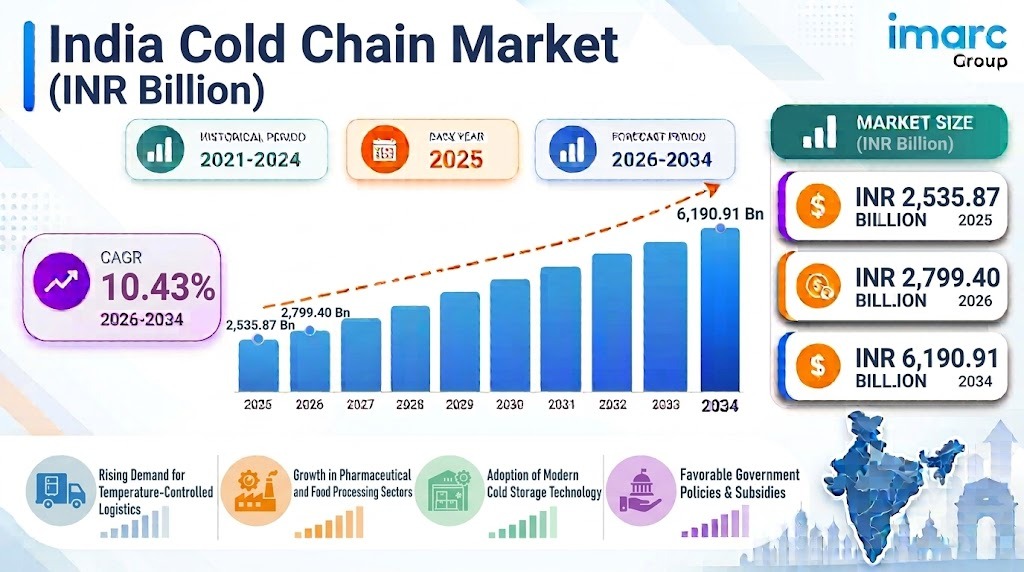
The market is demonstrating robust, sustained expansion, fundamentally anchored by food processing growth, pharmaceutical cold chain mandates, and government-backed infrastructure development programmes.
- Market Size in 2025: INR 2,535.87 Billion
- Market Size in 2026: INR 2,799.40 Billion
- Market Forecast in 2034: INR 6,190.91 Billion
- Compound Annual Growth Rate (CAGR): 10.43% during the 2026–2034 forecast period
- Underpinning Momentum: PM Kisan SAMPADA Yojana support, e-grocery expansion, and pharmaceutical export growth support long-term demand
What Are the Latest Emerging Trends in the India Cold Chain Market?
IoT-Enabled Real-Time Temperature Monitoring:
Advanced sensor networks and IoT platforms are transforming cold chain visibility across India's food and pharmaceutical logistics networks. In September 2025, Tag-N-Trac's AI and IoT tracking reduced pharmaceutical shipment excursions from 1.93% to 0.3%. Real-time monitoring reduces temperature deviations by up to 68%, directly improving product quality compliance and reducing wastage across the cold chain network. Adoption is spreading from premium pharmaceutical applications to mainstream food logistics, driven by regulatory compliance requirements and the measurable cost benefits of reduced spoilage. This technology shift is enabling operators to offer service-level guarantees that were previously unviable in the Indian market context.
Multi-Temperature Warehousing Adoption:
Operators are shifting from single-commodity to versatile multi-temperature facilities capable of handling frozen (-18°C), chilled (0-4°C), and ambient conditions simultaneously. Swisslog's AutoStore Multi-Temperature Solution features 9,500 bins for chilled storage and 5,500 bins for ambient storage, with an initial phase of 6,500 bins. This transition reflects changing client requirements, as organised food retailers and quick-commerce platforms need consolidated facilities serving diverse product categories under one roof. Multi-temperature capability also improves asset utilisation and enables operators to serve both food and pharmaceutical clients, diversifying revenue streams and reducing dependence on single-commodity seasonal cycles.
Solar-Powered Cold Storage Expansion:
India issued comprehensive solar cold storage guidelines in 2025, accelerating energy-efficient infrastructure investment across agricultural regions. Solar-integrated cold storage reduces operational energy costs by 30-40% and enables deployment in areas with unreliable grid connectivity, unlocking cold chain access for over 65% of India's agricultural hinterland. With solar energy costs declining 89% between 2010 and 2023, the economics of solar-powered facilities have become increasingly attractive for operators targeting off-grid agricultural clusters. This trend is particularly relevant for reducing post-harvest losses in states with high horticulture output but limited cold storage penetration.
➤ Request Sample Report with Datasheet: https://www.imarcgroup.com/indian-cold-chain-market/requestsample
What Growth Factors Are Driving the India Cold Chain Market?
Rising E-Commerce Food Delivery and Quick Commerce:
India's e-commerce grocery sector is expanding rapidly, with platforms like Blinkit, Zepto, and Swiggy Instamart creating high-frequency demand for temperature-controlled last-mile logistics. This demand vector is directly driving cold chain transportation investment, as quick-commerce operators require dark store infrastructure, reefer fleet deployment, and temperature-controlled micro-fulfilment centres within dense urban catchments. The e-grocery segment is growing at 28.4% annually, making it one of the fastest-expanding demand sources for cold chain services. Unlike traditional cold chain demand, which was concentrated in bulk agricultural storage, quick-commerce requires distributed, small-format, high-frequency infrastructure, creating new investment categories across urban logistics.
Pharmaceutical Sector Expansion and Vaccine Distribution:
India's pharmaceutical exports reached US$ 27.9 Billion in FY2024, with vaccine distribution under the Universal Immunization Programme covering 26 million newborns annually, creating non-negotiable demand for GDP-compliant cold chain infrastructure. The pharmaceutical cold chain sub-segment is growing at an estimated 13.5% CAGR from 2026 to 2034, driven by biologics, biosimilars, and expanding vaccine programmes. GDP-compliant facilities command 35-50% premium pricing over standard food-grade cold storage, offering superior unit economics for specialised operators. As India strengthens its position as a global pharmaceutical manufacturing hub, the need for validated, temperature-controlled logistics infrastructure continues to expand structurally.
Government Policy Support and Infrastructure Investment:
The PM Kisan SAMPADA Yojana allocated ₹630 Crore for food processing and cold chain infrastructure for the financial year 2024-25, providing substantial financial incentives for cold chain capacity creation. Government subsidy capture opportunities include grants of up to INR 10 Crore per ICCVAI-eligible project, offering attractive co-investment structures for private sector operators building multi-temperature integrated cold chain complexes. Beyond direct subsidy support, government programmes under MOFPI, NHB, and NABARD-linked schemes are channelling investment into under-penetrated states, reducing regional disparities in cold chain access and expanding the addressable market for logistics operators willing to invest in tier-2 and tier-3 geographies.
Government Initiatives Supporting India Cold Chain Market Growth
- PM Kisan SAMPADA Yojana: Provides grants up to INR 10 Crore per ICCVAI-eligible project for integrated cold chain infrastructure creation.
- ICCVAI Scheme: Offers financial assistance for automated storage, multi-temperature facilities, and integrated cold chain complexes.
- Solar Cold Storage Guidelines (2025): Comprehensive framework accelerating solar-powered cold storage deployment in off-grid agricultural regions.
- National Horticulture Board (NHB) Programmes: Support cold storage capacity expansion in horticulture-intensive states.
- NABARD-Linked Schemes: Provide institutional finance for cold chain infrastructure in under-penetrated geographies.
What Are the Key Challenges Facing the India Cold Chain Market?
- High Energy and Operational Costs: Electricity costs represent a significant portion of total operational expenses for cold chain operators, impacting profitability, particularly for smaller facilities.
- Infrastructure Gaps in Tier-2 and Tier-3 Markets: Over 60% of India's cold chain capacity is concentrated in 10 major states, leaving significant under-penetrated geographies with minimal temperature-controlled infrastructure.
- Skilled Workforce Shortage: Cold chain operations require specialised expertise in refrigeration engineering, GDP compliance, and temperature monitoring, skills in short supply across India.
- Regulatory Complexity: Compliance with FSSAI food safety standards, WHO-GDP guidelines, and state-level licensing requirements creates operational complexity for multi-state operators.
Deep-Dive Segment Insights
The market is meticulously segmented by segment, product, sector, organised and unorganised, and states.
By Segment
- Cold Chain Storage: Leads with a 68.0% revenue share in 2025, encompassing multi-purpose warehousing, controlled atmosphere facilities, and pharmaceutical-grade storage units.
- Cold Chain Transportation: Fastest-growing segment at 11.2% CAGR (2026-2034), driven by e-commerce grocery delivery growth and expanding last-mile reefer fleet deployment.
By Product
- Fruits and Vegetables: Leads with a 37.0% share in 2025, reflecting India's large horticulture output and the need for post-harvest preservation.
- Meat and Fish: Significant segment supported by export-oriented seafood processing and domestic protein consumption.
- Dairy Products: Anchored by cooperative cold chain networks including Amul's extensive infrastructure.
- Healthcare Products: Fastest-growing product category, projected to become the highest-value segment by 2032.
By Sector
- Private: Commands 72.0% of market revenue in 2025, reflecting sustained capital investment by organised logistics operators.
- Cooperative: Holds 16.8% share, primarily serving dairy and agricultural cooperative networks including Amul.
- Public: Contributes 11.2% of revenues, with government-owned facilities concentrated in agricultural states.
By Organised and Unorganised
- Unorganised: Holds 80.0% share in 2025, reflecting the fragmented structure of India's cold storage capacity.
- Organised: Commands premium pricing of 25-35% above unorganised equivalents due to technology integration and service quality differentiation.
By States
- Uttar Pradesh: Largest state market with 14.2% share in 2025, anchored by potato and horticulture production.
- Maharashtra: Holds 10.3%, reflecting organised retail, pharmaceutical manufacturing, and export-oriented food processing.
- West Bengal: Represents 9.8%, driven by fish and seafood exports and Kolkata's cold chain hub status.
- Punjab: Accounts for 8.4%, supported by grain, dairy, and horticulture cold chain demand.
- Gujarat: Holds 7.6%, anchored by Amul's dairy cold chain backbone and port cold storage.
- Tamil Nadu: Represents 7.4%, driven by seafood and pharmaceutical exports.
- Andhra Pradesh: Accounts for 6.8%, supported by aquaculture and mango belt cold chain requirements.
- Bihar: Holds 6.3%, with government cold storage expansion and NABARD-funded facility development.
- Karnataka: Represents 6.2%, driven by flower and vegetable exports and tech-driven processed food demand.
- Madhya Pradesh: Accounts for 5.9%, supported by Indore pharma hub and PM Kisan SAMPADA scheme participation.
- Haryana: Holds 5.7%, benefiting from NCR proximity and dairy distribution networks.
- Rajasthan: Represents 5.1%, with RCDF dairy cold chain and solar cold storage adoption leadership.
- Orissa: Accounts for 4.2%, driven by Chilika lake aquaculture and Paradip port export cold chain.
- Chhattisgarh: Holds 3.4%, with poultry cold chain and rice storage requirements.
- Others: Represents 8.7%, including Jharkhand, Northeastern states, Jammu & Kashmir, and Union Territories.
Competitive Landscape & Key Player Positioning:
The India cold chain market exhibits a fragmented competitive structure, with the top five organised players collectively accounting for approximately 18-22% of total market revenues in 2025. Key players include Snowman Logistics Ltd., Mahindra Logistics Ltd., Delhivery Ltd., Container Corporation of India, AFL (Agri Fresh Logistics), Radhakrishna Foodsland, and Riviera Cold Storage, among others. Organised players are differentiating through technology investment, multi-temperature capability, and integrated end-to-end service offerings.
Covering an in-depth analysis of the competitive landscape, market structure, key player positioning, competitive dashboards, top winning strategies, and detailed profiles of all major industry participants you will gain access to all these exclusive insights within the full research report.
Recent Developments
- October 2025: Snowman Logistics announced the commencement of construction of a new temperature-controlled warehouse facility in Pune, expanding its multi-temperature storage capacity in western India.
- February 2026: Delhivery Limited partnered with electric mobility startup RIDEV (ANV Web Ventures Pvt Ltd) to deploy 150 high-performance electric vehicles, supporting sustainable last-mile and cold chain logistics operations.
- September 2025: Tag-N-Trac's AI and IoT tracking reduced pharmaceutical shipment excursions from 1.93% to 0.3%, demonstrating measurable quality improvement through real-time monitoring technology.
- Ongoing 2025–2026: Mahindra Logistics partnered with Flipkart for grocery cold chain fulfilment and expanded its EV reefer fleet, strengthening its integrated 3PL cold chain capabilities.
Customization Note: If you require any specific information not covered within this report's scope, we will provide it as part of the customization.
➤ Request Report Customization: https://www.imarcgroup.com/request?type=report&id=1040&flag=E
Frequently Asked Questions (FAQs)
Q1. What is the current size of the India cold chain market?
The India cold chain market size increased from INR 2,535.87 Billion in 2025 to INR 2,799.40 Billion in 2026.
Q2. What is the projected market size by 2034 and the growth rate?
The market is projected to reach INR 6,190.91 Billion by 2034, exhibiting a compound annual growth rate (CAGR of 10.43%) during the 2026–2034 forecast period.
Q3. Which segment dominates the India cold chain market?
Cold chain storage dominates with a 68.0% revenue share in 2025, supported by extensive warehousing infrastructure development.
Q4. Which state accounts for the highest market share?
Uttar Pradesh leads with a 14.2% share in 2025, driven by high agricultural output and growing organised cold storage infrastructure.
Q5. What are the key factors driving market growth?
Rising e-commerce grocery delivery, pharmaceutical sector expansion, government PM Kisan SAMPADA Yojana investment, and increasing organised retail penetration are the primary growth drivers.
Stay Connected with India Market Research
Follow us on LinkedIn for the latest market research insights, industry trends, emerging business opportunities, and updates on India’s evolving markets.
Follow Us on LinkedIn: https://www.linkedin.com/company/india-market-research