India Interior Design Market Size, Growth Trends, Segment Analysis and Industry Forecast 2026–2034
India Interior Design Market: Industry Report 2026–2034
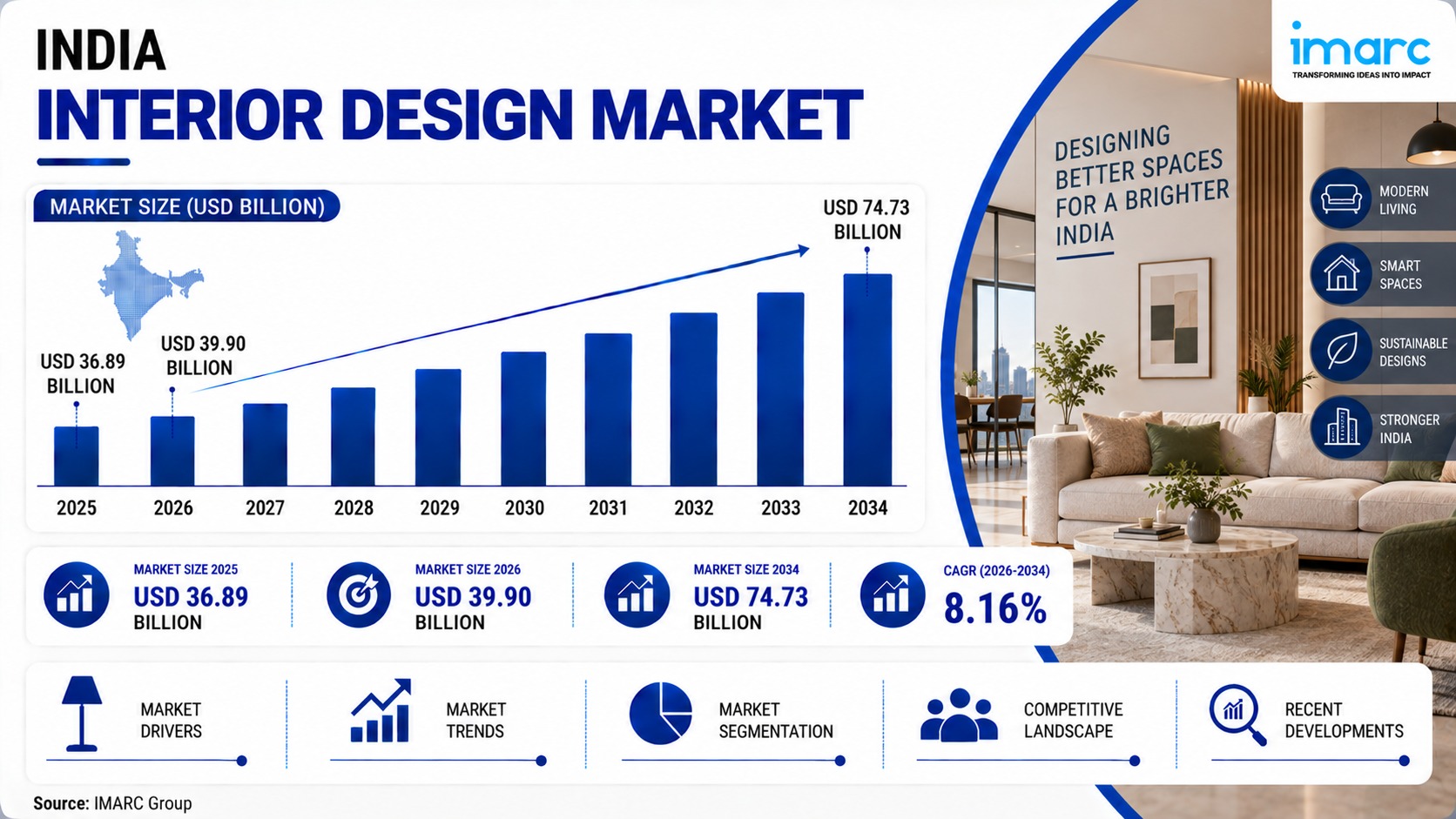
The India interior design industry size increased from USD 36.89 Billion in 2025 to USD 39.90 Billion in 2026 and is projected to reach USD 74.73 Billion by 2034, exhibiting a compound annual growth rate (CAGR of 8.16%) during the 2026–2034 forecast period. The industry is expanding steadily as homeowners and businesses prioritize well-designed, functional, and aesthetically refined spaces. Driven by rising homeownership, nuclear family living, commercial real estate growth, and greater willingness to invest in professional design services, interior design has become an integral part of both residential and commercial construction across India.
What Is the Size and Growth Forecast of the India Interior Design Market?
The market is exhibiting highly resilient, continuous expansion, fundamentally anchored by the essential desire for optimized, modern living and working environments amid rapid urbanization and lifestyle evolution.
- Market Size in 2025: USD 36.89 Billion.
- Market Size in 2026: USD 39.90 Billion.
- Market Forecast in 2034: USD 74.73 Billion.
- Compound Annual Growth Rate (CAGR): 8.16% during the 2026–2034 forecast period.
- Underpinning Momentum: Continuous expansion of residential and commercial construction, rising preference for professional design services, government housing and urban development initiatives, and growing consumer focus on aesthetics, functionality, and smart home features create a strong pipeline of new and renovation projects.
What Are the Latest Emerging Trends in the India Interior Design Market?
- Preference for End-to-End Full Home Design Packages: Homeowners increasingly choose complete interior solutions covering design, materials, furniture, and execution from a single provider. This approach ensures cohesive aesthetics, better project coordination, and reduced hassle compared to managing multiple vendors for different elements of a home.
- Rise of Warm Minimalism and Personalised Spaces: Design trends favour clean lines combined with warm textures, earthy neutrals, and culturally rooted elements. Clients seek calm, authentic interiors that blend modern functionality with personal and regional character rather than purely sterile global minimalism.
- Integration of Smart Home and Multifunctional Features: Technology is being seamlessly incorporated into lighting, storage, and furniture to support compact urban living. Flexible layouts and multi-use furniture help maximise limited space while enhancing convenience and everyday comfort for nuclear families.
- Growing Focus on Sustainable and Natural Materials: Demand is rising for reclaimed wood, eco-certified finishes, bamboo, and other sustainable options. Clients value durability, lower environmental impact, and materials that age gracefully while adding tactile warmth to residential and commercial interiors.
- Expansion of Experience Centres and Platform-Led Execution: Brands are opening immersive showrooms and leveraging digital platforms for design visualisation and project management. These formats help customers visualise complete interiors before committing and streamline delivery across cities.
Request a Sample Copy of this Report: https://www.imarcgroup.com/india-interior-design-market/requestsample
What Growth Factors Are Driving the India Interior Design Market?
- Rising Homeownership and Nuclear Family Living: Increasing numbers of millennials and dual-income households are investing in professionally designed homes. Compact urban apartments require optimised layouts that maximise functionality, storage, and visual appeal within limited square footage.
- Surge in New Residential and Commercial Construction: Continuous expansion of housing projects and commercial real estate in metros and tier-2 cities generates strong demand for fresh interior design solutions. Developers often partner with design firms to offer move-in-ready or branded interiors.
- Government Housing and Urban Development Initiatives: Schemes focused on affordable housing, smart cities, and urban renewal create sustained requirements for interior finishing and space optimisation services across both private and public projects.
- Growing Consumer Willingness to Invest in Design: Higher disposable incomes and greater awareness of interior design benefits encourage homeowners and businesses to allocate larger budgets for professional services, materials, and curated aesthetics.
- Demand for Contemporary and Hybrid Design Styles: Clients increasingly seek interiors that blend global design influences with local cultural aesthetics, creating distinctive yet functional spaces for both residential living and modern workplaces.
What Are the Key Challenges Facing the India Interior Design Market?
- Fragmented and Unorganised Service Landscape: A large portion of the market still relies on local contractors and informal providers. This fragmentation can lead to inconsistent quality, project delays, and difficulty in scaling professional design standards nationwide.
- Price Sensitivity and Budget Constraints: Many customers remain highly cost-conscious, especially in mid-segment housing. Balancing design quality, material standards, and project timelines within limited budgets remains a persistent challenge for service providers.
- Skill Gaps in Execution and Project Management: Shortage of trained designers, craftsmen, and project managers can affect timely delivery and finish quality, particularly when scaling operations across multiple cities and project types.
- Supply Chain and Material Availability Issues: Fluctuations in the cost and availability of quality materials, furniture, and fittings can disrupt project schedules and impact final pricing for both residential and commercial clients.
Explore the Full Report with Charts, Table of Contents, and List of Figures: https://www.imarcgroup.com/india-interior-design-market
Deep-Dive Segment Insights
The market is meticulously segmented to address diverse project scopes, client types, and regional design preferences.
By Decoration Type
- New (56% share in 2025): Dominates due to continuous expansion of residential and commercial construction. New housing projects and commercial spaces create substantial demand for fresh interior design solutions, often supported by developer partnerships offering pre-designed or move-in-ready interiors.
- Renovation: Gains steady traction as homeowners modernise existing properties with contemporary designs, smart features, and improved functionality.
By End User
- Residential (60% share in 2025): Leads the market, driven by rising homeownership among millennials, dual-income households, nuclear family living, and growing willingness to invest in professional interior services for optimised and aesthetically refined homes.
- Commercial: Supports office, retail, and institutional spaces seeking productive, brand-aligned, and visually appealing environments.
By Region
- North India (29% share in 2025): Maintains leadership supported by significant urban development, cultural diversity, and economic activity in cities such as Delhi, Chandigarh, and Jaipur. The region blends classical and contemporary styles and hosts a concentration of affluent clients and luxury projects.
- West and Central India, South India, and East India: Continue expanding with metropolitan growth, industrial and IT-driven commercial demand, and improving formalisation of interior spending in emerging markets.
Competitive Landscape & Key Player Positioning
The market research report has also provided a comprehensive analysis of the competitive landscape. Competitive analysis such as market structure, key player positioning, top winning strategies, competitive dashboard, and company evaluation quadrant has been covered in the report. Also, detailed profiles of all major companies have been provided.
Key players include:
- Leading organised interior design platforms and full-service firms
- Furniture and home-improvement brands expanding into end-to-end interiors
- Regional design studios and experience-centre operators
- Other specialised residential and commercial design providers
Competition is driven by design quality, project execution reliability, material partnerships, digital visualisation tools, and ability to deliver cohesive, on-time interiors across residential and commercial segments.
Recent Developments:
- 2025–2026: Home interiors platforms and furniture brands expanded experience centres and end-to-end design offerings, reflecting strong consumer preference for complete, coordinated home solutions rather than standalone product purchases.
- Ongoing: Full Home Design packages continued gaining popularity, with a majority of homeowners preferring single-provider solutions that cover design, materials, and execution for better consistency and convenience.
- 2025–2026: Design trends shifted toward warmer minimalism, sustainable materials, flexible layouts, and smart-home integration, aligning with compact urban living and demand for personalised, calming interiors.
- Market Expansion: Tier-2 cities showed rising interest alongside established metros, supported by growing housing activity and greater formalisation of interior design spending.
- Industry Outlook: Average spending on home interiors remained robust, with bedrooms and kitchens accounting for a major share of consumer investment across key urban markets.
Customization Note: If you require any specific information not covered within this report’s scope, we will provide it as part of the customization.
Request Report Customization: https://www.imarcgroup.com/request?type=report&id=6173&flag=E
Frequently Asked Questions (FAQs)
Q1. What is the current size of the India interior design market?
The India interior design market size was valued at USD 36.89 Billion in 2025 and increased to USD 39.90 Billion in 2026.
Q2. What is the projected market size by 2034 and the growth rate?
The market is projected to reach USD 74.73 Billion by 2034, exhibiting a compound annual growth rate (CAGR of 8.16%) during the 2026–2034 forecast period.
Q3. Which decoration type holds the largest share?
New decoration leads with a 56% share in 2025, driven by continuous residential and commercial construction activity.
Q4. Which end-user segment drives the highest demand?
Residential accounts for the largest share at 60% in 2025, supported by rising homeownership and investment in professional design services.
Q5. Which region accounts for the highest market share?
North India leads with a 29% share in 2025, backed by strong urban development and demand for both traditional and contemporary design styles.