Five Games Are a Snapshot, Not a Forecast
Five Games Are a Snapshot, Not a Forecast
Why “recent form” can be useful in sports analysis — and still send you in the wrong direction
SPORTS DATA LITERACY | STEEMIT EDITORIAL
Recent form is evidence. It is not a verdict. A short streak becomes useful only after you ask who was involved, who they faced, how the games were played, and how much data you actually have.
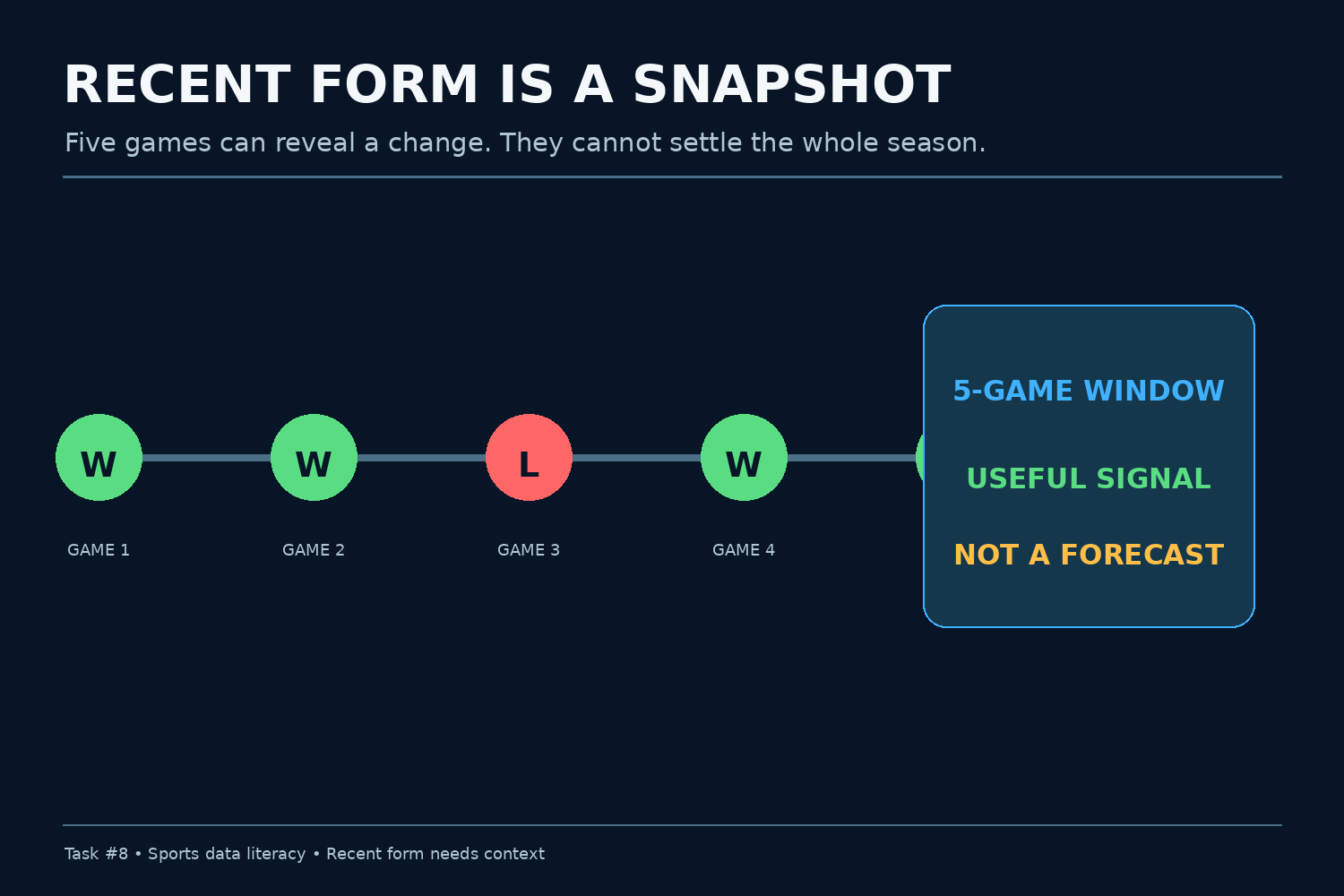
A five-game winning streak is one of the easiest sports stories to understand. The arrows point up. The graphic turns green. A team that looked ordinary two weeks ago suddenly looks dangerous. The opposite is just as tempting: three losses in a row can make a season feel as if it is sliding away.
That instinct is not useless. Recent results can reveal genuine changes in health, rotation, tactics, confidence or execution. The problem begins when a short sequence is treated as if it explains everything. Sports are noisy. Opponents differ. Schedules differ. A player can shoot unusually well for a week, a team can catch three exhausted opponents, or a lineup can look dominant before the rest of the league has had time to adjust.
The better question is not, “Who is hot?” It is, “What changed — and is that change likely to survive?”
1. “Recent” Is a Window, Not a Definition
People often talk about recent form as if everyone is looking at the same thing. They are not. One analyst may use the last five games, another the last ten, and another the period since a lineup change or a player returned from injury. Change the window and the story can change with it.
That matters because a short window magnifies randomness. One overtime game, one terrible shooting night or one opponent resting key players can move an average dramatically. A longer window usually smooths some of that noise, but it can also hide a genuine tactical change that happened only recently. There is no magic number of games that solves the problem. The window has to match the question.
If you are asking whether a new starting lineup is working, games before that lineup existed may be less informative. If you are asking how good the team is overall, ignoring the first three months of the season makes little sense.
2. Opponent Quality Can Make the Same Record Mean Different Things
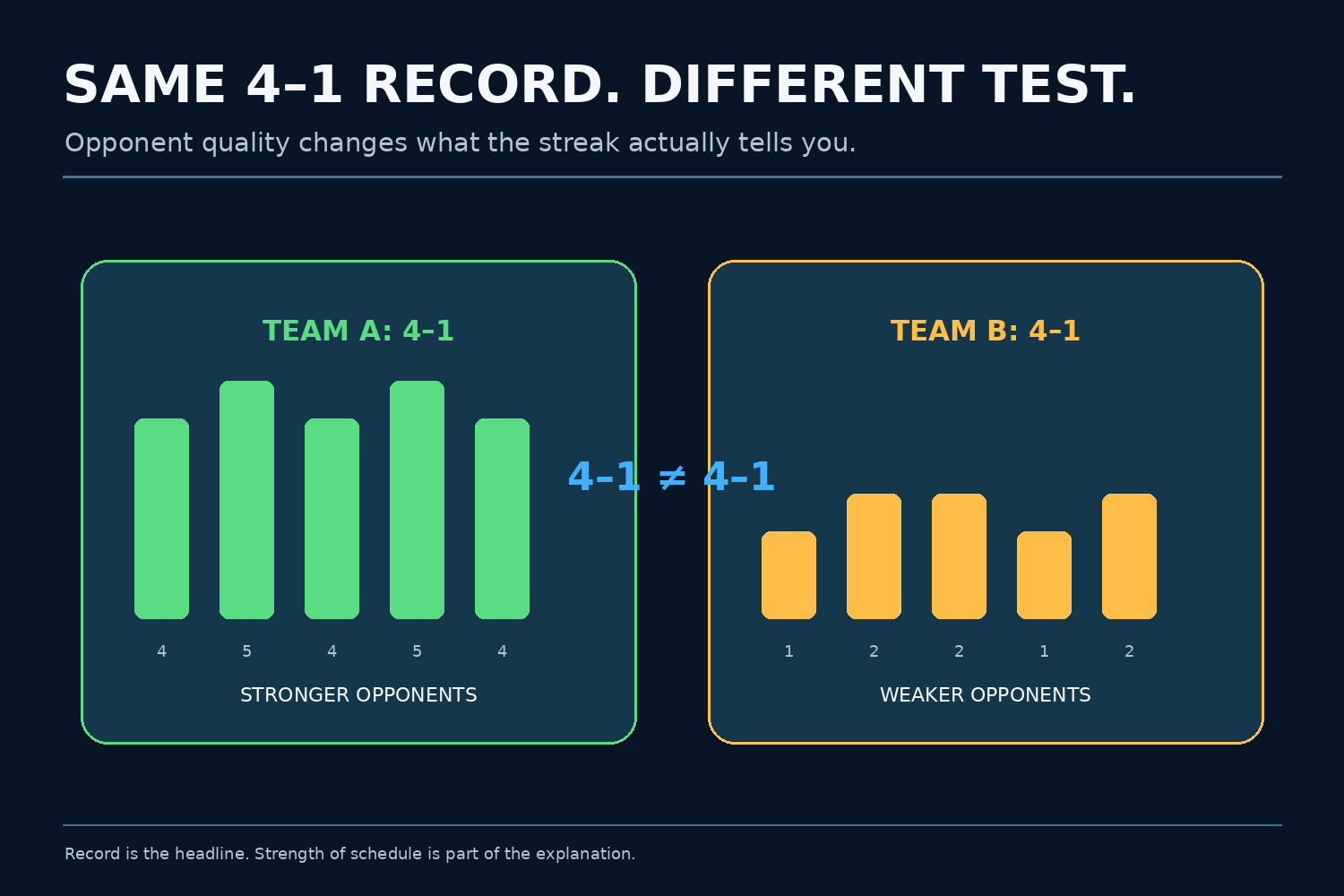
A 4–1 stretch against elite opponents is not the same analytical object as a 4–1 stretch against struggling teams. The record is identical; the test was not. Strength of schedule is one of the first pieces of context to add before deciding that a streak represents a real change in level.
Home and road conditions matter too. So do back-to-backs, travel, rest differences and injuries on the other side. Recent-form graphics often compress all of that into a row of W and L symbols. That is convenient for scanning. It is poor as a final argument.
A useful habit is to read the result and then immediately ask: who was available, where was the game played, and what kind of opponent produced that result?
3. Results Can Improve Before Performance Does
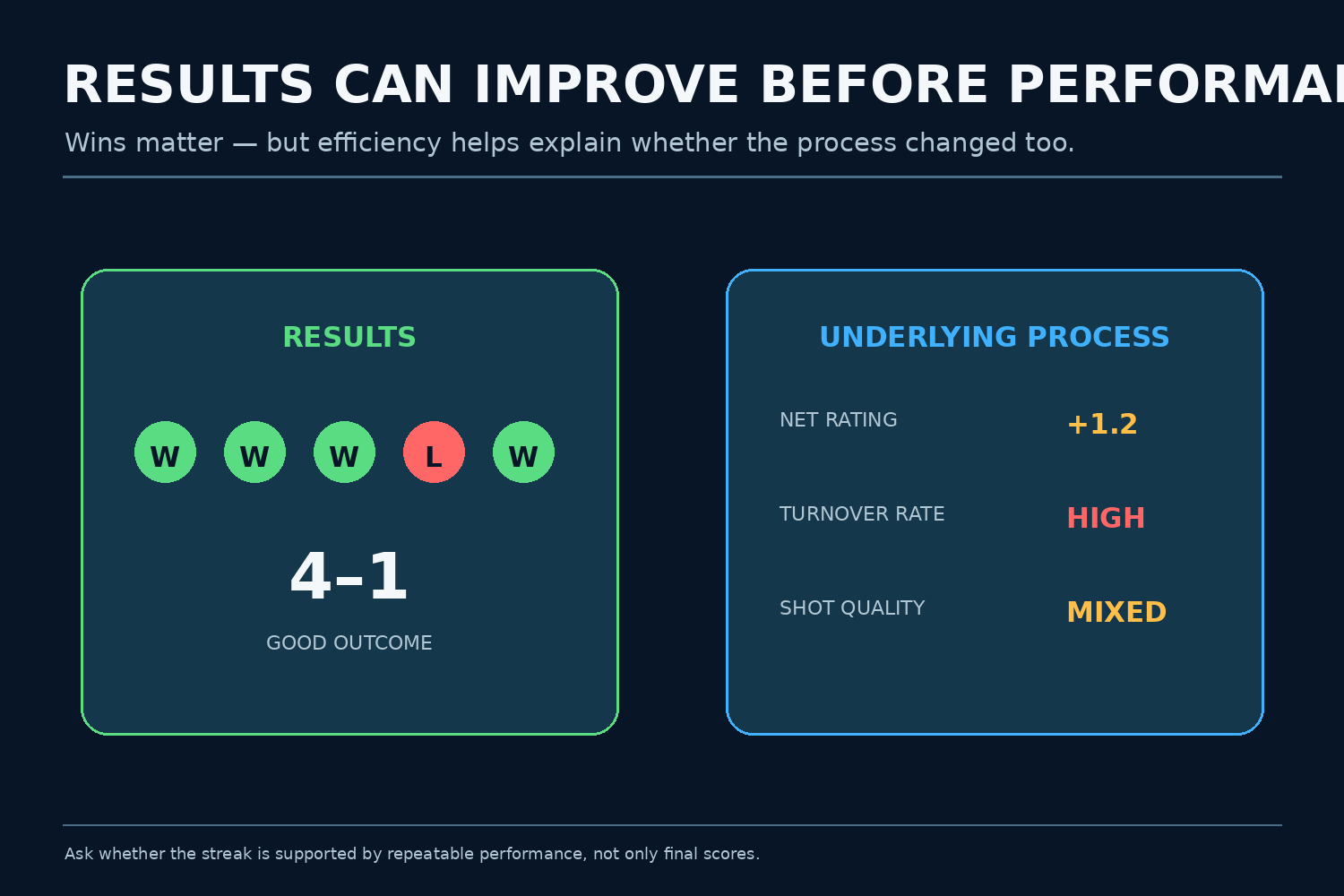
Winning and playing well are related, but they are not identical. A team can win several close games while being outplayed for long stretches. Another can lose a few tight finishes while producing stronger underlying numbers than its record suggests.
Basketball offers a simple example. The NBA’s own statistics guidance notes that pace can inflate or deflate raw totals, which is why per-possession measures are useful when comparing teams. Its official tools also allow analysts to examine lineup combinations and advanced measures such as Net Rating rather than relying only on final scores.
The broader lesson travels across sports: look underneath the result. Shot quality, possession control, turnover rate, territorial dominance, lineup efficiency or other sport-specific indicators may tell you whether the streak is being supported by repeatable performance or by a run of fortunate outcomes.
4. Personnel Changes Can Make Old Form Irrelevant
Recent form becomes much more meaningful when you can explain why it changed. A returning starter can stabilize a defense. A new role can reduce a player’s turnovers. A coach can shorten the rotation. A team can abandon one tactical approach and start creating better chances in another way.
This is where simple streak-watching becomes actual analysis. Do not just count wins. Identify the mechanism. If the mechanism is visible and repeatable, the recent numbers deserve more weight. If the explanation is basically “they made every difficult shot for a week,” caution is more appropriate.
Lineup context is especially important because five players share the court at once. The NBA’s official lineup database can break performance down by two-, three-, four- and five-player combinations. That is a reminder that a player’s apparent surge may partly be a teammate effect, and a team’s improved form may come from one specific unit rather than the roster as a whole.
5. The Eye Loves Streaks More Than Probability Does
Humans are pattern-finders. Once we decide a team is “in form,” confirming evidence becomes easier to notice. A lucky bounce feels like momentum. A missed open shot gets dismissed as an exception. After the result is known, it is also easy to build a story that makes the outcome feel inevitable.
That is why recent form should be written down before it is interpreted. Define the window. Compare the opponents. Note injuries and lineup changes. Check whether efficiency changed or only the final result. Then decide how strong the evidence actually is.
On an informational site such as Bybet Casino PH, recent-form labels are most useful when they are treated as compact summaries rather than promises about what happens next. The site describes itself as an independent informational guide, not an operator. [4]
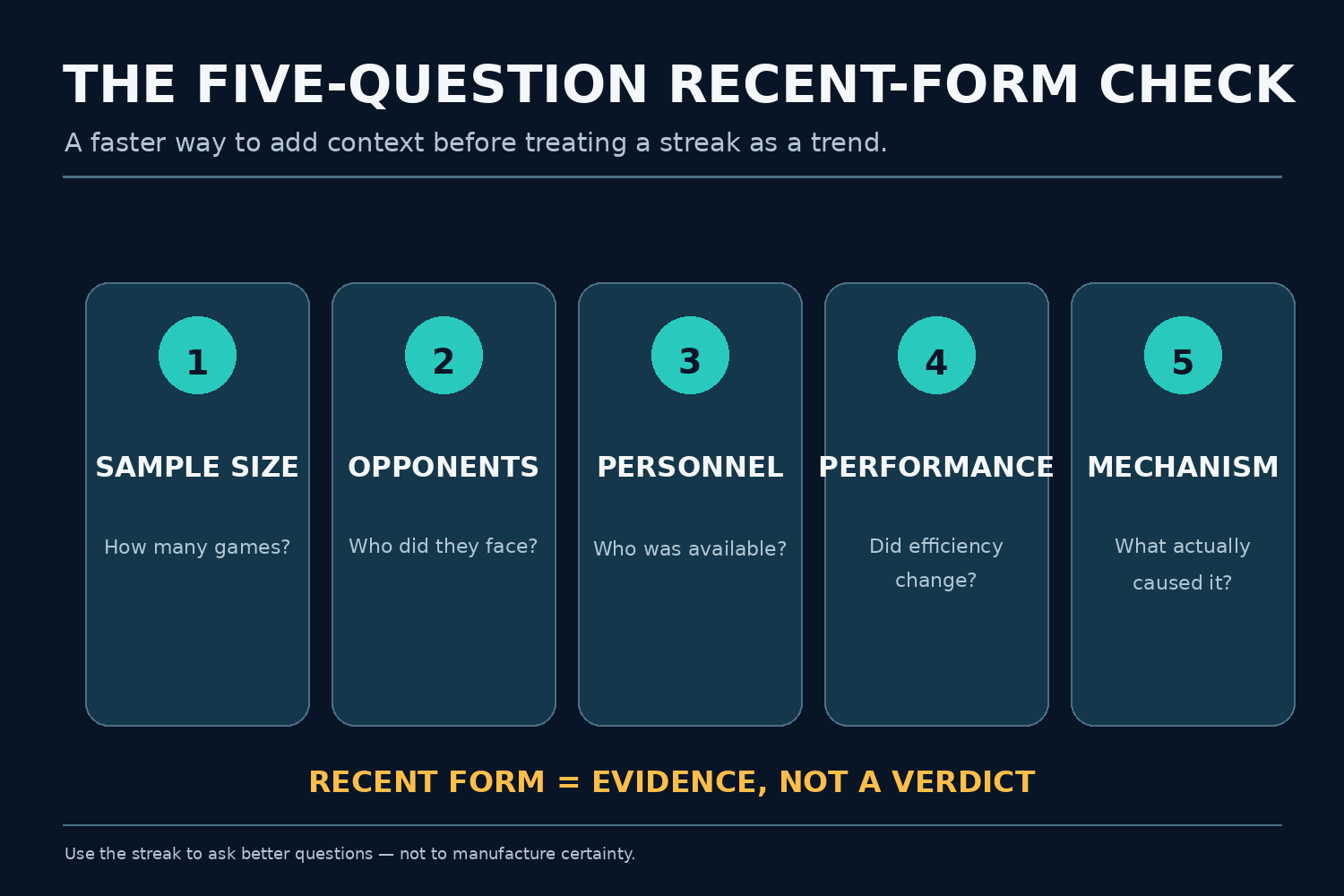
6. A Better Five-Question Recent-Form Check
| Question | Why it matters |
| How large is the sample? | Five games can flag a change; they rarely settle a debate. |
| Who were the opponents? | Separate a difficult run from a soft schedule. |
| What changed in personnel? | Injuries, returns, trades and rotation changes can reset the context. |
| Did underlying performance improve? | Look beyond the W–L line at efficiency and repeatable process. |
| Is there a plausible mechanism? | A tactical adjustment is more informative than a vague claim about momentum. |
Recent Form Is Most Useful When It Makes You Ask Better Questions
There is nothing wrong with looking at the last five games. The mistake is allowing five games to erase everything else you know.
Recent form can identify a new lineup, a recovering player, a tactical shift or a real change in efficiency. It can also be a mirage created by opponent quality, shooting variance, close-game luck or an arbitrary date range. Good analysis keeps both possibilities alive until the evidence gets stronger.
So the next time a graphic says a team is “red hot” or “ice cold,” do not stop at the label. Ask what changed, how large the sample is, and whether the underlying process moved with the results. That is slower than reacting to a streak. It is also much closer to understanding the sport.
Responsible-use note: This article is for sports-data education. It does not provide wagering advice or guarantee future outcomes. Where regulated gaming is involved, follow applicable age, legal and responsible-gaming requirements.
Sources & Publication Notes
[1] NBA Stats FAQ — Pace and per-possession context
[2] NBA Stats — Lineups Advanced
[3] NBA Stats Glossary — Net Rating
[4] Bybetcasino.ph Privacy Policy — site describes itself as an independent informational guide
[6] PAGCOR — Registered Brands and Domain Names/URLs, as of July 30, 2026
Publication check (August 12, 2026): Steemit’s official FAQ states that legal content complying with its Terms is welcome and separately addresses plagiarism, spam and abuse. This article is original, educational, and uses one contextual external link. PAGCOR’s July 30, 2026 list includes the ByBet brand and registered domains such as bybet.com, bybet.ph, bybet.app and bybet.tv; this article does not claim that bybetcasino.ph is an operator or registered gaming domain.