Car Accident in Latvia or Elsewhere in Europe: A Step-by-Step Guide (and Is Liability Insurance Compulsory EU-Wide?)
Short answer to the question most drivers ask first: yes, motor third-party liability insurance is compulsory in every EU country, not only in Latvia. A standard policy from one EU or EEA state is valid across the whole European Economic Area, and in Switzerland, so a Latvian OCTA policy covers you in Germany, Spain or Finland. Outside that zone the rules change, and you may need a Green Card. Here is what to do when something goes wrong.
First, at the scene
Whatever country you are in, the first steps are the same.
- Stop and stay. Leaving the scene is an offence everywhere.
- Make the scene safe. Switch on hazard lights and set up the warning triangle.
- Help the injured. Latvian rules oblige every road user to provide first aid as far as they can.
- Call for help. Dial 112 for any emergency across the EU. In Latvia, the State Police line is 110.
When you must call the police in Latvia
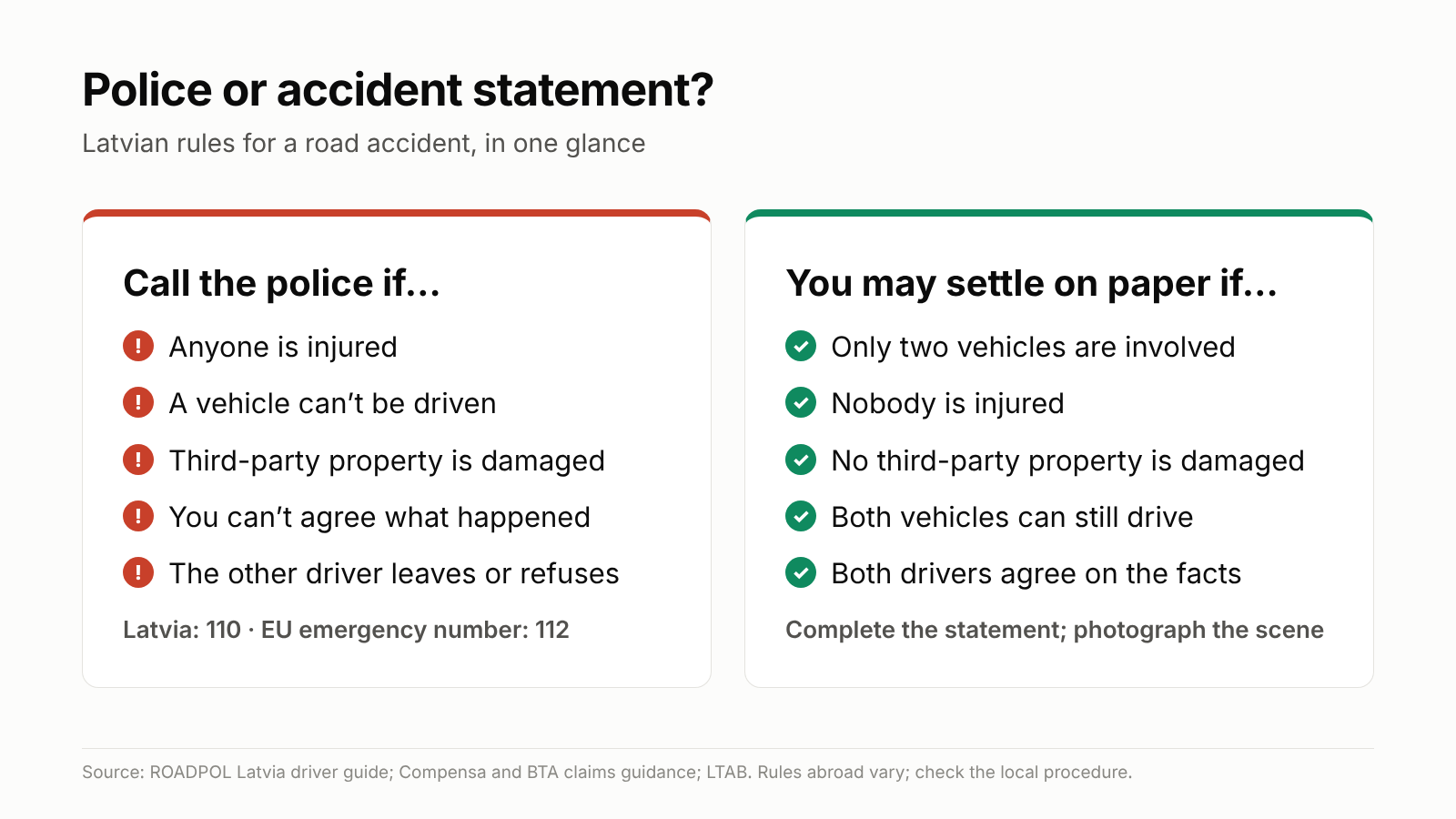
You must report to the traffic police if anyone is injured, or if vehicles are damaged so badly that they cannot or may not continue on the road. Until officers arrive, do not move the vehicles or touch objects connected with the accident. Also call the police if the other driver leaves the scene, refuses to complete a statement or you cannot agree on what happened. In those cases the police take over the record.
When you can settle it on paper (the agreed statement)
If only two vehicles are involved, nobody is injured, no third-party property is damaged, both vehicles can still be driven and both drivers agree on the circumstances, you can complete a statement yourselves. In Latvia it is called the agreed statement (saskaņotais paziņojums). Elsewhere in Europe it is the European Accident Statement, a standardised form. The layout is the same in every language, so you can fill one in with a driver who does not speak yours.
Practical tips:
- Photograph everything before moving the cars (if moving is allowed): positions, damage, plates, road markings and the scene from a distance.
- Note witness contacts.
- Do not sign what you do not understand. If you disagree, call the police instead.
- Fill it in carefully. Errors in the form can delay the payment and, according to Latvian insurers, can even expose you to recourse by the insurer.
- Send it fast. One Latvian insurer states that the statement must reach the insurer within 10 days.
After the accident: who pays?
The at-fault driver's liability insurer pays for the injured parties and their property. So if the other driver was at fault, you claim from their insurer. If you were at fault, your policy pays the other side, but not your own repairs unless you have CASCO.
Your own claim checklist:
- Get the other driver's name, address, vehicle plate and insurer.
- Keep the damaged vehicle in its post-accident condition until the insurer has seen it.
- Submit the claim to the right insurer with the statement, photos and any documents.
Accidents abroad
- Inside the EU/EEA: if the at-fault driver's insurer is based in another EEA country, that insurer must have a claims representative in your country. If there is none, the national Motor Insurers' Bureau (LTAB in Latvia) can help you find the insurance company where you should file.
- In Green Card countries outside the EEA: report the accident to the traffic police and the local Green Card office, and claim from the insurer of the at-fault party. The Green Card is an international certificate of minimum compulsory cover. Carrying it is still required in a handful of non-EEA countries, and the list can change, so check with your insurer before you travel. Countries often cited include Albania, Belarus, Israel, Moldova, Montenegro, Morocco, North Macedonia, Tunisia, Turkey and Ukraine.
- If the other car is uninsured: a guarantee fund exists in each EU country to compensate victims, but it takes longer and more paperwork. Latvia's LTAB warns that accidents with uninsured vehicles abroad should be reported immediately.
What to pack for a European road trip
- Your insurance policy (a copy on your phone is fine) and the insurer's emergency number.
- A blank European Accident Statement, or the LTAB app.
- Warning triangle and reflective vest, which are required in many countries.
- Your driving licence and registration papers.
- Travel insurance for the people in the car, because liability insurance never covers your own injuries or those of your passengers if you are at fault.