Intraoperative Imaging Market Drivers: Minimally Invasive Surgery Demand & Growth Outlook 2026-2034
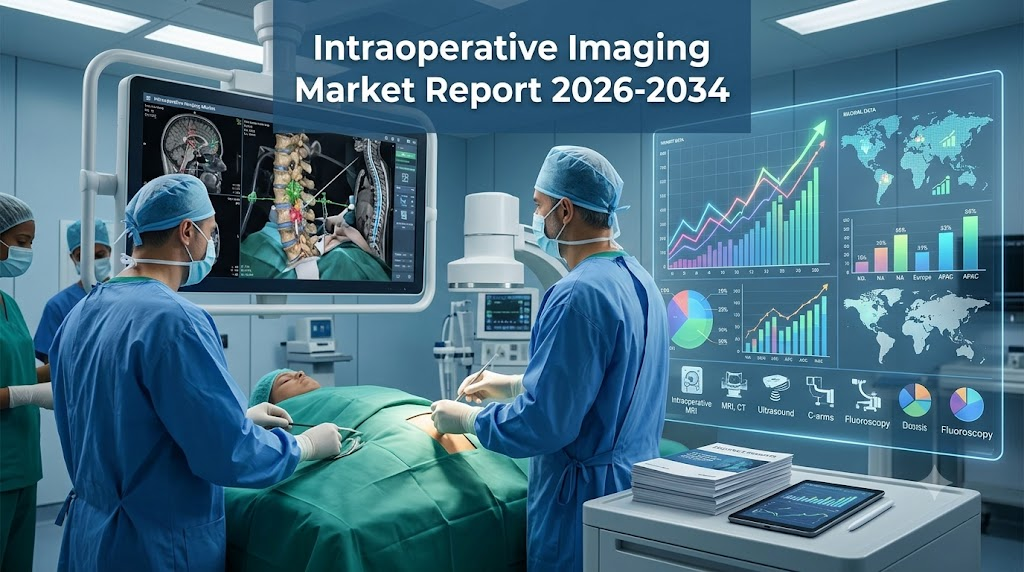
IMARC Group, a leading global market research and management consulting firm, has published its latest market intelligence report on the intraoperative imaging market. The global intraoperative imaging market size reached USD 2.49 Billion in 2025 and is projected to reach USD 3.65 Billion by 2034, growing at a CAGR of 4.22% during 2026-2034. driven by escalating demand for precision in complex surgeries, rising incidence of neurological, orthopedic, and cardiovascular conditions, accelerating adoption of minimally invasive and robotic-assisted surgery, and continual technological advancements in image-guided surgical platforms.
The market is on a steady growth path underpinned by rising global surgical volumes tied to aging demographics, deepening technological convergence between imaging modalities and robotic surgical platforms, and expanding healthcare infrastructure across Asia-Pacific and Latin America. C-arm fluoroscopy systems remain the technological backbone of the industry given their versatility and relative cost efficiency, while intraoperative MRI commands premium positioning in high-precision neurosurgical procedures. Hospitals and clinics anchor the bulk of demand as the primary setting for complex, multi-disciplinary procedures requiring dedicated hybrid operating room infrastructure, even as ambulatory surgical centers emerge as the fastest-growing site of care on the back of migrating elective procedure volumes.
Intraoperative Imaging Market at a Glance:
- Market Size 2025: USD 2.49 Billion
- Forecast Size 2034: USD 3.65 Billion
- Growth Rate 2026-2034: CAGR of 4.22%
- Leading Product: C-arm Systems, 39.8% share in 2025
- Leading End Use: Hospitals and Clinics, 67.5% share in 2025
- Dominant Region: North America, with a 41.2% revenue share in 2025
How AI is Reshaping the Future of the Intraoperative Imaging Market
- AI-Powered Low-Dose Imaging Chains: In November 2025, Siemens Healthineers introduced Optiq AI, an AI-powered imaging chain for its interventional systems designed to deliver high-quality, low-dose images in real time across cardiology, radiology, and minimally invasive surgery.
- AI-Guided Robotic Neurosurgery: In September 2025, AiM Medical Robotics secured USD 8.1 Million in Series A financing led by IQ Capital and 1540 Ventures to advance its MRI-compatible robotic neurosurgery platform, integrating real-time intraoperative MRI with robotic guidance for cranial procedures toward first-in-human trials.
- AI-Linked Navigation Integration: In April 2026, GE HealthCare announced a digital integration between its bkActiv intraoperative ultrasound system and Medtronic’s Stealth AXiS surgical navigation system, enabling real-time ultrasound imaging to feed directly into navigation workflows during cranial procedures, part of a broader industry shift in which AI-assisted robotic surgeries have shown a 25% reduction in operative time and a 30% decrease in intraoperative complications.
Grab a sample PDF of this report: https://www.imarcgroup.com/intraoperative-imaging-market/requestsample
Intraoperative Imaging Market Trends and Drivers:
Rising global surgical volumes, driven by an aging population expected to grow from 1.1 Billion people aged 60 and above in 2023 to 1.4 Billion by 2030, form the foundational driver of market growth. With the World Health Organization estimating over 300 million surgical procedures performed annually worldwide, orthopedic joint replacements, neurosurgical interventions, and cardiovascular procedures increasingly rely on real-time imaging guidance to improve precision and outcomes.
Chronic disease burden is compounding this structural demand: approximately 90% of the United States’ USD 4.9 Trillion in annual healthcare spending is directed toward individuals with chronic and mental health conditions, directly expanding the surgical base that depends on intraoperative imaging. At the same time, minimally invasive and robotic-assisted surgical techniques require continuous high-resolution imaging guidance to compensate for reduced tactile feedback, cementing intraoperative imaging as an indispensable procedural tool rather than an optional add-on.
Regulatory and reimbursement policy is increasingly shaping how fast vendors can bring new imaging platforms to market and how hospitals get paid for using them, a dynamic spanning the United States, European Union, and China that is detailed further below. Medical imaging devices must clear rigorous, non-harmonized approval processes across FDA, EU MDR, CDSCO, and NMPA, extending time-to-market even as reimbursement frameworks evolve around site-of-care and value-based payment models.
Global Regulatory, Trade, and Sustainability Landscape Shaping Demand:
- EU MDR and Mandatory EUDAMED Rollout: From 28 May 2026, the EU’s EUDAMED device-registration modules become mandatory under Regulation (EU) 2017/745, with a new Breakthrough Device (BtX) pathway offering prioritized review for high-impact imaging and navigation technologies.
- US Medicare Site-Neutral Reimbursement Reform: CMS finalized a 2.6% FY2026 IPPS payment increase for hospitals, including roughly USD 192 Million in new-technology add-on payments, even as its proposed CY2027 rule would cut over USD 260 Million in imaging spending through site-neutral payment reforms extending to MRI and CT services performed without contrast.
- China’s Regulatory Modernization Push: China’s State Council introduced healthcare reform guidelines in March 2025 targeting a modernized medical device regulatory framework by 2027, aimed at strengthening innovation support alongside the country’s rapid hospital equipment upgrade cycle.
- Global Surgical Volume as a Structural Tailwind: The WHO’s estimate of over 300 million annual surgical procedures worldwide continues to anchor long-term demand for image-guided surgical platforms across both developed and emerging healthcare systems.
Key Government Schemes and Policy Programs Supporting the Industry:
- India, PLI Scheme for Medical Devices: India’s Rs 3,420 Crore Production Linked Incentive scheme for medical devices, covering radiology and imaging equipment as one of four target segments, has driven cumulative beneficiary sales of Rs 8,039 Crore (including Rs 3,844 Crore in exports) as of September 2024, with the government releasing a further Rs 266.64 Crore in incentives and Rs 209.80 Crore for Medical Device Parks through FY2024-25.
- United States, Medicare Capital and Technology Add-On Payments: CMS’s FY2026 Hospital Inpatient Prospective Payment System rule lifts operating payment rates by 2.6% and allocates approximately USD 192 Million toward new medical technology add-on payments, even as proposed CY2027 site-neutral reforms targeting USD 260 Million in imaging savings signal a tightening reimbursement environment for hospital-based imaging.
- European Union, MDR Breakthrough Device Pathway and Innovation Funding: The EU’s proposed MDR/IVDR revision introduces the Breakthrough Device (BtX) pathway with access to EU-level funding mechanisms including the EIC Accelerator and Horizon Europe, alongside reduced Notified Body fees for micro, small, and orphan device manufacturers developing novel imaging technologies.
- China, Medical Equipment Renewal Special Program: China’s National Development and Reform Commission released its first 2026 batch of ultra-long-term special treasury bond funding under the Medical Equipment Renewal Special Program, estimated to drive approximately RMB 60 Billion in healthcare device purchases, building on a medical imaging market that surged 47% in 2024 and county-level procurement projected to grow 25% in 2025.
Intraoperative Imaging Industry Segmentation:
The report has segmented the market into the following categories:
Breakup By Product:
- C-arm Systems
- Intraoperative MRI (iMRI)
- Intraoperative CT (iCT)
- Intraoperative Ultrasound (iUltrasound)
C-arm systems dominate the product segment with a 39.8% share in 2025, reflecting their broad clinical utility across orthopedic, cardiovascular, urological, and spinal disciplines combined with relative cost efficiency versus iMRI and iCT installations, with AI-assisted fluoroscopy and 3D reconstruction sustaining replacement demand across existing installed bases. iMRI holds 24.6% share, commanding premium pricing at major academic medical centers for high-precision neurosurgical procedures such as tumor resection and deep brain stimulation.
Breakup By Application:
- Neurosurgery
- Orthopedic Surgery
- ENT Surgery
- Oncology Surgery
- Trauma Surgery/Emergency Room
- Cardiovascular
- Others
Breakup By End Use:
- Hospitals and Clinics
- Ambulatory Surgical Centers
- Academic Institutes and Research Laboratories
Hospitals and clinics command 67.5% share in 2025 as the primary setting for complex procedures requiring dedicated hybrid operating room infrastructure and multi-modality imaging procurement contracts. Ambulatory surgical centers, while smaller in current share, represent the fastest-growing end-use segment as elective procedures migrate to outpatient settings demanding portable, space-efficient imaging systems.
Breakup By Region:
- North America (United States, Canada)
- Europe (Germany, France, United Kingdom, Italy, Spain, Russia, Others)
- Asia Pacific (China, Japan, India, South Korea, Australia, Indonesia, Others)
- Latin America (Brazil, Mexico, Others)
- Middle East and Africa
North America leads with a 41.2% revenue share in 2025, anchored by advanced surgical infrastructure, comprehensive Medicare/Medicaid and private insurance reimbursement for image-guided procedures, and a concentration of leading imaging technology developers. Europe follows at 26.4%, supported by strong public health expenditure and rising neurosurgery and orthopedic volumes, while Asia-Pacific at 22.7% is the fastest-growing region on the back of hospital construction in China, India’s Ayushman Bharat-driven specialist access expansion, and mature technology-intensive demand in Japan and South Korea.
Competitive Landscape:
The report provides a comprehensive analysis of the competitive landscape in the intraoperative imaging market with detailed profiles of key companies, including:
- GE HealthCare
- Siemens
- Medtronic
- Koninklijke Philips N.V.
- ATON GmbH
The market exhibits moderate concentration, with the top five vendors collectively holding approximately 54-58% of global revenue in 2025. Siemens Healthineers’ Imaging division, the company’s largest revenue contributor, grew comparable revenue by 6.1% to €2.973 Billion in its fiscal second quarter of 2026, while Medtronic’s O-arm and StealthStation platforms remain the clinical standard for intraoperative spinal and orthopedic CT navigation.
Market Concentration Analysis:
- Moderately Concentrated with Rising AI-Driven Consolidation: The top five global vendors hold approximately 54-58% of total revenue in 2025, with consolidation increasingly driven by strategic acquisition of AI software and robotic surgery integration capabilities by established imaging hardware incumbents.
- Imaging Platforms Acquiring AI-Native Specialists: In March 2026, RadNet completed its acquisition of Gleamer SAS, a France-based AI imaging software company, reinforcing a broader trend of diagnostic and surgical imaging platforms absorbing AI-native capabilities rather than building them internally.
- Software-Only Entrants Pressuring Incumbents: AI-native entrants focused on software-only imaging enhancement represent an emerging competitive threat that large OEMs are countering through internal R&D investment and targeted acquisitions rather than price competition.
What Does The Full Report Cover?
If you are tracking the intraoperative imaging market for investment decisions, market entry planning, competitive benchmarking, or strategic advisory, IMARC Group’s report gives you everything in one place:
- Complete market sizing with revenue forecasts covering the full 2020-2034 projection period
- Quantified growth driver analysis with impact scoring across product, application, end use, and regional markets
- Sub-segment breakdowns for C-arm systems, iMRI, iCT, and iUltrasound with individual share data
- Country-level data for the United States, Canada, Germany, France, United Kingdom, Italy, Spain, Russia, China, Japan, India, South Korea, Australia, Indonesia, Brazil, and Mexico
- Competitive and key company profiles with strategic landscape assessment
- Porter’s Five Forces, value chain analysis, and technology landscape mapping
- Investment and growth opportunity mapping across AI-enabled imaging software, portable mobile C-arm systems, and robotic surgery-integrated imaging
Recent News and Developments in Intraoperative Imaging Market
- July 2026: Vanderbilt Health and Siemens Healthineers formed an USD 87 Million partnership focused on advancing medical imaging technology within Vanderbilt’s health system.
- April 2026: GE HealthCare announced a digital integration between its bkActiv intraoperative ultrasound system and Medtronic’s Stealth AXiS surgical navigation system, embedding real-time ultrasound directly into cranial surgical navigation workflows.
- March 2026: Medtronic received US FDA clearance for its Stealth AXiS surgical system in cranial and ENT procedures, expanding its indication beyond spine surgery and uniting imaging, navigation, and robotics in a single platform.
- March 2026: RadNet completed its acquisition of France-based AI imaging software company Gleamer SAS, contributing to first-quarter 2026 revenue of USD 575.6 Million, up 22.1% year-on-year.
- November 2025: Siemens Healthineers launched Optiq AI, an AI-powered imaging chain delivering high-quality, low-dose real-time images for complex image-guided procedures across cardiology and minimally invasive surgery.
- September 2025: AiM Medical Robotics closed an USD 8.1 Million Series A round led by IQ Capital and 1540 Ventures to advance its MRI-compatible robotic neurosurgery platform toward first-in-human trials.
Note: If you require specific details, data, or insights that are not currently included in the scope of this report, we are happy to accommodate your request. As part of our customization service, we will gather and provide the additional information you need, tailored to your specific requirements. Please let us know your exact needs, and we will ensure the report is updated accordingly to meet your expectations.
Key Questions This Report Answers
- What is the current global intraoperative imaging market size and what is its projected value?
- Which product and end-use segments hold the largest share in the global intraoperative imaging market?
- What are the key drivers of global intraoperative imaging market growth?
- Which region dominates the global intraoperative imaging market and why?
- How are evolving reimbursement policies and regulatory frameworks reshaping intraoperative imaging investment worldwide?
- Who are the top companies in the global intraoperative imaging market and what are their competitive strategies?
- What are the investment and market entry opportunities across AI-enabled imaging software, portable C-arm systems, and robotic surgery-integrated imaging?
About Us:
IMARC Group is a global management consulting firm that helps the world’s most ambitious changemakers to create a lasting impact. The company provides a comprehensive suite of market entry and expansion services. IMARC offerings include thorough market assessment, feasibility studies, company incorporation assistance, factory setup support, regulatory approvals and licensing navigation, branding, marketing and sales strategies, competitive landscape and benchmarking analyses, pricing and cost research, and procurement research.
Media and Sales Contact
IMARC Group
Email: sales@imarcgroup.com
United States: +1-201-971-6302
India: +91-120-433-0800
United Kingdom: +44-753-714-6104