Fiscal History as a Warning
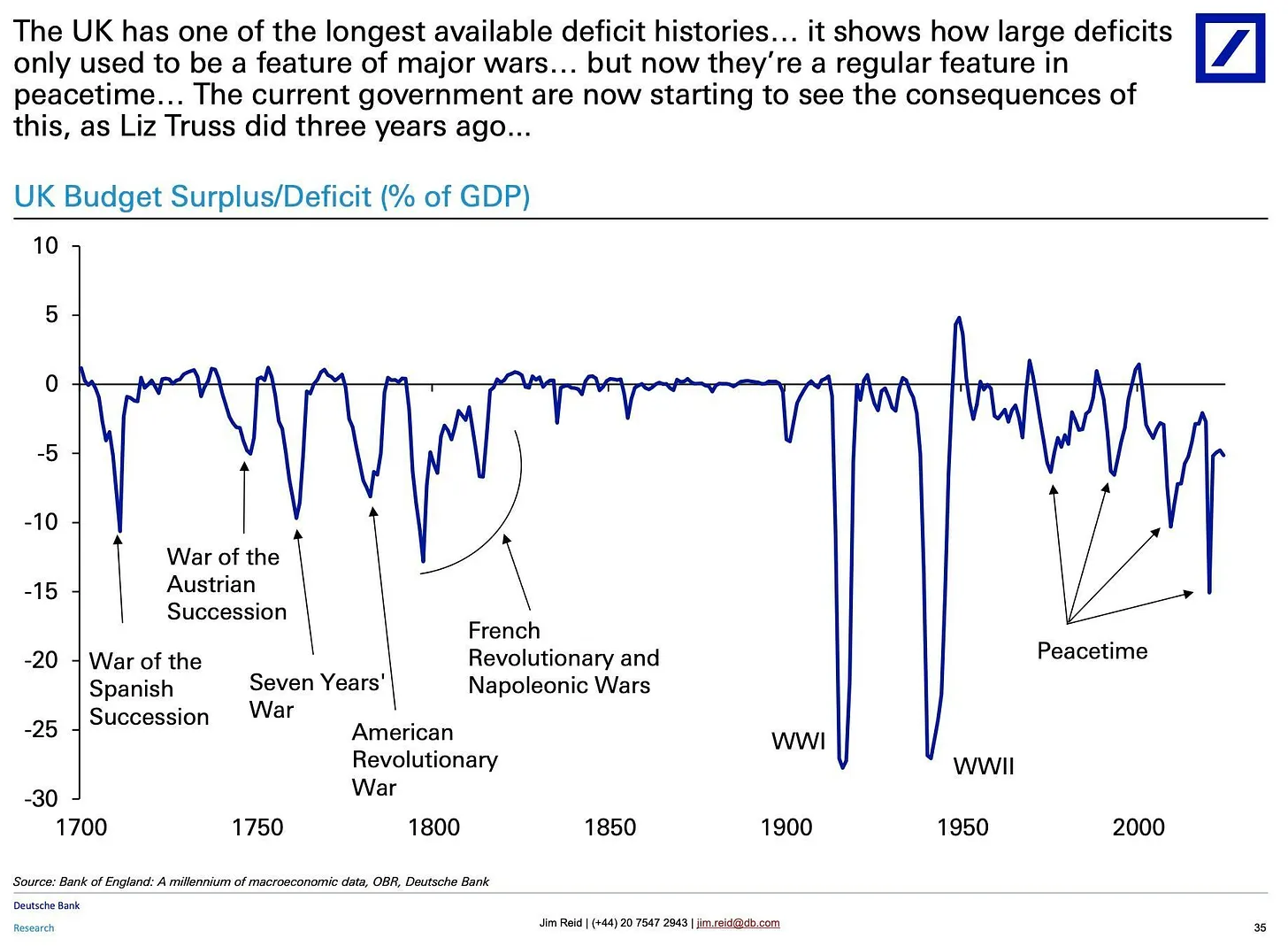
The United Kingdom offers a sobering precedent for what we are now witnessing in Germany. Historical budget data show that Britain’s deepest deficits occurred almost exclusively during major wars – the War of the Spanish Succession, the Napoleonic Wars, the World Wars. Crucially, those wartime deficits were followed by rapid debt reduction, driven by post-war growth, inflation, and disciplined fiscal consolidation.
In contrast, today’s deficits in Britain and increasingly across Europe are peacetime phenomena. They lack both the political legitimacy of wartime borrowing and the natural reset mechanisms of post-conflict reconstruction. The result is a slower, more fragile downward trajectory, where debt burdens accumulate without relief.
This is precisely why war begins to look like an economic solution: it legitimises deficit spending, accelerates the destruction of unsustainable liabilities, and creates the conditions for rapid restructuring once the conflict subsides. Germany’s militarisation therefore cannot be understood in isolation. It fits into a broader historical pattern: when peacetime deficits become permanent and politically untenable, war is reframed as both necessity and cure.
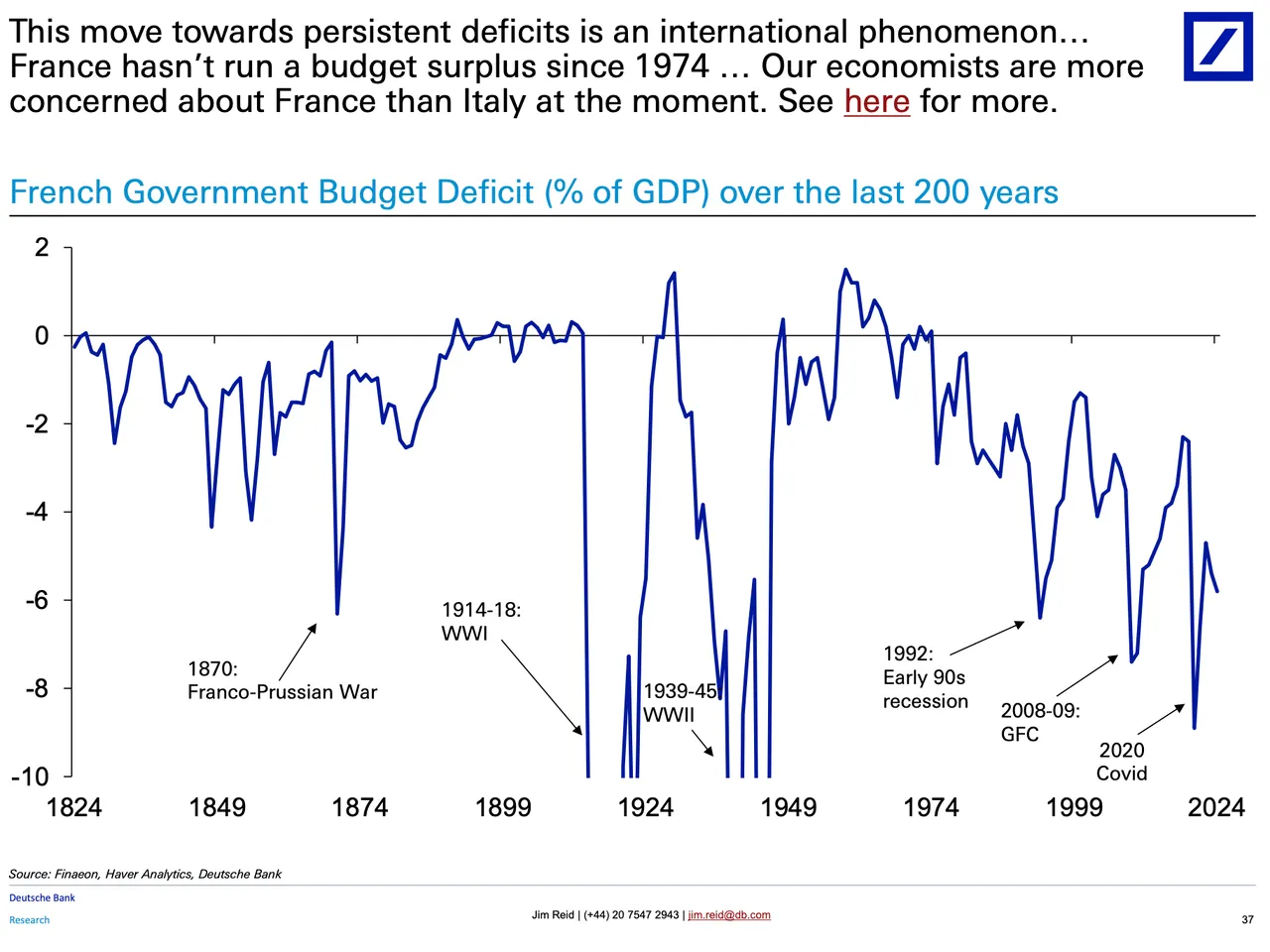
The French case underlines the same historical pattern we observed in Britain, but with an even sharper warning. For almost two centuries, France’s deepest fiscal deficits coincided with wars: the Franco-Prussian War, World War I, and World War II. In each case, extraordinary wartime borrowing was followed by a clear reset mechanism (reconstruction, inflation, or political restructuring) that allowed deficits to be reduced.
Since 1974, however, France has not recorded a single budget surplus. The extraordinary has become permanent. Deficits are no longer linked to existential wars but to the day-to-day functioning of the state. What was once exceptional wartime finance has turned into chronic fiscal imbalance.
This shift is dangerous because it removes the “reset button” that wars once provided. Without either genuine growth or the destructive-cleansing cycle of conflict, deficits accumulate endlessly. For policymakers, this makes war appear, paradoxically, not as a calamity but as the only remaining tool to compress obligations and restart the fiscal cycle.