711Bet Live Score Reliability Guide: Why Sports Updates Can Arrive at Different Times
Two sports apps can show the same match and still update a goal, basket, point, or final score at slightly different times. That does not automatically mean one source is wrong. Live sports data travels through a chain of systems: the event is observed, encoded as a data event, transmitted to a provider, processed by a publisher, cached or distributed through network infrastructure, and finally rendered on the user's device.
For 711Bet readers who follow live sports information, the useful question is therefore not simply 'Which screen changed first?' A stronger approach is to understand which timestamp the interface is showing, whether the event is provisional or confirmed, how the data reached the client, and whether a cache or network delay is involved.
1. Event Time and Arrival Time Are Different
The moment an event happens in the match and the moment a phone displays it are not the same timestamp. A data feed may record the game clock or event time, then attach another timestamp showing when the feed itself was updated. The user sees the result only after that update travels through the remaining delivery path.
This is why a clean live-data model should preserve both concepts. Event time explains where the action belongs in the match. Update time explains when the data system last changed its representation of the match.
2. Live Data Moves Through Several Hops
A simplified sports-data pipeline can be represented as: venue or official source → data collector/provider → publisher backend → API or push channel → CDN/cache layer → browser or mobile client. Each hop can add a small delay. A provider may also validate an event before distributing it, while a publisher may batch or transform data before sending it to users.
The total delay is therefore the sum of several small delays rather than one universal 'live-score latency.' Different services can also use different providers or update policies, so their end-to-end timing does not have to match exactly.
3. 'Updated At' Is More Useful Than a Guess About Freshness
Professional sports-data APIs commonly expose explicit status and timestamp fields. Sportradar's soccer documentation, for example, includes an updated_at timestamp for match situations, while its live event structures expose match status, score, period scores, and clock information. Those fields make it possible to distinguish the event state from the time the feed most recently changed.
For a user-facing interface, a visible 'last updated' value can be more informative than pretending every number is perfectly simultaneous with the venue. It tells the reader how fresh the displayed state is without implying zero latency.
4. Corrections Are Part of Live Data
Live sports feeds are not always final on the first observation. A point can be overturned, a goal can be disallowed, a player attribution can be corrected, or a match can move into an interrupted, resumed, extra-time, or completed state. A reliable system therefore needs to support corrections rather than treating the first event as immutable truth.
This is also why a temporary disagreement between two live screens should be interpreted cautiously. One source may have already processed a correction while another is still showing an earlier state.
5. Caching Can Make Correct Data Look Old
HTTP caches improve speed by reusing stored responses instead of requesting the origin server every time. That is useful for static content, but highly dynamic score data needs deliberate cache rules. If a live endpoint is cached too aggressively, a user can receive a technically valid response that is already stale.
The HTTP Cache-Control header exists specifically to control this behaviour. A response can declare how long it remains fresh, require revalidation, or prevent inappropriate reuse. The Age header can also indicate how long an object has been held in a shared cache.
6. Polling and Push Delivery Behave Differently
Some interfaces poll a server at regular intervals: every few seconds the client asks whether the score changed. That creates a built-in delay of up to roughly one polling interval before the next request, even when the backend already has the new event.
Other systems use push-oriented delivery such as server-sent events, WebSockets, or provider push feeds. Push can reduce waiting caused by polling intervals, but it still cannot remove delays that occurred earlier in the pipeline, nor can it guarantee that every user's network will deliver the update at the same instant.
7. Device and Network Conditions Add the Final Delay
The last hop belongs to the user's connection and device. High latency, packet loss, background data restrictions, a suspended browser tab, battery-saving behaviour, or a network transition can all delay when the interface processes an update.
When two devices disagree briefly, compare them on the same network before concluding that the publisher's backend is at fault. A stable Wi-Fi test and a mobile-data test can help separate local delivery problems from upstream feed timing.
8. Use 711Bet's Sports Coverage as Context, Not as a Timing Guarantee
The 711Bet sports coverage overview describes football, basketball, tennis, volleyball, and a live interface with real-time-style updates and statistics. That makes it a relevant brand-side example for discussing how users consume changing sports data, but the existence of a live interface should not be interpreted as a guarantee that every data point reaches every device with zero delay.
9. A Better Way to Compare Two Live Score Sources
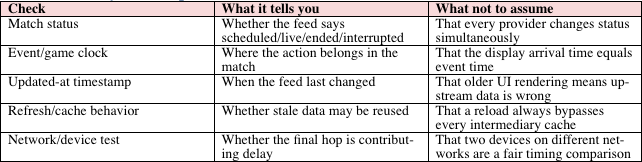
A Practical Live-Score Reliability Checklist
Check the match status before comparing individual events.
Distinguish the event clock from the feed's update timestamp.
Allow for corrections when an event is provisional or later reviewed.
Remember that provider, publisher, cache, and client layers can each add delay.
Treat cached responses carefully for highly dynamic data.
Know whether the interface polls or receives pushed updates.
Compare devices on the same stable network before blaming the upstream feed.
For official results, prefer the competition or governing body's confirmed record when final accuracy matters.
Conclusion
Live sports data is a pipeline, not a single clock. The event occurs first, then it is observed, encoded, transmitted, processed, cached or pushed, and finally rendered to the user. Small timing differences between services are therefore possible even when both systems are functioning normally.
For 711Bet readers, the most useful habit is to read live information with timestamps and status in mind. A one- or two-screen disagreement should be investigated through event time, update time, correction state, cache behaviour, and network conditions before it is labelled an error.
Technical References
Sportradar — Soccer Sport Event Timeline
Sportradar — Soccer Live Timelines
Sportradar — Extended Push Events
MDN — HTTP caching
MDN — Cache-Control
Steemit Wallet FAQ — Posting, Markdown, spam and abuse