India Luxury Travel Market | Premium Tourism Demand, Experiential Travel Trends & Revenue Outlook Through 2034
India Luxury Travel Market Outlook
The market is expanding due to rising disposable incomes, an expanding affluent class, growing demand for personalized experiences, improved air connectivity, expansion of high-end hotels and resorts, and government tourism initiatives. Interest in wellness and adventure tourism is adding new dimensions to premium travel across the country.
The market spans bespoke holiday planning, luxury accommodation, private transportation, curated cultural experiences, and exclusive wellness retreats, serving HNIs, affluent millennials, and aspirational travellers. Anyone reading an India luxury travel market report will see a sector shifting from standardized packages toward immersive, hyper-personalized journeys, supported by AI-driven booking platforms and growing sustainability expectations.
Market Snapshot
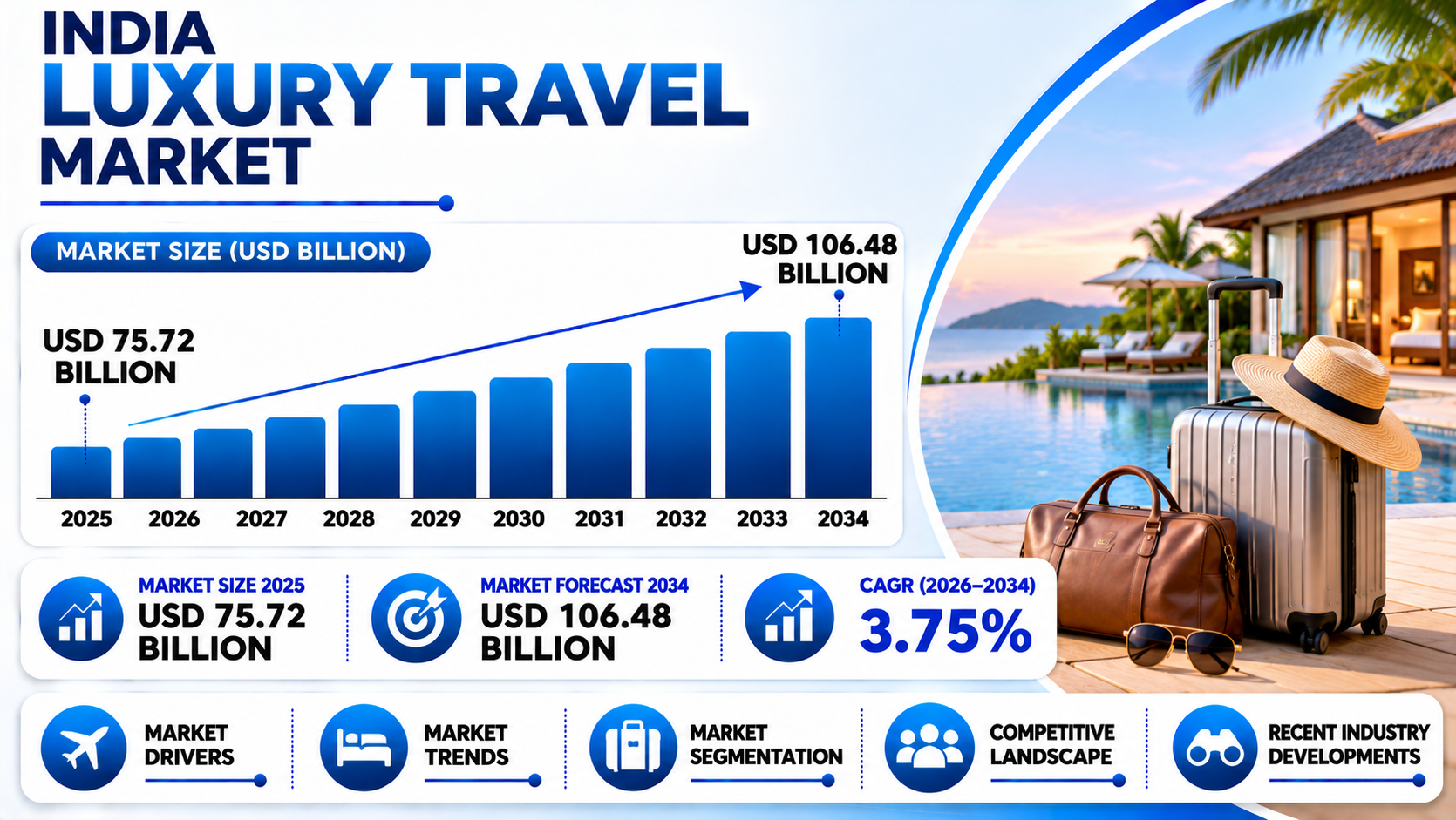
- Market Size (2025): USD 75.72 Billion
- Forecast Market Size (2034): USD 106.48 Billion
- CAGR (2026–2034): 3.75%
- Dominant Age Group: Generation X (31–40) — 32.6% share (2025)
- Dominant Type of Traveller: Absolute Luxury — 38.7% share (2025)
- Leading Region: West and Central India — 34.8% share (2025)
- Key Drivers: Rising affluence, digital personalization, tourism infrastructure, experiential travel demand
Key Market Drivers
- Rising Affluence and HNI Base Expansion:
India’s growing base of high-net-worth individuals, fuelled by wealth creation in technology, finance, and entrepreneurship, expands the addressable market for luxury travel. Operators are responding with HNI-focused products, private villa packages, and bespoke concierge programs. This growing affluent population is also supporting the expansion of the India luxury travel market size.
- Digital Penetration and OTA Personalization:
Online travel agencies with AI-driven personalization make it easier to discover and book luxury experiences. AI-powered concierge tools and virtual destination previews are redefining how luxury trips are planned.
- Government Tourism Infrastructure Initiatives:
Schemes including Swadesh Darshan, PRASAD, and UDAN enhance tourism infrastructure, regional connectivity, and destination readiness across heritage, wellness, and adventure circuits. UDAN opens premium circuits in lesser-explored destinations.
- Experiential Travel Demand Among Millennials and Gen Z:
Younger affluent travellers prioritize unique, culturally immersive, purpose-driven experiences over material possessions, accelerating demand for tailored itineraries, eco-luxury retreats, and philanthropic travel. These evolving preferences are shaping India luxury travel market trends, with growing interest in personalized holidays, sustainable luxury stays, and exclusive experiential tourism.
Evaluate Market Opportunity with the Business Sample Report
Emerging Trends
- Immersive and Hyper-Personalized Luxury Journeys:
Discerning travellers are shifting from standardized luxury packages to deeply personalized experiences. AI-powered concierge tools, bespoke itinerary designers, and private cultural access programs are becoming the benchmark for premium operators.
- Sustainable and Conscious Luxury Travel:
Eco-luxury lodges, conservation travel, and carbon-neutral itineraries are gaining traction among environmentally aware HNIs. In 2025, Miros Hotels & Resorts launched its first luxury property in Central Goa featuring solar energy systems, water recycling, and plant-based supply chain management.
- Luxury Rail Travel Renaissance:
Iconic trains such as the Maharajas’ Express and Palace on Wheels are drawing renewed interest from domestic and international HNIs, supported by dedicated booking platforms and curated multi-city itineraries.
- Wellness and Medical Tourism Integration:
Luxury travel is converging with Ayurveda, yoga retreats, and preventive healthcare. Kerala and Uttarakhand are establishing themselves as wellness tourism hubs, supporting year-round luxury demand.
Market Challenges
Despite strong growth momentum, the India luxury travel market faces several structural headwinds:
- Remote or tier-2 luxury destinations often face inadequate transport links, connectivity gaps, and limited premium amenities, constraining traveller experience and deterring investment
- A limited pool of professionals trained in high-end, personalized guest service restricts consistency and scale-up as operators enter new geographies
- Pronounced seasonality, with peak demand from October to March, creates revenue volatility and underutilized assets in monsoon and summer months
- India competes with established luxury destinations such as France, Italy, the Maldives, and Switzerland for the international HNI traveller’s wallet, requiring sustained marketing investment
Explore the Full Report with Charts, Table of Contents, and List of Figures
Segment Insights
By Type of Tour
- Customized and Private Vacation
- Adventure and Safari
- Cruise and Ship Expedition
- Small Group Journey
- Celebration and Special Event
- Culinary Travel and Shopping
By Age Group
- Generation X (31–40) — 32.6% (peak-earning professionals; highest per-trip luxury spend)
- Baby Boomers (41–60) — 29.7% (heritage, wellness, and pilgrimage-integrated journeys)
- Millennials (21–30) — 24.8% (fastest-growing; digital-native HNIs)
- Silver Hair (60 and Above) — 12.9% (accessibility-focused luxury and wellness-religious circuits)
By Type of Traveller
- Absolute Luxury — 38.7% (ultra-HNI; bespoke itineraries and highest per-trip spend)
- Aspiring Luxury — 34.5% (upper-middle-class; highest growth potential)
- Accessible Luxury — 26.8% (OTA-enabled premium packages and value-focused itineraries)
Regional Insights
- West and Central India — 34.8%; Mumbai’s HNI outbound base, Goa’s coastal resorts, and MICE-driven demand
- North India — 27.6%; heritage palace circuits, Delhi-NCR’s HNI base, and Himalayan wellness retreats
- South India — 24.7%; Ayurvedic and wellness tourism leadership and eco-luxury resorts
- East and Northeast India — 12.9%; an emerging frontier with river cruise potential and adventure luxury circuits
Competitive Landscape
The India luxury travel market is moderately concentrated, with a few full-service operators, established international luxury specialists, and a growing group of niche boutique operators focused on ultra-premium, wellness, and adventure segments. Key players include Abercrombie & Kent Ltd., Cox & Kings, and Travelogy India Pvt. Ltd.
The report offers an in-depth examination of the competitive landscape, including market structure, key player positioning, leading strategies for success, a competitive dashboard, and a company evaluation quadrant.
Recent Developments
- February 2025 — Cox & Kings launched 10 new franchise locations across key Indian cities under Wilson & Hughes ownership, with a plan to establish 300 franchises, preferred agents, and holiday clubs across India and globally within two years
- 2025 — Miros Hotels & Resorts launched its first luxury property in Central Goa with solar energy, water recycling, and plant-based supply chain management
- Planned 2027 — Viking’s planned Brahmaputra river cruise launch signals investor confidence in India’s river cruise potential
Investment Opportunities
- Wellness and Ayurvedic Tourism Infrastructure: Premium retreats in Kerala, Uttarakhand, and Himachal Pradesh offer a high-margin, repeat-visit segment for health-conscious HNI travellers worldwide.
- Luxury River Cruise and Rail Experiences: Rivers such as the Brahmaputra and Ganges offer scope for purpose-built luxury vessels and multi-modal itineraries, while luxury rail continues to attract premium demand.
- AI-Driven Luxury Travel Platforms: Platforms that deliver personalized itineraries and concierge-level service to digital-native affluent travellers can capture high-value premium bookings.
Request Customized Data Tailored to Your Interest
Frequently Asked Questions (FAQ)
- What is the current size of the India luxury travel market?
The India luxury travel market reached USD 75.72 Billion in 2025.
- What is the CAGR for 2026–2034?
The market is projected to grow at a CAGR of 3.75% during 2026–2034, reaching USD 106.48 Billion by 2034.
- Which age group leads?
Generation X (31–40) leads with a 32.6% share in 2025, driven by peak career earnings and a preference for culturally immersive, curated journeys.
- Which type of traveller and region lead?
Absolute Luxury leads with a 38.7% share, and West and Central India leads regionally with a 34.8% share in 2025.
- Who are the top companies?
Leading companies include Abercrombie & Kent Ltd., Cox & Kings, and Travelogy India Pvt. Ltd., among others.
Conclusion
India’s luxury travel market is on a measured but steady growth path through 2034, supported by HNI wealth creation, maturing millennial affluence, and improving tourism infrastructure. Personalization, wellness, sustainability, and new experiences such as river cruises and luxury rail are redefining what premium travel means in India.
Operators and investors that invest in bespoke, technology-enabled, and wellness-led offerings, and that extend into emerging destinations, will capture the largest share of the USD 30.76 Billion in incremental value between 2025 and 2034.
Source: IMARC Group