India Roofing Market Report 2026–2034: Size, Share, Growth, Trends and Analysis
India Roofing Market Outlook
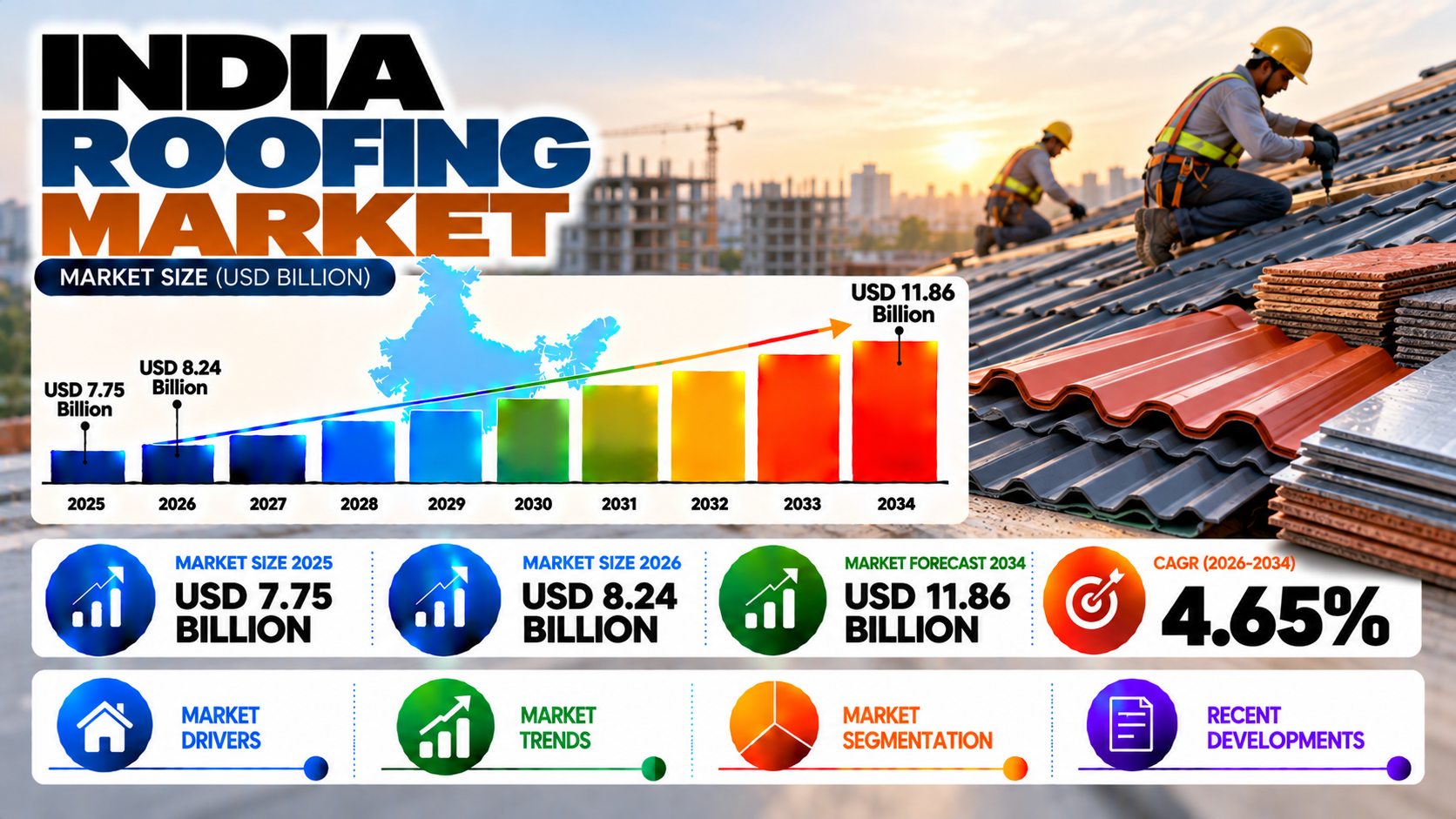
The India roofing market is shaped by rapid urban housing construction, expanding industrial and warehousing development, and a steady shift from traditional roofing toward durable, weather-resistant systems. The India roofing market size grew from USD 7.75 Billion in 2025 to USD 8.24 Billion in 2026, supported by residential construction, government housing missions, and rising commercial activity.
The industry has moved from traditional clay and asbestos-based roofing toward engineered fiber cement, steel, and polymer-coated systems. Stricter building standards, rooftop solar interest, and demand for cool-roof coatings and lightweight composites are pushing manufacturers toward higher-performance products across residential, commercial, and industrial projects.
Market-At-A-Glance
- Market Size (2025): USD 7.75 Billion
- Market Size (2026): USD 8.24 Billion
- Forecast Market Size (2034): USD 11.86 Billion
- CAGR (2026-2034): 4.65%
- Leading Material Type: Bituminous, 35.0% share
- Leading Type: Flat Roof, 52.5% share
- Leading Application: Residential, 54.5% share
- Leading Region: West and Central India, 30.5% share
Why the India Roofing Market Is Growing?
- Rapid Urban Housing and Infrastructure Growth:
India’s expanding urban population and steady residential construction are creating continuous demand for flat and slope roof systems in both new builds and replacements.
- Government Affordable Housing Schemes:
Central and state housing missions are speeding up pucca house construction, which lifts demand for cost-effective, durable roofing across income segments.
- Rising Industrial and Warehousing Construction:
Growing manufacturing capacity, cold storage networks, and logistics infrastructure drive demand for large-format steel and fiber cement roofing. According to Invest India, warehousing space demand is projected to reach 159 Million square feet by 2047, reinforcing long-term industrial roofing demand.
- Growing Adoption of Durable, Weather-Resistant Materials:
Rising awareness of lifecycle costs is encouraging builders to move from traditional roofing to engineered fiber cement, steel, and coated systems.
- Commercial Construction Expansion:
Retail, office, and hospitality projects across metro and tier-2 cities support the commercial segment, which holds 25.8% of the market.
Evaluate Market Opportunity with the Business Sample Report
What Are the Key Trends Shaping the India Roofing Market?
- Shift Toward Cool-Roof and Reflective Coatings:
India roofing market trends show manufacturers adding heat-reflective and cool-roof coatings to lower indoor temperatures and energy use, especially in warmer regions across residential and commercial buildings.
- Rise of Solar-Integrated Roofing Systems:
Building owners want to generate renewable energy while making the most of rooftop space, and manufacturers are developing solar-ready panels and mounting-compatible roofing. Visaka Industries, for example, is diversifying into solar-integrated products.
- Growing Preference for Lightweight Composite Materials:
Lightweight fiber cement and polymer-composite products are gaining ground, including in the India composite slate roofing market, because they allow faster installation, lower structural load, and better durability.
- Stricter Bureau of Indian Standards Compliance:
Tighter BIS quality norms for roofing sheets and coatings are moving manufacturers toward higher-grade materials and gradually reshaping competition between organized and unorganized producers.
Government Support Driving Market Expansion
Affordable Housing Missions:
- Central and state housing missions are accelerating pucca house construction nationwide
- Programs such as Pradhan Mantri Awas Yojana support housing across income segments
- Demand rises for cost-effective, durable roofing in both new construction and re-roofing
Bureau of Indian Standards Quality Norms:
- Tightening norms for roofing sheets and coatings push producers toward higher-grade materials
- Compliance raises the bar for unorganized manufacturers
- Inconsistent enforcement across states remains a challenge for nationwide standardization
Rooftop Solar and Clean Energy Programs:
- PM Surya Ghar: Muft Bijli Yojana encourages rooftop solar adoption across households
- Growing rooftop solar use creates demand for solar-ready roofing and mounting-compatible systems
- Supports distributed solar power and energy-efficient building goals
Urban, Industrial, and Logistics Infrastructure Push:
- Urban development programs such as the Smart Cities Mission and AMRUT support commercial and civic construction
- The National Logistics Policy and PM Gati Shakti support logistics and warehousing development
- Together they sustain demand for large-format industrial roofing
Explore the Full Report with Charts, Table of Contents, and List of Figures
Segment Insights
Material Type Insights:
- Bituminous
- Tiles
- Metal
- Plastic
- Others
Bituminous leads with a market share of 35.0% of the total India roofing market in 2025.
Type Insights:
- Flat Roof
- Slope Roof
Flat roof leads with a market share of 52.5% in 2025, favored in multi-storey residential and commercial buildings for usable terrace space and easy integration of water tanks and solar installations. Slope roof holds 47.5%, valued for drainage in hilly and high-rainfall areas.
Application Insights:
- Residential
- Commercial
- Industrial
Residential leads with a market share of 54.5% in 2025, followed by commercial at 25.8%. Industrial is expected to expand fastest among applications, driven by warehousing, cold storage, and manufacturing construction.
Regional Insights:
- West and Central India
- North India
- South India
- East India
West and Central India dominates with a market share of 30.5% in 2025, followed by North India at 26.4%, South India at 24.7%, and East India at 18.4%. South India is the fastest growing region, supported by rapid urbanization and IT-led commercial and industrial construction.
Competitive Landscape
The market is moderately fragmented. Organized manufacturers lead fiber cement and steel roofing sales, while many regional and unorganized players compete on price. Leading names covered in the India roofing market report from IMARC Group include BirlaNu Limited (Charminar), Everest Industries Limited, Tata Steel Limited (DURASHINE and COLORBOND), Visaka Industries Limited (ATUM), JSW Steel Limited (JSW Colouron+), and Ramco Industries Limited.
Brand legacy, manufacturing scale, distribution reach, and product durability are the main advantages. Capital-intensive manufacturing, dealer networks, and BIS compliance act as barriers to entry, and consolidation is gradually rising as larger organized players expand capacity while smaller producers face compliance and raw material cost pressure.
Key Opportunities for Businesses and Investors
High-Growth Areas:
- Industrial roofing for warehousing, cold storage, and manufacturing facilities
- Flat roof systems for commercial and multi-storey construction
- Solar-integrated and solar-ready roofing panels
- Cool-roof coatings and lightweight composite products
- Green and recyclable roofing aligned with green building certification
- South India, the fastest growing region
Strategic Opportunities:
- Vertical integration of proprietary manufacturing technology with direct distribution networks to capture more value
- Installer training and certification partnerships to address the shortage of skilled roofing contractors
- Capacity expansion and dealer network growth to meet tightening BIS standards and rising organized-sector demand
Request Customized Data Tailored to Your Interest
Frequently Asked Questions (FAQ)
- How big is the India roofing market?
The India roofing market was valued at USD 7.75 Billion in 2025 and is estimated at USD 8.24 Billion in 2026.
- What is the projected growth rate?
The market is expected to grow at a CAGR of 4.65% during 2026-2034, reaching USD 11.86 Billion by 2034.
- Which roofing type dominates the market?
Flat roof dominates with a 52.5% share in 2025, driven by adoption in multi-storey residential and commercial buildings.
- What are the major challenges?
Key challenges include raw material price volatility, competition from the unorganized sector, a shortage of skilled installation labor, extreme weather, and inconsistent building code enforcement.
- How do government schemes affect the market?
Affordable housing missions accelerate pucca house construction, and BIS norms and rooftop solar programs are reshaping product demand toward durable, compliant, and energy-efficient roofing.
Conclusion
India’s roofing market is set for steady expansion through 2034, underpinned by housing programs, industrial and warehousing construction, and a shift toward engineered roofing systems. Cool-roof coatings, solar integration, and lightweight composites are redefining what builders expect from a roof.
Accelerating industrial construction, wider adoption of solar-integrated and cool-roof technologies, and tighter BIS enforcement will shape the market. Organizations that invest in manufacturing capacity, distribution reach, and compliance, particularly in industrial and South India markets, will be best placed to capture long-term demand.
Source: IMARC Group