Indian Honey Market Size, Share, Production Landscape and Demand Forecast 2026–2034
Indian Honey Market Outlook
The market is expanding on rising health consciousness, a clear preference for natural sweeteners over refined sugar, and growing recognition of honey’s nutritional and medicinal value. Honey demand now spans household consumption, Ayurvedic wellness, food and beverage manufacturing, pharmaceuticals, and cosmetics.
The honey industry in India is also being reshaped by government investment in scientific beekeeping, e-commerce reach for regional producers, and premium innovation in organic, wild forest, and single-origin products. With India now a leading global exporter, the sector is moving from a traditional, fragmented activity toward a more organized, quality-assured value chain.
Market Snapshot
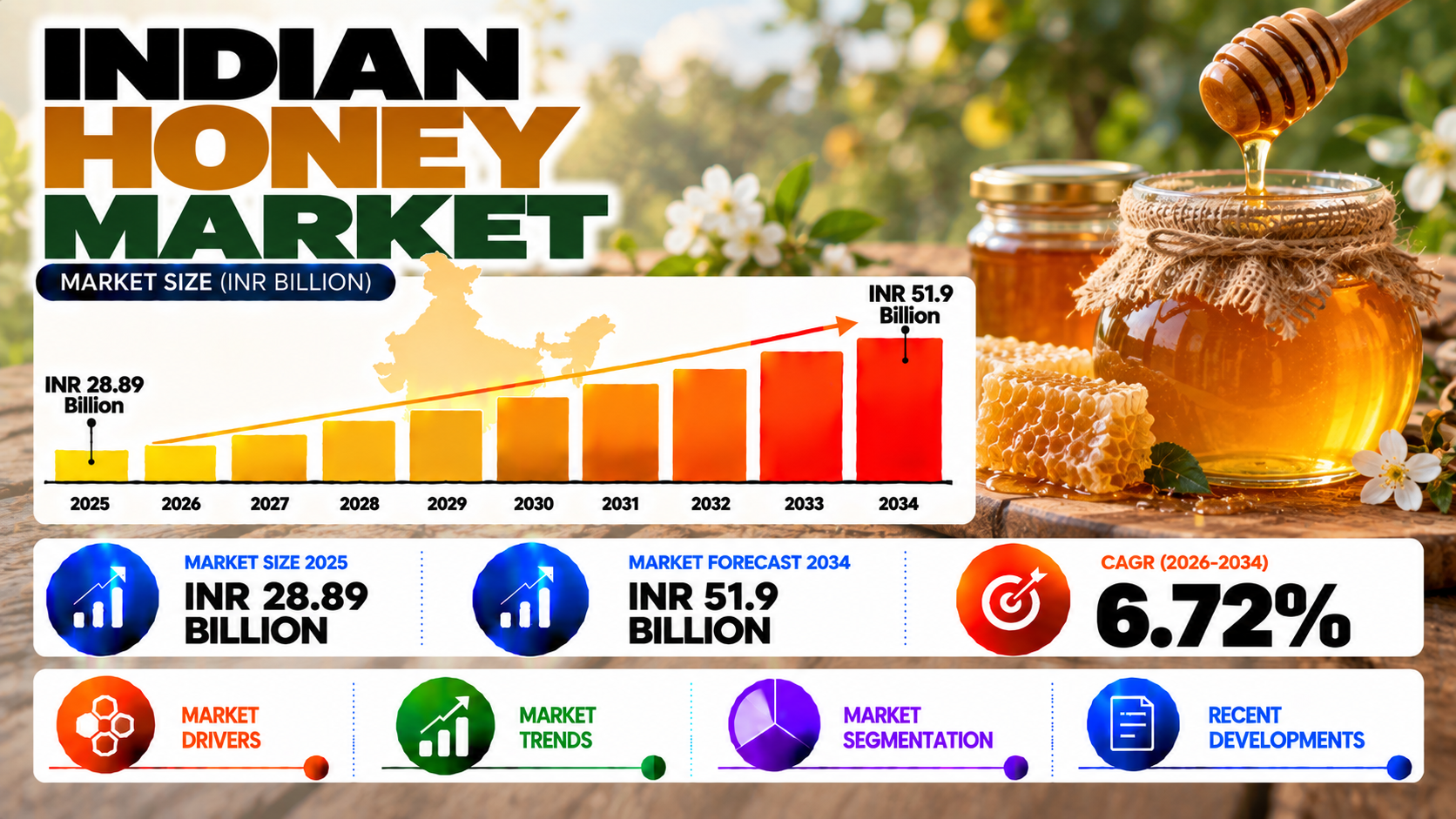
- Market Size (2025): INR 28.89 Billion
- Forecast Market Size (2034): INR 51.9 Billion
- CAGR (2026-2034): 6.72%
- Leading Distribution Channel: Business to Consumer (57% share in 2025)
- Leading Flavor: Multiflora Honey (34% share in 2025)
- Leading State: Rajasthan (24% share in 2025)
- Key Drivers: Health awareness, exports, industrial applications, Ayurveda
Key Market Drivers
- Export Market Expansion:
IIndia became the world’s second-largest honey exporter by 2024, up from ninth position in 2020. The country exported 1.07 lakh metric tonnes valued at USD 177.55 million in FY 2023–24, supported by competitive pricing and improving quality standards. Export growth, alongside domestic consumption, is strengthening honey demand in India.
- Cross-Industry Application Growth:
Food processors use honey as a natural sweetener and clean-label ingredient, pharmaceutical firms use it in cough syrups and ointments, and cosmetics brands use it for moisturizing and antioxidant benefits. In 2025, QNET launched its Nutriplus Monofloral Honey collection in India, with Ramtil and Tulsi varieties.
- Ayurvedic Healthcare Resurgence:
Honey is valued as a carrier for herbal preparations and as a standalone remedy for respiratory, digestive, and immunity needs. In 2025, GNC India introduced Ayurvedic Honeysticks enriched with Shilajit, Saffron, and Ashwagandha.
- Rising Health Concerns:
India has approximately 77 million adults with type 2 diabetes and 25 million prediabetics, which is intensifying interest in healthier sugar alternatives.
Evaluate Market Opportunity with the Business Sample Report
<p dir="ltr"Emerging Trends
- Digital Commerce and Quick Commerce:
India’s online shopper base exceeded 270 million in 2024. BigBasket moved entirely to quick commerce in October 2024, and regional producers now reach nationwide buyers without heavy distribution networks.
- Premium and Specialty Honey:
In October 2024, Farmery introduced Organic Honey and Wild Forest Honey in eco-friendly glass bottles, and in January 2024 Apis India released organic honey from Kashmir’s certified organic lands. These products command prices of INR 600-650 for 500-600 gram packs.
- Scientific Beekeeping Ecosystem:
The India Honey Alliance held its fourth Annual General Meeting in New Delhi in September 2025, covering technical training, a proposed national honey database, and consumer education to build trust at home and abroad.
- Functional and Wellness Launches:
Brands are launching honey in new formats for energy, fitness, and immunity, aimed at health-focused urban consumers.
Market Challenges
Despite strong momentum, the Indian honey market faces several headwinds:
- Sophisticated adulteration, including sugar syrup blending designed to pass standard tests, undermines consumer trust and requires advanced detection such as NMR spectroscopy that is not universally available
- Seasonal and climate-linked production swings complicate supply planning and strain small beekeepers’ cash flow
- A fragmented supply chain with limited processing and cold storage reduces quality, price realization, and access to organized retail and export markets
- Weak value-chain integration gives individual beekeepers limited bargaining power with processors and traders
Government Initiatives Supporting the Market
- National Beekeeping and Honey Mission: Established 6 world-class testing laboratories and 47 mini testing labs by March 2025, strengthening quality assurance across the supply chain
- FSSAI Honey Standards and Testing Requirements: Set purity and labelling norms that help counter adulteration
- National Bee Board and Beekeeper Training Programmes: Build skills and market linkages for small producers
- APEDA Export Promotion: Supports quality certification and international market access for Indian honey
Explore the Full Report with Charts, Table of Contents, and List of Figures
Segment Insights
By Distribution Channel
- Business to Consumer (dominant at 57%; general trade, modern trade, and e-commerce)
- Business to Business (food and beverage, pharmaceuticals, and cosmetics)
By Flavor
- Multiflora Honey (leading at 34%; broad appeal, versatile use, easy year-round production)
- Eucalyptus Honey
- Ajwain Honey
- Sidr Honey
- Others
Regional Insights
- Rajasthan (24% share): diverse flora such as Khejri and Acacia, desert honey, and established beekeeping infrastructure
- Maharashtra
- Tamil Nadu
- Karnataka
- Punjab
Competitive Landscape
The market combines multinational FMCG companies, Ayurvedic brands, and emerging regional and D2C specialists competing across organized and unorganized segments. Organized brands emphasize certification, modern processing, and transparent sourcing, while smaller producers rely on traditional channels and lower overhead.
Key players include Apis India Ltd, Baidyanath, Beez International, Dabur India Limited, Hitkary, Nature’s Nectar (Kejriwal Bee Care India Pvt Ltd), Organic India Pvt. Ltd., Patanjali Ayurved Limited, Saffola, and Zandu Care.
Recent Developments
- September 2025: The India Honey Alliance held its fourth Annual General Meeting in New Delhi, bringing together beekeepers, FPOs, exporters, scientists, and policymakers
- August 2025: Nutrica, part of BN Holdings Limited, launched Nutrica Bee Honey in three variants for energy, fitness, and immune support in Delhi NCR and Mumbai
- June 2025: Students at Mother Terasa College of Agriculture launched MTCA Honey Cafe to promote value-added honey products and nutrition awareness
Investment Opportunities
- Premium and Single-Origin Honey: Organic, wild forest, and desert varieties with traceability support higher margins.
- Testing, Processing, and Traceability: Investment in purity testing and cold chain tackles adulteration and builds brand trust.
- Industrial and Export Supply: Food, pharma, and cosmetics demand, plus India’s export standing, offer scale beyond retail.
Request Customized Data Tailored to Your Interest
Frequently Asked Questions (FAQ)
- What is the honey market size in India?
The Indian honey market was valued at INR 28.89 Billion in 2025.
- What is the projected CAGR?
It is expected to grow at a CAGR of 6.72% during 2026-2034, reaching INR 51.9 Billion by 2034.
- Which channel leads?
Business to consumer leads with a 57% share in 2025.
- Which flavor and state lead?
Multiflora honey leads with 34%, and Rajasthan leads states with 24%.
- What are the key challenges?
Adulteration, seasonal production swings, and a fragmented supply chain with limited processing infrastructure.
Conclusion
India’s honey market is entering a durable growth phase, supported by health-led demand, export strength, industrial uses, and strong government backing for beekeeping infrastructure. IMARC Group expects the market to reach INR 51.9 Billion by 2034.
Players that invest in purity testing, traceability, premium products, and digital distribution will earn the trust needed to lead this evolving category.
Source: IMARC Group