Malaysia Smart City Development Market Outlook 2026–2034: Industry Insights and Future Growth Prospects
Malaysia Smart City Development Market Outlook
The Malaysia smart city development market value is growing as the government accelerates digital transformation and urban modernization. The Malaysia Smart City Framework and the Malaysia Digital Economy Blueprint guide the integration of advanced technologies into urban planning, transportation, energy management and public services.
Growing urbanization is driving demand for intelligent infrastructure that improves service delivery, reduces congestion and supports environmental sustainability. In 2024, Malaysia’s urban population stood at 79.2% of the total population, according to the World Bank, creating a strong base for connected city solutions.
Market-At-A-Glance
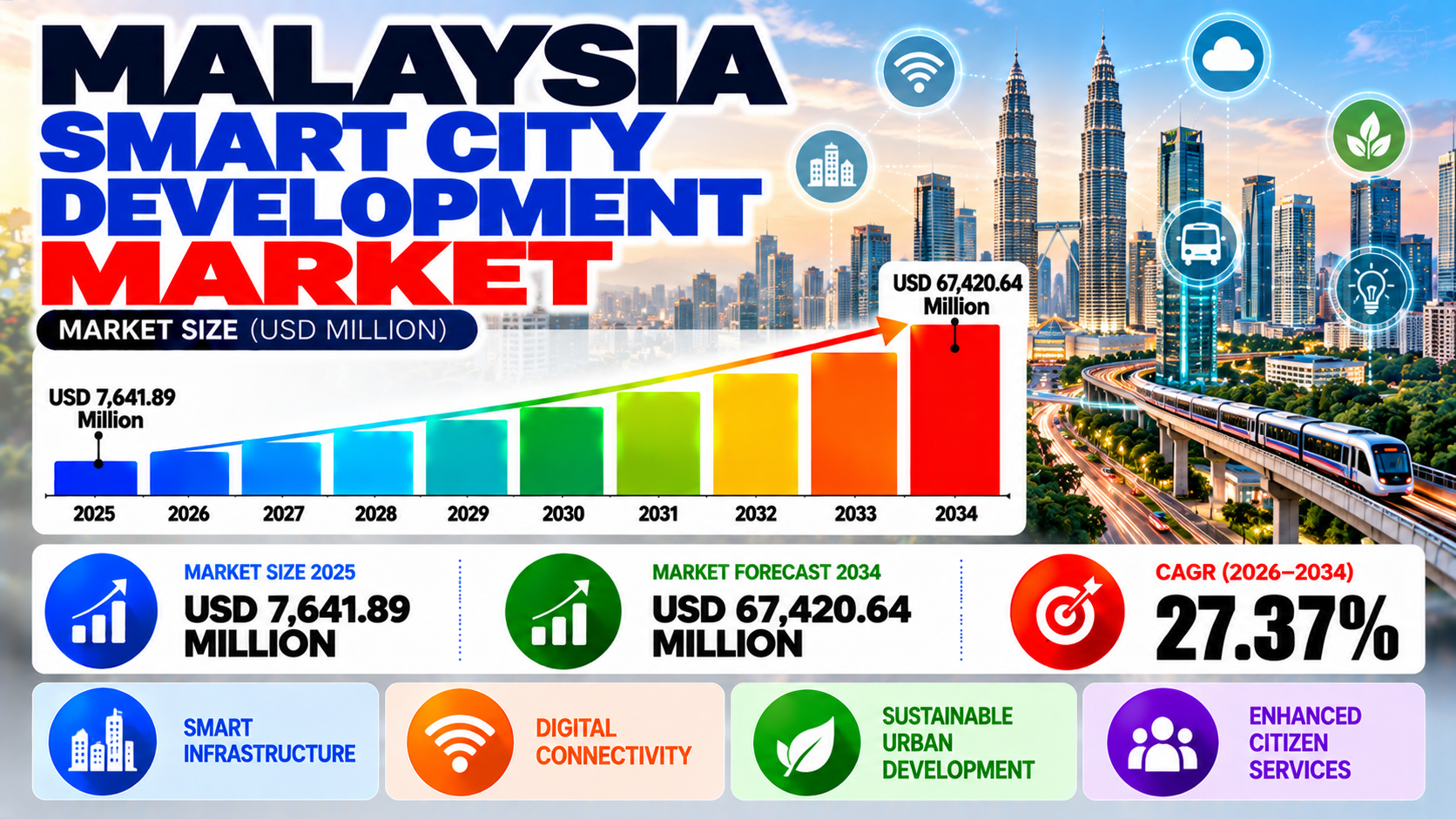
- Market Size (2025): USD 7,641.89 Million
- Forecast Market Size (2034): USD 67,420.64 Million
- CAGR (2026-2034): 27.37%
- Leading Application Area: Smart Mobility and Transportation, 26.8% share
- Leading Technology: IoT Platforms and Sensors, 34.6% share
- Leading State: Selangor, 38.2% share
Why the Malaysia Smart City Development Market Is Growing?
- Strong Government Policy Frameworks and Strategic Investment:
Policy alignment with national development goals supports the rollout of IoT, AI and smart mobility. The government allocated RM15.1 Million to the Housing and Local Government Ministry in Budget 2025 for smart city development, and incentives for public-private partnerships are helping projects move forward.
- Rapid 5G Deployment and Digital Infrastructure Expansion:
Nationwide 5G provides the low-latency backbone for autonomous transport, traffic management, remote healthcare and environmental monitoring. As of April 2024, Malaysia had deployed 7,065 5G sites.
- Focus on Sustainability and Energy Efficiency:
Municipalities are deploying smart grids, intelligent lighting and energy management systems, while IoT sensors track water use, waste and air quality. Incentives for green buildings and energy-efficient technology encourage private participation.
- Data Center and Cloud Investment:
Malaysia attracted over RM86 Billion in data center investments in 2024, establishing it as Southeast Asia’s leading data center hub and giving smart city applications a strong cloud and AI foundation.
Evaluate Market Opportunity with the Business Sample Report
What Are the Key Trends Shaping the Malaysia Smart City Development Market?
- Digital Twin Technology for Urban Planning:
In October 2025, the Penang Island City Council introduced its Virtual Island of Penang platform, an RM30 million digital twin that uses real-time data, satellite imagery and AI to map structures, roads and trees for better urban management.
- AI-Driven Urban Governance Platforms:
AI is being embedded into municipal systems for traffic management, waste collection and public safety. Smart City Expo Kuala Lumpur 2025, held in September 2025, drew over 10,700 participants and 146 speakers focused on AI-driven governance and citizen-focused innovation.
- Hyperscale Data Centers Supporting Smart Infrastructure:
Hyperscale facilities support the cloud computing, AI workloads and real-time data processing behind smart mobility, energy management and digital public services.
Government Support Driving Market Expansion
Malaysia Smart City Framework and Digital Economy Blueprint:
- Provide the policy direction for digital transformation of urban planning, transport, energy and public services
- Create regulatory support and funding incentives for mobility, public safety and utilities solutions
Infrastructure and Transport Funding:
- The government allocated RM95 Billion in its 2024 budget for infrastructure development, a 12% increase from 2023, with substantial portions directed to smart transportation systems
- The Malaysian Intelligent Transport System Blueprint lays the groundwork for IoT-enabled traffic monitoring, real-time analytics and connected vehicle technologies
Public-Private Partnerships and Flagship Projects:
- In June 2025, the Prime Minister launched the Kota MADANI smart city project in Putrajaya’s Precinct 19, an RM4 Billion public-private partnership with 10,000 residential units for over 30,000 residents
- The project integrates AI, smart digital infrastructure, green mobility systems and automated waste disposal as a national model
Explore the Full Report with Charts, Table of Contents, and List of Figures
Segment Insights
Application Area Insights:
- Smart Governance
- Smart Mobility and Transportation
- Smart Energy and Utilities
- Smart Buildings and Infrastructure
- Smart Healthcare
- Smart Education
- Smart Environment and Sustainability
- Smart Security and Public Safety
Smart mobility and transportation dominate with a market share of 26.8% of the total Malaysia smart city development market in 2025.
Technology Insights:
- Internet of Things (IoT) Platforms and Sensors
- Artificial Intelligence (AI) and Data Analytics
- Cloud Computing
- 5G and Communication Networks
- Blockchain and Cybersecurity Solutions
- Geographic Information Systems (GIS)
- Digital Twins
IoT platforms and sensors lead with a market share of 34.6% of the total Malaysia smart city development market in 2025.
States Insights:
- Selangor
- W.P. Kuala Lumpur
- Johor
- Sarawak
- Others
Selangor leads with a market share of 38.2% of the total Malaysia smart city development market in 2025.
Competitive Landscape
The Malaysia smart city development market is a dynamic environment where global technology providers, regional system integrators and local solution developers deliver urban digitalization together. Companies are expanding IoT platforms, strengthening cloud infrastructure and building AI-powered analytics tailored to Malaysian municipalities.
Public-private partnerships are accelerating pilot projects and scalable solutions. Multinational hyperscalers are establishing cloud regions and data center campuses, while domestic firms use local expertise and regulatory familiarity in specialized areas such as smart governance, environmental monitoring and public safety.
Key Opportunities for Businesses and Investors
High-Growth Areas:
- Smart mobility: intelligent traffic signals, integrated fare payment and mobility-as-a-service platforms
- IoT sensor networks for environmental monitoring, waste management and energy optimization
- AI-enabled urban governance and predictive analytics for service planning
- Digital twin platforms for urban planning and resource management
Strategic Opportunities:
- Public-private partnerships with local authorities for pilot-to-scale smart city projects
- Smart city solutions for Selangor, W.P. Kuala Lumpur, Johor and Sarawak, with Selangor leading today
- Cybersecurity and interoperability solutions to address risks in interconnected urban systems
Discuss Your Requirements With an Analyst and Get Your Customized Market Report
Frequently Asked Questions (FAQ)
- How big is the Malaysia smart city development market?
The Malaysia smart city development market size was valued at USD 7,641.89 Million in 2025, and this Malaysia smart city development market value is projected to reach USD 67,420.64 Million by 2034.
- What is the projected growth rate?
The market is expected to grow at a CAGR of 27.37% during 2026-2034.
- Which application area holds the largest share?
Smart mobility and transportation, with 26.8%, driven by intelligent transport investment, real-time traffic analytics and public transit modernization.
- What are the major challenges?
Cybersecurity vulnerabilities, the urban-rural digital divide, high implementation costs, skilled workforce shortages and interoperability issues with legacy systems.
- Where can I find detailed segment data?
The Malaysia smart city development market report from IMARC Group covers application area, technology and state-level analysis.
Conclusion
Malaysia’s smart city development market is positioned for accelerated growth through 2034, backed by sustained government commitment, 5G rollout, data center investment and rising demand for intelligent urban management.
Organizations that partner with public agencies, invest in IoT, AI and cloud capability, and address cybersecurity and workforce gaps will capture the most value as Malaysia moves toward becoming a regional smart city leader.
Source: IMARC Group