Choosing Veterinary Surgical Instruments for Different Procedures
Choosing Veterinary Surgical Instruments for Different Procedures
There is no single veterinary surgical instrument set that is perfect for every procedure.
A small-animal soft-tissue surgery, orthopedic procedure, dental extraction and ophthalmic operation can require very different instruments. For veterinary clinics, the challenge is deciding which instruments deserve a place in the everyday inventory and which should remain procedure-specific.
How do you choose veterinary surgical instruments?
Start with the procedures your clinic performs most frequently.
A general-practice hospital may need a dependable core of general surgery instruments, while a referral center may need specialized orthopedic, ophthalmic or dental equipment.
HK Medical Instruments organizes its catalog across areas including general surgery, orthopedics, dental instruments, eye instruments, forceps, small-animal and large-animal categories.
This type of organization reflects an important point: instrument selection should follow clinical use.
General soft-tissue surgery
General surgery is where versatility matters most.
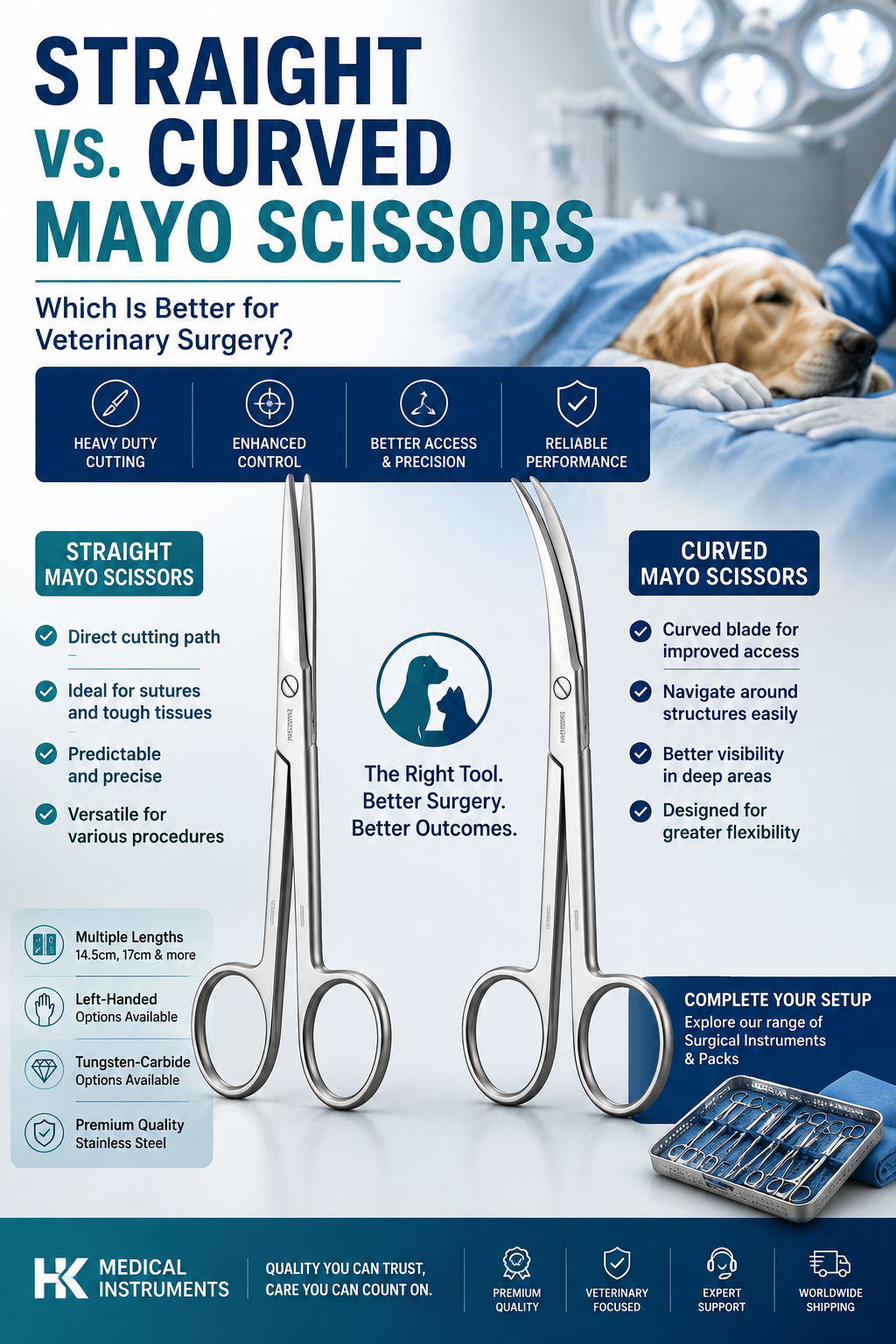
A basic tray may include a scalpel handle, Mayo and Metzenbaum scissors, artery forceps, tissue forceps, towel clamps, a needle holder and retractors.
The 20-piece General Surgery Pack brings many of these instruments together, including a Mayo scissor, curved Metzenbaum scissor, several artery forceps and an Olsen-Hegar needle holder.
For a general-practice clinic, this type of standardized setup can provide a practical foundation.
Orthopedic procedures
Orthopedic surgery has different demands.
Exposure, clamping and tissue handling may require instruments that are not routinely needed for soft-tissue surgery.
HK Medical Instruments currently offers an eight-piece Orthopedic Knee Pack designed around small-animal stifle procedures and containing compact clamps and retractors.
A clinic that performs orthopedic procedures regularly may therefore benefit from maintaining a separate orthopedic tray rather than mixing these instruments into its general surgery inventory.
Ophthalmic procedures
Ophthalmic surgery calls for particularly fine handling.
Small instruments such as fine needle holders and specialized forceps can be more appropriate than the heavier instruments used for general surgery.
HK Medical Instruments' current range includes Castroviejo needle holders in straight and curved configurations, including tungsten-carbide versions.
The key consideration is control. Instruments should match the delicate nature of the surgical field.
Dental procedures
Dental surgery has its own instrument language.
Probes, scalers, curettes, root elevators and extraction forceps all have different purposes. A general surgical tray should not be treated as a substitute for a dental kit.
For clinics that routinely perform dental work, a dedicated dental setup can make instrument selection quicker and tray preparation more predictable.
Large-animal work
Large animals often require longer instruments and different working dimensions than small-animal procedures.
Length can affect reach, leverage and access, so clinics serving both small and large animals should consider whether one-size-fits-all purchasing actually makes sense.
HK Medical Instruments' catalog includes long needle holders and other instruments intended for different veterinary applications.
The appropriate size should ultimately be determined by the procedure, patient and surgeon's technique.
Do left-handed surgeons need different instruments?
For some instruments, handedness can make a real difference in handling.
A left-handed surgeon using a conventional right-handed pattern may need to adjust grip or wrist position. HK Medical Instruments offers left-handed Metzenbaum scissors and needle holders specifically configured for left-handed use.
Clinics do not necessarily need to replace every instrument, but keeping essential left-handed options available can make a surgical inventory more practical for mixed teams.
Should clinics choose stainless steel or tungsten carbide?
Both have a place.
Standard stainless-steel instruments can be practical for general clinic inventory, while tungsten-carbide cutting edges may be attractive for instruments subjected to frequent cutting.
HK Medical Instruments offers both standard and TC Gold versions across several scissor patterns.
Rather than upgrading every instrument automatically, clinics can consider which instruments receive the heaviest use.
How can clinics keep their instrument inventory under control?
A simple inventory system helps.
Group instruments by procedure, keep standardized trays where possible and record instruments that are repeatedly missing or damaged. This provides useful information when it is time to purchase replacements.
It is also worth keeping individual instruments available for unusual procedures rather than expecting every requirement to fit inside a standard pack.
Frequently Asked Questions
What surgical instruments should every veterinary clinic have?
Most general practices need a core selection of scissors, forceps, needle holders, scalpel handles, towel clamps and retractors. The exact inventory depends on the clinic's caseload.
Should veterinary clinics use procedure-specific instrument packs?
They can be particularly useful for clinics that perform recurring procedures such as spays, dental procedures, ear surgery or orthopedic procedures.
Are longer instruments better for veterinary surgery?
Not necessarily. Longer instruments provide additional reach, but shorter instruments may offer better control in smaller surgical fields.
How often should veterinary instruments be replaced?
There is no universal replacement interval. Instruments should be inspected routinely and removed from service when damaged, excessively worn or no longer performing properly.
What is the best way to organize veterinary surgical instruments?
Organize them around actual clinical workflows. Separate general surgery, dental, orthopedic, ophthalmic and procedure-specific instruments so staff can locate the appropriate equipment quickly.
Veterinary clinics looking to expand their inventory can review the HK Medical Instruments veterinary surgical instrument range and its instrument pack collection for procedure-specific options.