Wood Pellets Market Size, Share and Trends Forecast 2026-2034
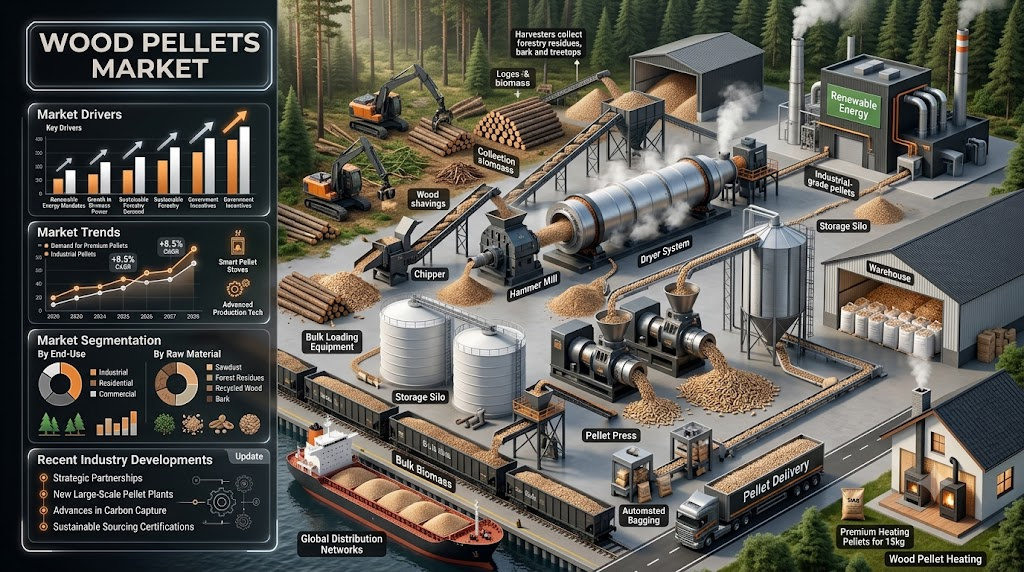
IMARC Group, a leading global market research and management consulting firm, has published its latest market intelligence report on the wood pellets market. The global wood pellet market size reached USD 14.78 Billion in 2025 and is projected to reach USD 23.32 Billion by 2034, exhibiting a CAGR of 5.20% during 2026-2034. driven by supportive renewable energy mandates in Europe, rising residential pellet heating adoption, expanding industrial co-firing demand across Asia, and growing interest in Bioenergy with Carbon Capture and Storage (BECCS) as a negative-emissions pathway.
The market is on a sustained growth path underpinned by structural decarbonization policy, established European heating infrastructure, and an expanding Asia-Pacific import base. Forest Wood and Waste remains the dominant feedstock given its cost-competitiveness and mature supply chains across North America and Scandinavia, while Agriculture Residue is gaining ground fast in Asian markets where forestry residues are limited. Residential Heating continues to anchor demand in Europe, even as industrial co-firing and combined heat and power (CHP) applications post the fastest incremental growth, supported by government renewable portfolio mandates in South Korea and Japan.
Wood Pellets Market at a Glance:
- Market Size 2025: USD 14.78 Billion
- Forecast Size 2034: USD 23.32 Billion
- Growth Rate 2026-2034: CAGR of 5.20%
- Leading Feedstock Type: Forest Wood and Waste, 33.6% share in 2025
- Leading Application: Residential Heating, 58.4% share in 2025
- Dominant Region: Europe, with a 47.9% revenue share in 2025
How AI is Reshaping the Future of the Wood Pellets Market
- AI-Driven Process Optimization in Pellet Manufacturing: Advanced pelletizing press technology combined with AI-driven process optimization is reducing specific energy consumption in pellet production by 15-20%, allowing producers to improve margins and compete more effectively against fossil fuel alternatives as feedstock costs fluctuate.
- Digital Chain-of-Custody and Traceability Systems: Digital mass-balance and chain-of-custody platforms are enabling certification bodies and regulators to trace pellet flows from forest origin through to end-use combustion, satisfying EU RED III sustainability reporting requirements and supporting carbon credit verification for BECCS applications.
- AI-Assisted Dryer and Combustion Monitoring: Heat-recovery dryer systems integrated with automated sensor monitoring are cutting primary energy inputs by 30-40% in the drying stage, the most energy-intensive step in pellet production, materially improving the carbon efficiency of manufacturing facilities.
Grab a sample PDF of this report: https://www.imarcgroup.com/wood-pellet-market/requestsample
Wood Pellets Market Trends and Drivers:
Rising residential heating adoption across Europe is a foundational driver, with more than 12 million residential pellet heating installations already in place and Germany, Italy, Austria, and France leading uptake as households switch away from higher-cost fossil fuel heating systems under government subsidy programs. Pellet stoves and boilers continue to gain share as a carbon-neutral substitute for gas and oil, reinforced by the EU's broader push to lower household energy costs.
Sustainability certification is emerging as both a growth driver and a structural differentiator. ENplus A1 certification is becoming a de facto requirement for residential and commercial pellet sales across Europe and increasingly Asia, and producers investing in certified quality management gain access to premium pricing tiers. At the same time, the EU's Renewable Energy Directive (RED III) mandates a 42.5% renewable energy share by 2030, a target that is directly lifting biomass co-firing adoption among European utilities and industrial heat consumers.
Government-backed industrial co-firing mandates are reshaping where new pellet demand originates, a dynamic that now spans Europe, South Korea, Japan, and India, detailed further below. South Korea's Renewable Portfolio Standard alone is driving import demand estimated at 5-6 million metric tons of wood pellets annually, underscoring how policy design in individual countries can move global trade flows.
Global Regulatory, Trade, and Sustainability Landscape Shaping Demand:
- EU RED III and Carbon Pricing: The EU's revised Renewable Energy Directive sets a binding 42.5% renewables target for 2030, with carbon pricing under the EU ETS reinforcing biomass co-firing economics and cementing Europe's position as the most policy-supportive wood pellet market globally.
- South Korea's REC Weighting Reform: South Korea's Ministry of Trade, Industry and Energy is phasing down Renewable Energy Certificate weightings for imported wood pellets, reducing state-owned plant weightings from 1.5 in 2024 to 0.5 by 2027 and phasing out co-fired biomass RECs entirely over the next decade, a shift expected to gradually reshape Asian import volumes.
- Sustainability Certification Requirements: ENplus and the Sustainable Biomass Program (SBP) certification schemes are adding compliance costs for producers, while EU debates over forest carbon debt and indirect land-use change continue to create policy uncertainty around what qualifies as sustainable biomass.
- Forest Carbon Debt and BECCS Accounting Scrutiny: Regulatory scrutiny of "forest carbon debt" payback periods is intensifying under RED III and UK audits, directly affecting the bankability of Bioenergy with Carbon Capture and Storage (BECCS) projects such as Drax's plan to capture 8 million tonnes of CO2 annually by 2030.
Key Government Schemes and Policy Programs Supporting the Industry:
- India, National Unified Scheme for Compressed Biogas (GOBARdhan): India's Union Cabinet approved the GOBARdhan scheme in August 2026 with a Rs 23,731 Crore outlay running through FY 2035-36, offering capital assistance of up to Rs 2 Crore per tonne-per-day of installed capacity and targeting a nearly tenfold increase in domestic compressed biogas and biomass utilization, alongside a separate biomass co-firing mandate requiring coal plants within 300 km of Delhi to reach 7% biomass co-firing in FY 2025-26.
- United States, USDA Rural Energy for America Program (REAP): USDA has made over USD 1.055 Billion available under REAP for Fiscal Years 2025-2027, offering grants of up to USD 1 Million and loan guarantees of up to 75% of project costs for biomass systems including wood pellet boilers, directly supporting rural pellet heating and small-scale biomass adoption.
- European Union, REPowerEU and RED III: REPowerEU channels an additional EUR 210 Billion in investment through 2027 on top of Fit for 55 requirements, while RED III's binding 42.5% renewables target continues to anchor long-term European utility and residential demand for certified biomass fuel.
- South Korea, Renewable Portfolio Standard (RPS): South Korea's RPS, targeting 25% renewable electricity by 2030, has historically driven wood pellet imports of 5-6 million metric tons annually, even as the government's December 2024 REC reform begins phasing down support specifically for imported (non-domestic) biomass fuel.
Wood Pellets Industry Segmentation:
The report has segmented the market into the following categories:
Breakup By Feedstock Type:
- Forest Wood and Waste
- Agriculture Residue
- Others
Forest Wood and Waste commands a 33.6% share in 2025, reflecting the cost-competitiveness of sawmill residues, wood chips, and forestry leftovers as pellet inputs, supported by established supply chain infrastructure across North American and European forestry regions. Agriculture Residue holds 28.9% share and is growing rapidly, driven by rising use of rice husks, sugarcane bagasse, and wheat straw, particularly across Asian and developing markets where forestry residues are limited.
Breakup By Application:
- Power Plants
- Residential Heating
- Commercial Heating
- Combined Heat and Power (CHP)
- Others
Residential Heating dominates at 58.4% share in 2025, the largest and most established end-use category, underpinned by European government subsidy programs for biomass boiler installations and rising fossil fuel heating costs, particularly in Germany, Italy, Austria, France, and the UK. Power Plants account for 17.6% share, reflecting utility-scale co-firing driven by renewable portfolio standard compliance, while Commercial Heating (11.3%) serves district heating systems, hotels, and institutional buildings.
Breakup By Region:
- Europe (Germany, France, United Kingdom, Italy, Spain, Others)
- North America (United States, Canada)
- Asia Pacific (China, Japan, India, South Korea, Australia, Indonesia, Others)
- Latin America (Brazil, Mexico, Others)
- Middle East and Africa
Europe leads with a 47.9% revenue share in 2025, driven by the most policy-supportive environment globally for biomass energy, with Germany, Italy, Austria, France, and the UK together accounting for the bulk of regional consumption. North America holds 21.8% share, powered by a large production base and export demand, with the United States alone exporting 10 million metric tons of wood pellets in 2024, predominantly to European utilities. Asia-Pacific (18.6%) is scaling fast on South Korea and Japan RPS-driven import demand, while Latin America (6.4%) and the Middle East and Africa (5.3%) remain smaller but emerging bases for agricultural residue pellet production.
Competitive Landscape:
The report provides a comprehensive analysis of the competitive landscape in the wood pellets market with detailed profiles of key companies, including:
- Asia Biomass Public Company Limited
- Fram Fuels
- Savoie
- Sinclar Group Forest Products
The market is moderately fragmented, with no single company holding more than 8-10% of global revenue, though consolidation is picking up as large energy companies acquire pellet producers to secure biomass supply. Drax Group reported record pellet production of 4.2 million metric tons in 2025 but saw first-half 2026 production fall 10% to 1.9 million metric tons amid a constrained Canadian fiber market, while Fram Renewable Fuels, a US Southeast producer established in 2005, continues leveraging its production cost advantage and long-term European offtake contracts alongside a push into ENplus-certified residential pellets.
Market Concentration Analysis:
- Fragmented Globally, Consolidating at the Top: No single producer holds more than 8-10% of global market revenue, but the sector has seen major consolidation shocks, most notably the completed acquisition of Pinnacle Renewable Energy by Drax Group, which created one of the world's largest vertically integrated biomass energy and pellet supply organizations.
- Financial Stress Reshaping the Largest Players: Enviva, historically the world's largest industrial wood pellet producer with roughly 6.2 million metric tons of annual capacity, filed for Chapter 11 bankruptcy in March 2024 citing debts exceeding USD 2.6 Billion, later emerging from restructuring with USD 250 Million in new equity financing and completing its 11th production plant in Epes, Alabama.
- New Entrants Targeting Premium Black Pellet Niches: Emerging players such as Power Wood Holdings are targeting higher-margin black pellet production, securing up to CA$84 Million in investment in August 2026 for two Alberta facilities with combined 700,000-tonne capacity under 10-year offtake agreements with Japanese energy buyers.
What Does The Full Report Cover?
- Complete market sizing with revenue forecasts covering the full 2020-2034 projection period
- Quantified growth driver analysis with impact scoring across feedstock type, application, and regional markets
- Sub-segment breakdowns for forest wood and waste, agriculture residue, and other feedstocks with individual share data
- Country-level data for the United States, Canada, Germany, France, United Kingdom, Italy, Spain, Russia, China, Japan, India, South Korea, Australia, Indonesia, Brazil, and Mexico
- Competitive and key company profiles with strategic landscape assessment
- Porter's Five Forces, value chain analysis, and technology landscape mapping
- Investment and growth opportunity mapping across torrefied premium pellets, BECCS-linked demand, and Asia-Pacific capacity expansion
Recent News and Developments in Wood Pellets Market
- August 2026: Power Wood Holdings agreed terms for up to CA$84 Million in investment from Chair Capital to develop two advanced black pellet production facilities in Northern Alberta with combined annual capacity of 700,000 tonnes, backed by 10-year take-or-pay offtake agreements with multiple Japanese energy companies.
- July 2026: Drax Group reported that its North American pellet mills produced 1.9 million metric tons of wood pellets in the first half of 2026, down from 2.1 million metric tons a year earlier, as a constrained Canadian fiber market prompted a strategic review of its Canadian operations after a GBP 337 Million write-off.
- February 2026: Drax Group reported record full-year 2025 wood pellet production of 4.2 million metric tons, even as it announced a strategic review of its Canadian pellet operations due to margin pressure.
- January 2025: Drax signed a long-term supply agreement with Texas-based Pathway Energy to provide more than 1 million tons of wood pellets annually to support a sustainable aviation fuel (SAF) production facility in Port Arthur, Texas, with construction scheduled to begin in 2026.
- November 2025: Haryana, India inaugurated a 240 tonne-per-day biomass pellet facility in Rewari converting agricultural residues into pellets for thermal power plant co-firing, aligning with the state's broader 12+ GW renewable energy expansion plans.
- December 2024: South Korea's Ministry of Trade, Industry and Energy announced a major reform phasing down Renewable Energy Certificate support for imported wood pellets, the largest biomass policy rollback of its kind in Asia, expected to reshape long-term Southeast Asian export flows to Korea.
Note: If you require specific details, data, or insights that are not currently included in the scope of this report, we are happy to accommodate your request. As part of our customization service, we will gather and provide the additional information you need, tailored to your specific requirements. Please let us know your exact needs, and we will ensure the report is updated accordingly to meet your expectations.
Key Questions This Report Answers
- What is the current global wood pellets market size and what is its projected value?
- Which feedstock type and application segments hold the largest share in the global wood pellets market?
- What are the key drivers of global wood pellets market growth?
- Which region dominates the global wood pellets market and why?
- How are renewable portfolio standards and certification requirements reshaping wood pellet trade flows worldwide?
- Who are the top companies in the global wood pellets market and what are their competitive strategies?
- What are the investment and market entry opportunities across torrefied pellets, BECCS, and Asia-Pacific capacity expansion?
About Us:
IMARC Group is a global management consulting firm that helps the world's most ambitious changemakers to create a lasting impact. The company provides a comprehensive suite of market entry and expansion services. IMARC offerings include thorough market assessment, feasibility studies, company incorporation assistance, factory setup support, regulatory approvals and licensing navigation, branding, marketing and sales strategies, competitive landscape and benchmarking analyses, pricing and cost research, and procurement research.
Media and Sales Contact
IMARC Group
Email: sales@imarcgroup.com
United States: +1-201-971-6302
India: +91-120-433-0800
United Kingdom: +44-753-714-6104