How to Choose Copper Stock for Electrical and Thermal Parts
How to Choose Copper Stock for Electrical and Thermal Parts
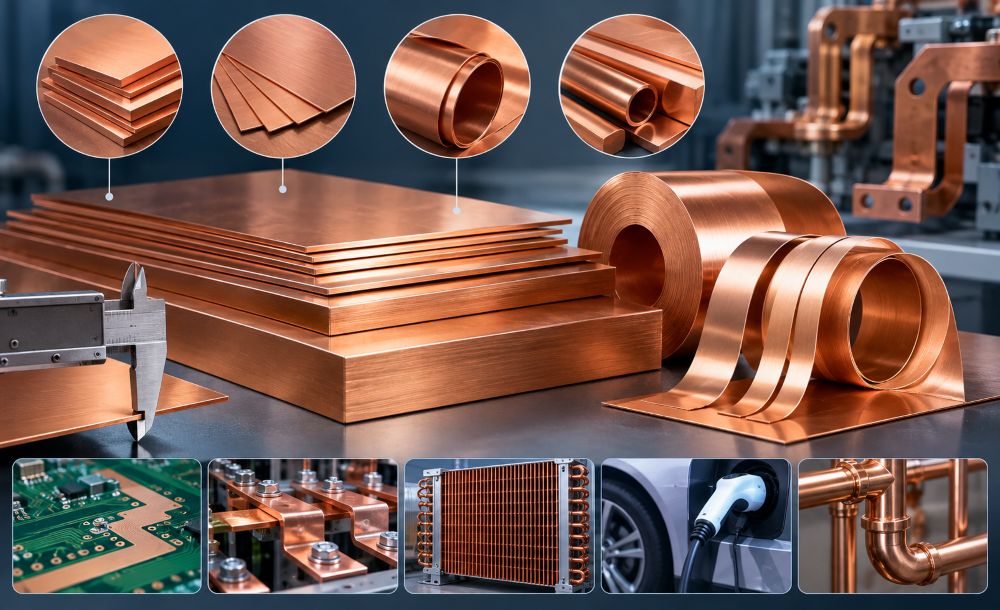
Copper is easy to specify badly. A drawing may say “copper plate” and include a thickness, but leave out the details that decide whether the part will carry current, spread heat, form cleanly, or machine without trouble. The better starting point is the job the finished part has to do. Once that is clear, grade, thickness, temper, stock form, and inspection requirements become much easier to define.
Start with the load, not the material nickname
Busbars, terminals, heat spreaders, welding electrodes, plumbing components, and decorative panels can all be made from copper. They do not need the same material.
For an electrical part, the key questions are current, allowable temperature rise, connection method, and conductivity requirement. For a thermal part, look at heat flow, joining method, wall thickness, and whether the part will be brazed or welded. For formed covers and architectural work, the priorities may be bendability, surface condition, weather exposure, and appearance.
This sounds basic, but it prevents a common purchasing mistake: choosing a material only because it is labeled “copper sheet” or “copper plate.” Those labels describe a form of supply. They do not finish the engineering decision.
Match the grade to the process
Three grades appear often in general copper purchasing.
C110 is a practical default for many electrical parts. It offers high conductivity, is widely available, and is commonly used for busbars, terminals, grounding hardware, and formed conductive components.
C101 is selected when very high purity and conductivity matter. It is a strong option for demanding electrical and thermal applications, especially when the design calls for tight control of oxygen content or high performance at a connection.
C122 is phosphorus-deoxidized copper. It is often considered for tube, heat-transfer, and fabricated assemblies that will be brazed or welded. It should not be treated as an automatic substitute for a high-conductivity electrical grade; the conductivity target needs to be checked first.
The grade callout should be on the drawing or RFQ, not buried in an email. If an alternate material is acceptable, state the limits: conductivity, temper, certification, finish, or joining process.
Thickness is a design decision
Thin copper can save weight and material cost, but it can also buckle, distort during machining, or leave too little material after finishing. Heavy stock adds stiffness and heat capacity, yet it may raise cost and increase machining time.
For a current-carrying part, thickness and cross-sectional area affect resistance and temperature rise. For a heat spreader, thickness affects stiffness and the available path for heat. For a bent enclosure, thickness must suit the intended inside bend radius. For a CNC-milled block, it must leave enough material for clamping and for the final machined surfaces.
There is no universal “best” thickness. A useful RFQ gives the nominal thickness plus its tolerance, final flatness requirement, and whether the part will be cut, formed, machined, plated, or joined.
Do not assume “sheet” and “plate” answer the same question
The thickness line between sheet and plate changes by supplier, standard, and industry. In day-to-day work, sheet usually suggests stock intended for cutting or forming, while plate often suggests heavier stock for machined or structural parts.
That shorthand can be useful in a conversation, but it is not adequate for a purchase order. Specify the actual thickness, width, length, temper, and required flatness. If the material will be CNC machined, include the finished drawing and identify which faces are critical.
Temper changes how the material behaves
Copper is available in different tempers, from soft annealed material to harder conditions. The choice affects bending, stamping, springback, and machining response.
Soft material is usually easier to form. A harder condition can be helpful where the part needs more stiffness or better resistance to handling damage. Neither is automatically better. A thin, deeply formed cover and a rigid machined contact can need very different tempers even when both use the same alloy.
When the drawing calls for a bend, share the bend direction, radius, and cosmetic-surface requirements. When the part will be machined, describe the features that are most sensitive to flatness or burrs.
Plan for the real manufacturing route
Copper transfers heat quickly and is relatively soft. Those properties are valuable in the finished part, but they influence production.
During machining, a shop may need to manage chip control, tool edge condition, part support, and heat. Thin sections can move when clamping pressure is released. Deep pockets and fine threads need a practical tool path. A part that looks simple in CAD may need a different stock size, a second setup, or a light finish pass to meet flatness requirements.
The same principle applies to fabrication. Cutting, punching, bending, brazing, welding, plating, and surface protection all need to be considered before the material is ordered. Early communication reduces rework later.
A short RFQ checklist
Before sending a request for quote, confirm these points:
- Copper grade and permitted alternatives
- Stock form: sheet, plate, bar, strip, or tube
- Nominal thickness and tolerance
- Temper or hardness requirement
- Width, length, quantity, and acceptable mill-size variation
- Surface condition, protective film, and cosmetic-side requirements
- Flatness, burr, edge-break, and machining requirements
- Certificates, traceability, plating, joining, or packaging requirements
This information gives suppliers a clear basis for quoting. It also makes it easier to identify a material or process concern before production starts.
Final thought
The right copper specification is not just a grade name and a thickness. It is a practical description of what the part must do and how it will be made. When that information is clear, material selection becomes faster, quotes are more comparable, and the risk of a wrong stock choice drops.
For a broader look at copper sheet applications, including electrical, thermal, architectural, and machined uses, see this detailed reference guide.
Suggested external publishing notes
- Use this as a standalone guest post or supplier-resource article; do not add a canonical tag pointing to the target page.
- Keep the single contextual link in the final paragraph. Avoid adding sitewide, footer, or keyword-stuffed links.
- Replace the author byline and add only a real author/company disclosure required by the publishing platform.