How to Choose the Right MLM Software Company in 2026
Choosing the right MLM software company is an important decision for any network marketing business. The software you select can influence how efficiently you manage distributors, process commissions, handle payouts, track sales, and scale your network.
In 2026, businesses have more options than ever, from ready made MLM platforms to customized solutions with mobile applications, API integrations, automation, AI capabilities, and blockchain support. However, having more options also makes the selection process more complicated.
The right provider is not necessarily the company offering the longest list of features. It is the one that understands your business model, supports your compensation plan, provides reliable technology, and can adapt as your network grows.
This guide explains the key factors to consider when choosing an MLM software company in 2026.
What Is an MLM Software Company?
An MLM software company develops or provides technology designed to manage the operations of a multi level marketing or network marketing business.
Depending on the platform, MLM software can help businesses manage:
- Distributor registration
- Genealogy and network structures
- Sales and orders
- Compensation plans
- Commission calculations
- Rank management
- E wallet transactions
- Payouts and withdrawals
- Reports and analytics
- Customer management
- Payment integrations
- Mobile access
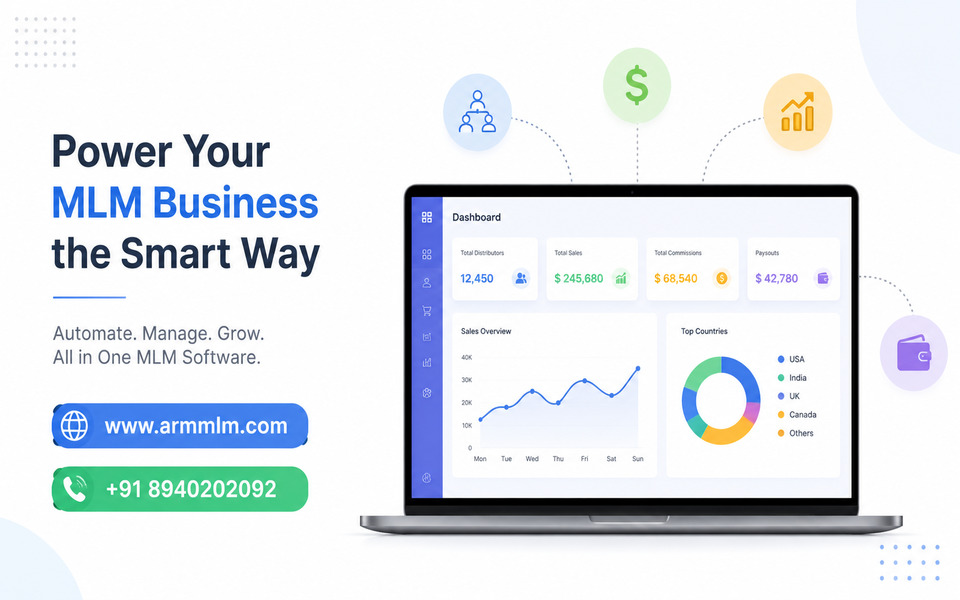
Before comparing providers, it is useful to understand what MLM software is and how it supports the different processes involved in network marketing.
Why Choosing the Right Provider Matters
MLM software becomes part of the operational infrastructure of your business.
If the platform is unreliable or difficult to customize, problems can extend beyond the software itself. Commission delays, inaccurate reports, poor distributor experiences, and integration issues can affect everyday operations.
On the other hand, a suitable platform can centralize business processes and reduce repetitive administrative work.
The provider you choose can also affect:
- Software scalability
- Security
- Technical support
- Customization
- Future upgrades
- Integration capabilities
- Data migration
- Mobile development
- Long term maintenance
For this reason, choosing software should be treated as a long term business decision rather than simply a purchase.
1. Start With Your Business Requirements
Before contacting software providers, define what your business actually needs.
Every MLM company operates differently. A startup launching with a single product may have very different requirements from an established network operating across several countries.
Start by documenting:
Your Compensation Plan
Identify whether you use Binary, Unilevel, Matrix, Hybrid, Generation, Board, or another compensation structure.
The software should support your current plan and ideally provide flexibility if your compensation structure changes later.
For businesses evaluating different models, reviewing available MLM compensation plan software can help clarify what functionality is required.
Your Network Size
Consider your current distributor count and expected growth.
Do not select software based only on today's network size. Think about where your business could be in three to five years.
Your Products
Determine whether you sell physical products, digital products, subscriptions, services, or a combination.
Your product model can affect order management, commissions, inventory, customer accounts, and ecommerce requirements.
Your Markets
If you plan to operate internationally, consider:
- Multiple currencies
- Multiple languages
- Local payment methods
- Tax requirements
- Regional compliance
- International distributor management
Creating this requirements list before comparing providers makes the selection process much easier.
2. Check Compensation Plan Flexibility
Your compensation plan is one of the most important areas to evaluate.
A software platform should not force your business to change its compensation model simply because the technology cannot support it.
For example, Binary MLM businesses may require placement rules, left and right volume tracking, carry forward calculations, and other plan specific functions.
You can review how Binary MLM compensation plan software handles the requirements of this particular structure.
Businesses using multiple compensation mechanisms may need greater flexibility. In such cases, Hybrid MLM software can be relevant when different structures need to work together.
When evaluating a provider, ask:
- Can the compensation plan be configured?
- Can commission rules be modified?
- Can new bonuses be introduced?
- Can rank requirements be changed?
- Can the system handle future compensation changes?
- Does customization require additional development?
A provider that understands compensation logic can be more valuable than one that simply offers a standard package.
3. Evaluate Automation Capabilities
Automation is one of the major reasons businesses invest in MLM software.
A good platform should reduce repetitive administrative work rather than simply move manual processes into a digital interface.
Look for automation in areas such as:
- Commission calculations
- Payout processing
- Rank updates
- Distributor placement
- Notifications
- E wallet management
- Reporting
- Sales tracking
- User onboarding
The objective is to reduce unnecessary human intervention while maintaining appropriate administrative controls.
When comparing providers, ask them to demonstrate the actual automated workflow rather than relying only on feature descriptions.
For example, request a demonstration of what happens from the moment a qualifying sale is recorded until the applicable commission appears in a distributor's account.
That gives you a much better understanding of the platform than a feature checklist.
4. Look at Scalability
A software platform should be able to grow with your network.
Scalability involves more than supporting a large number of user accounts. It can also involve transaction volume, database performance, reporting, integrations, and simultaneous users.
Ask potential providers:
- How does the platform handle network growth?
- What happens when transaction volumes increase?
- How is database performance maintained?
- Can additional servers or infrastructure be introduced?
- Are there limits on distributors or transactions?
- Can the platform support international expansion?
A platform that works well for a small network may not necessarily be appropriate for a rapidly expanding organization.
This is particularly important if your business expects significant growth in the next few years.
5. Review the Software Features
Do not choose a provider based purely on the number of features it advertises.
Instead, identify whether the features solve real business problems.
A comprehensive MLM software features page can help you create a checklist, but you should still evaluate each feature against your own requirements.
Important areas may include:
Distributor Management
The system should allow administrators to manage distributor profiles, accounts, statuses, and activities efficiently.
Genealogy Management
Administrators and distributors may need clear visibility into network structures and team relationships.
Commission Management
The system should calculate commissions according to your configured compensation rules.
E Wallet
Distributors may need to view balances, transaction histories, and withdrawal information.
Reporting
Management should be able to access useful sales, distributor, commission, and performance reports.
Administration
Administrators should have appropriate controls for managing users, business settings, commissions, products, and other operations.
The goal is to determine whether the platform is genuinely useful rather than simply feature rich.
6. Check Mobile Capabilities
Mobile access is increasingly important for network marketing businesses.
Distributors may not always work from a desktop computer. They may need to check their sales, commissions, team activity, and notifications while travelling or communicating with customers.
Ask the software company whether it provides:
- Responsive web access
- Android applications
- iOS applications
- Distributor dashboards
- Push notifications
- Mobile genealogy
- Mobile wallet access
- Mobile sales management
If your business requires a dedicated application, explore the provider's MLM mobile app development capabilities.
Do not evaluate the mobile application only from screenshots. Request a live demonstration and test common distributor workflows yourself.
7. Evaluate Integration Capabilities
Your MLM software may need to communicate with other business systems.
Common integrations include:
- Payment gateways
- Ecommerce platforms
- CRM systems
- Accounting software
- Email platforms
- SMS services
- KYC systems
- Analytics tools
- Blockchain networks
An API integrated MLM software approach can help connect the MLM platform with external applications.
When speaking with a provider, ask whether integrations are:
- Built in
- API based
- Custom developed
- Available through third party services
Also ask about the cost and timeline for custom integrations.
A provider may claim that integrations are supported, but the actual implementation process can vary considerably.
8. Consider AI Capabilities Carefully
AI is becoming increasingly common in business software, including MLM platforms.
However, businesses should distinguish between meaningful AI functionality and features added primarily for marketing purposes.
Potential AI applications in MLM software can include:
- Business analytics
- Distributor insights
- Sales pattern analysis
- Automated recommendations
- Network monitoring
- Customer support assistance
- Report generation
- Workflow automation
AI powered MLM software can be considered when AI capabilities align with specific business requirements.
The important question is:
What business problem does the AI feature solve?
Ask the provider to demonstrate the feature using realistic business scenarios instead of simply presenting an AI label.
9. Assess Security and Data Protection
Security should be one of the highest priorities when selecting an MLM software provider.
The platform may process distributor information, sales data, commission records, payment information, and identification documents.
Ask the provider about:
- Data encryption
- User authentication
- Access controls
- Database security
- Backup procedures
- Security updates
- Activity logs
- Server infrastructure
- Disaster recovery
If your business operates internationally, you should also understand the data protection and compliance requirements relevant to your target markets.
Do not hesitate to ask technical questions. A reliable provider should be able to explain its security approach clearly.
10. Understand Customization Options
Not every MLM business can operate effectively with a standard configuration.
You may require customization for:
- Compensation rules
- Distributor workflows
- Dashboard design
- Product management
- Payment methods
- Integrations
- Reports
- Mobile applications
- Business specific processes
A custom MLM software solution may be appropriate when standard functionality cannot adequately accommodate your business model.
However, customization can increase development time and cost.
Before approving custom development, ask:
- What exactly will be customized?
- Is the customization included in the package?
- Will future software updates affect it?
- Who will maintain the custom functionality?
- What happens if the business requirements change?
A clear scope can prevent misunderstandings later.
11. Check the Provider's Technical Experience
The software company itself matters as much as the software.
Look beyond marketing claims and evaluate whether the provider has experience working with businesses similar to yours.
Consider:
- Years of software development experience
- Number and type of projects completed
- Technical expertise
- Compensation plan experience
- Integration capabilities
- Mobile development experience
- International deployment experience
- Post launch support
Ask for relevant case studies or examples where possible.
You should also determine whether you are dealing directly with the development team or through an intermediary.
Direct communication with technical teams can make requirements gathering and troubleshooting easier.
12. Test the Software Before Making a Decision
Never select an MLM platform based solely on a brochure or website.
A live demonstration can reveal how the software actually works.
During a demo, ask the provider to demonstrate important workflows such as:
- Distributor registration
- Referral and placement
- Genealogy management
- Product purchase
- Commission calculation
- Rank qualification
- Wallet update
- Withdrawal request
- Administrator approval
- Reporting
If possible, provide your actual compensation plan and ask the provider to demonstrate how it would be configured.
This makes the evaluation much more practical.
You can also request an MLM software demo to explore the platform before making a final decision.
13. Understand Pricing and the Total Cost
Price is important, but the cheapest platform is not necessarily the most economical option.
Look at the total cost of ownership rather than only the initial software price.
Potential costs can include:
- Software license
- Customization
- Hosting
- Mobile applications
- API integrations
- Payment gateway integration
- Maintenance
- Support
- Upgrades
- Additional development
Ask the provider for a clear pricing structure.
You can also review MLM software pricing to understand the factors that can influence the overall investment.
Compare providers based on long term value rather than simply comparing headline prices.
14. Examine Support and Maintenance
Software support becomes especially important after launch.
Even a well designed platform can require technical assistance when your network grows or business requirements change.
Ask:
- What support channels are available?
- What are the support hours?
- How are critical issues handled?
- Are software updates included?
- How are bugs resolved?
- Is maintenance included?
- Is there a dedicated technical team?
You should also clarify what happens when you request a new feature or modification.
A strong relationship with the provider can make the software easier to manage over the long term.
15. Plan for Data Migration
If you are replacing an existing MLM platform, data migration should be considered before signing a contract.
Your existing system may contain years of valuable information, including:
- Distributor profiles
- Genealogy structures
- Sales records
- Commission history
- Rank information
- Wallet balances
- Withdrawal records
- Product information
Ask the provider:
Can you migrate our existing data?
Then clarify:
- What data can be migrated?
- What format is required?
- How will data be validated?
- How will historical commissions be handled?
- Will the existing genealogy structure be preserved?
- How will the migration be tested?
- What happens if migration problems occur?
Migration should be planned as part of the implementation rather than treated as an afterthought.
Common Mistakes to Avoid When Choosing an MLM Software Company
Choosing software can become difficult when businesses focus on the wrong criteria.
Here are some common mistakes to avoid.
Choosing Only Based on Price
A low initial price may become expensive if the platform requires significant customization or lacks essential functionality.
Choosing Based on Feature Count
A long feature list does not automatically mean better software.
Focus on features that solve actual business requirements.
Ignoring Scalability
Do not choose software only for your current network size.
Consider future growth.
Not Testing the Platform
A sales presentation is not the same as using the software.
Request a practical demonstration.
Overlooking Support
Technical support can become important after launch, especially during migration, upgrades, and business expansion.
Ignoring Data Migration
If you already operate an MLM business, your historical data is valuable.
Migration should be discussed before selecting the platform.
Assuming Every AI Feature Is Useful
AI should solve a business problem. Do not select a platform simply because it advertises AI.
A Practical Checklist for Comparing MLM Software Companies
You can use the following checklist when comparing providers.
| Evaluation Area | Questions to Ask |
|---|---|
| Compensation Plan | Does it support our current plan? |
| Scalability | Can it support our expected growth? |
| Automation | Which manual processes can be automated? |
| Mobile | Is mobile access available? |
| Integrations | Can it connect with our existing systems? |
| Security | How is business and user data protected? |
| Customization | Can the platform adapt to our workflows? |
| Reporting | Are the required reports available? |
| AI | Do AI capabilities solve useful business problems? |
| Migration | Can existing data be migrated? |
| Support | What technical support is provided? |
| Pricing | What is the total cost of ownership? |
| Demo | Can we test real business workflows? |
Using the same checklist for every provider makes comparisons more objective.
Ready Made or Custom MLM Software?
One of the biggest decisions businesses face is whether to purchase ready made software or build a customized platform.
Ready Made Software
Ready made software can be suitable when your business requirements align with the platform's existing functionality.
Advantages can include:
- Faster implementation
- Established features
- Lower development requirements
- Easier deployment
Custom Software
Custom software may be more appropriate when you have unique compensation rules, workflows, integrations, or business requirements.
It can provide greater control over the platform but generally requires more planning and development.
The right choice depends on the complexity and uniqueness of your business.
Questions to Ask an MLM Software Company Before Signing
Before making a final decision, ask the provider these questions:
- How does the software support our compensation plan?
- Can we customize commission rules?
- How scalable is the platform?
- What automation capabilities are included?
- Does it support mobile applications?
- Which payment gateways can be integrated?
- Does it provide APIs?
- How is data protected?
- Can you migrate our existing MLM data?
- What support is included after launch?
- How are upgrades handled?
- What costs are additional?
- Can we test the platform before purchasing?
- How long will implementation take?
- What happens if our business requirements change?
The answers can reveal far more about a provider than its marketing material.
Final Thoughts
Choosing the right MLM software company in 2026 requires more than comparing prices or feature lists.
Start with your business requirements. Evaluate compensation plan flexibility, automation, scalability, mobile access, integrations, security, customization, reporting, AI capabilities, technical support, and data migration.
Most importantly, test the software before making a final decision.
Your MLM platform should be able to support the way your business operates today while providing enough flexibility for future growth.
A good provider should also be willing to understand your business model rather than simply selling you a standard package.
Whether you are launching a new network marketing business, replacing an outdated platform, or expanding an existing network, taking the time to evaluate the right technology provider can help you make a more informed long term decision.
If you are comparing MLM software solutions for your business, you can explore an MLM software demo and evaluate the platform based on your specific operational requirements.