Mortar and Cement: Easily Confused ‘Partners’ in Construction Projects
In construction contexts, ‘mortar’ and “cement” are two frequently encountered terms. Many confuse the two due to their common pairing, even believing that ‘mortar is cement’ or ‘cement can be used directly as mortar’. In reality, however, they exhibit fundamental differences in composition, function, and application scenarios, playing distinctly different roles within building systems. This article will commence with their definitions, employing a multi-dimensional comparison to clearly delineate the distinctions between mortar and cement. It will further elucidate their interrelationship, thereby providing guidance for material selection in engineering practice.
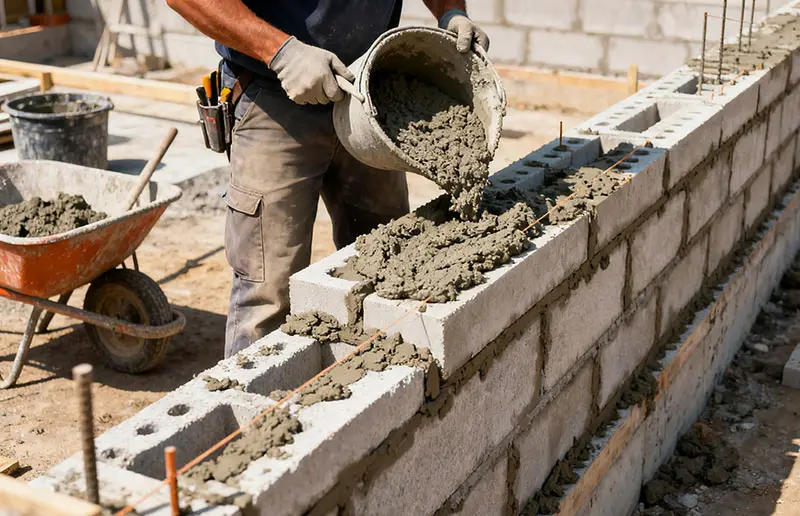
I. Fundamental Definition: The Core Distinction Between ‘Raw Material’ and ‘Composite Material’
To differentiate mortar from cement, one must first clarify their essential attributes — cement is a single-function cementitious raw material, whereas mortar is a functional building material composed of cement and other components. This constitutes their most fundamental difference.
1. Cement: The ‘Cementitious Core’ in Construction
Cement is an inorganic hydraulic cementitious material. Its core constituents are silicate minerals (such as tricalcium silicate, dicalcium silicate, and tricalcium aluminate). It is produced by grinding cement clinker (formed by high-temperature calcination of raw materials like limestone and clay) and blending in appropriate quantities of gypsum (to regulate setting time). Its defining characteristic is ‘hydraulicity’: when mixed with water, it undergoes self-catalysed hydration reactions to progressively harden, with this hardening process being impervious to water erosion (distinguishing it from ‘air-hardening cementitious materials’ like lime, which require dry conditions to set).
In construction, cement is rarely used in isolation – it functions more as a ‘binding agent raw material’ that must be combined with other materials to achieve stable structural or adhesive properties. For instance, cement mixed solely with water exhibits excessive shrinkage, making it highly prone to cracking and unsuitable for meeting the strength and durability requirements of building components.
2. Mortar: Customised ‘Bonding/Levelling Material’
Mortar is a composite material formed by mixing cementitious materials, fine aggregates, and water in specific proportions. The cementitious material is typically cement (though lime or gypsum may also be used), while fine aggregates specifically refer to sand with particle sizes under 5mm (e.g., river sand or manufactured sand). Depending on functional requirements, admixtures (such as water-retaining agents or crack-resistant agents) may be incorporated to adjust workability (e.g., flowability, water retention) and performance characteristics (e.g., strength, frost resistance).
In essence, mortar represents one application form of cement – utilising cement's binding action to agglomerate sand particles into a cohesive mass. Simultaneously, the skeletal structure provided by the sand mitigates shrinkage during cement hardening, ultimately yielding a material possessing bonding strength, structural integrity, and stability.
II. Multi-dimensional Comparison: Comprehensive Differences from Composition to Application
Beyond their fundamental definitions, mortar and cement exhibit more specific distinctions in composition, performance, functionality, and application scenarios, which directly determine their respective boundaries of use in construction. The table below clearly outlines the core comparison dimensions:
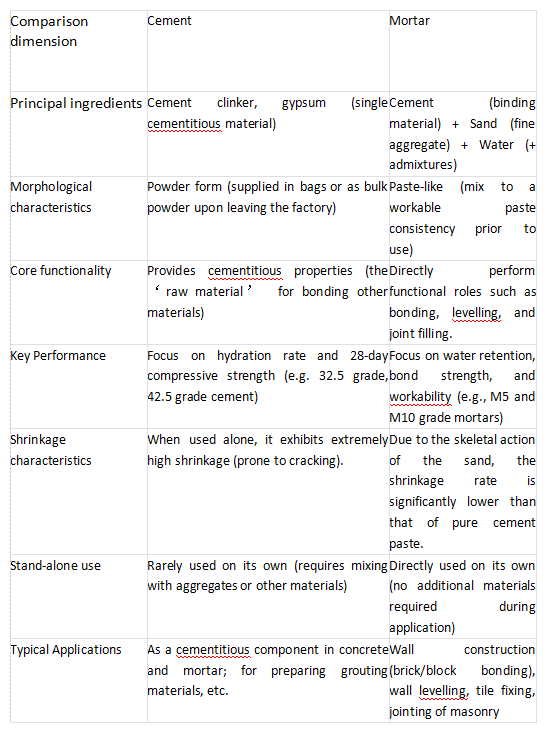
As can be seen from the table, the fundamental difference between the two lies in their status as ‘raw materials’ versus ‘finished materials’: cement is a ‘semi-finished product’ requiring processing and blending, whereas mortar is a ‘finished product’ ready for direct application. For instance, when laying brickwork, pure cement paste cannot be used to bond bricks — as it shrinks and cracks, causing the wall to become unstable. In contrast, ‘masonry mortar’ made from cement and sand both bonds the bricks through the cement and fills the gaps between them with sand, reducing shrinkage and ensuring the wall's structural integrity.
III. The Relationship Between the Two: Cement is the “Core Framework” of Mortar
Although mortar and cement differ significantly, they share a close interdependence—cement serves as the core binding component of mortar, determining its strength grade and durability; conversely, mortar represents one of cement's most common applications.
1. Cement Determines Mortar's “Fundamental Properties”
Mortar strength (e.g., M5, M10, M15 grades) is directly determined by the cement strength grade and cement dosage:
For high-strength mortar (e.g., M15 masonry mortar for load-bearing walls), use high-grade cement (e.g., 42.5 grade) and increase the cement proportion in the mortar mix.
For low-strength mortar (e.g., M5 masonry mortar for non-load-bearing partitions), 32.5-grade cement may be used, or cement content reduced appropriately while adding small amounts of lime to improve workability.
Simultaneously, cement's hydration characteristics influence mortar setting time—for instance, quick-setting cement shortens initial setting time, making it suitable for emergency repairs requiring rapid hardening; while ordinary Portland cement is suitable for routine construction scenarios, ensuring sufficient working time.
2. Mortar Expands Cement's “Application Value”
Cement itself has limited functionality, but mortar, through the addition of sand and admixtures, enables cement's binding capacity to be “targeted for specific applications”:
The inclusion of sand significantly enhances mortar's volume stability, preventing cracking issues common in pure cement paste, making it suitable for wall leveling (e.g., plastering mortar);
By adjusting sand particle size and additives (such as water-retaining agents), mortar can achieve varying workability — for instance, tile adhesive mortar requires high water retention to prevent rapid moisture loss causing tile voids, while grout mortar needs low flowability to avoid runoff during application.
.jpg)
3. Both require chemical additives to maintain performance
As mentioned earlier, both mortar and cement require water retention and workability. This water retention is achieved through additives like HPMC and HEMC, which effectively preserve their superior properties.
How to Know Which One You Need
If you’re doing a small home project, here’s a quick guide to help you choose:
Use Cement if:
You are mixing your own mortar or concrete.
You need a binding ingredient to add to sand and gravel.
⇒ Cement is not used alone—it needs to be mixed with other ingredients.
Use Concrete if:
You are building something strong, like a patio, driveway, or foundation.
You need the material to support weight or pressure.
⇒ Concrete is best for structure and support.
Use Mortar if:
You are laying bricks, stones, or blocks.
You need something to stick materials together.
⇒ Mortar is ideal for bonding and finishing work.
Ⅳ. Conclusion: Define Boundaries, Select Appropriately
In short, the relationship between mortar and cement can be summarized as “raw material and finished product”: cement is the core raw material providing binding capability, while mortar is the functional finished material formed by combining cement with sand. The two must not be confused, nor can they substitute for each other. Correctly distinguishing their differences and selecting appropriate materials based on construction needs (e.g., using cement to prepare mortar rather than applying pure cement) is fundamental to ensuring construction quality and durability.
In practical engineering, determining whether to use cement or mortar hinges on identifying the core requirement: if creating bonding/leveling material is needed, directly use or prepare mortar; if mixing concrete, mortar, or other cementitious materials is required, select cement of the corresponding strength grade as the raw material. Only with clear boundaries can these two construction “partners” fulfill their respective roles effectively.