Film Review: Harry Potter and the Chamber of Secrets (2002)
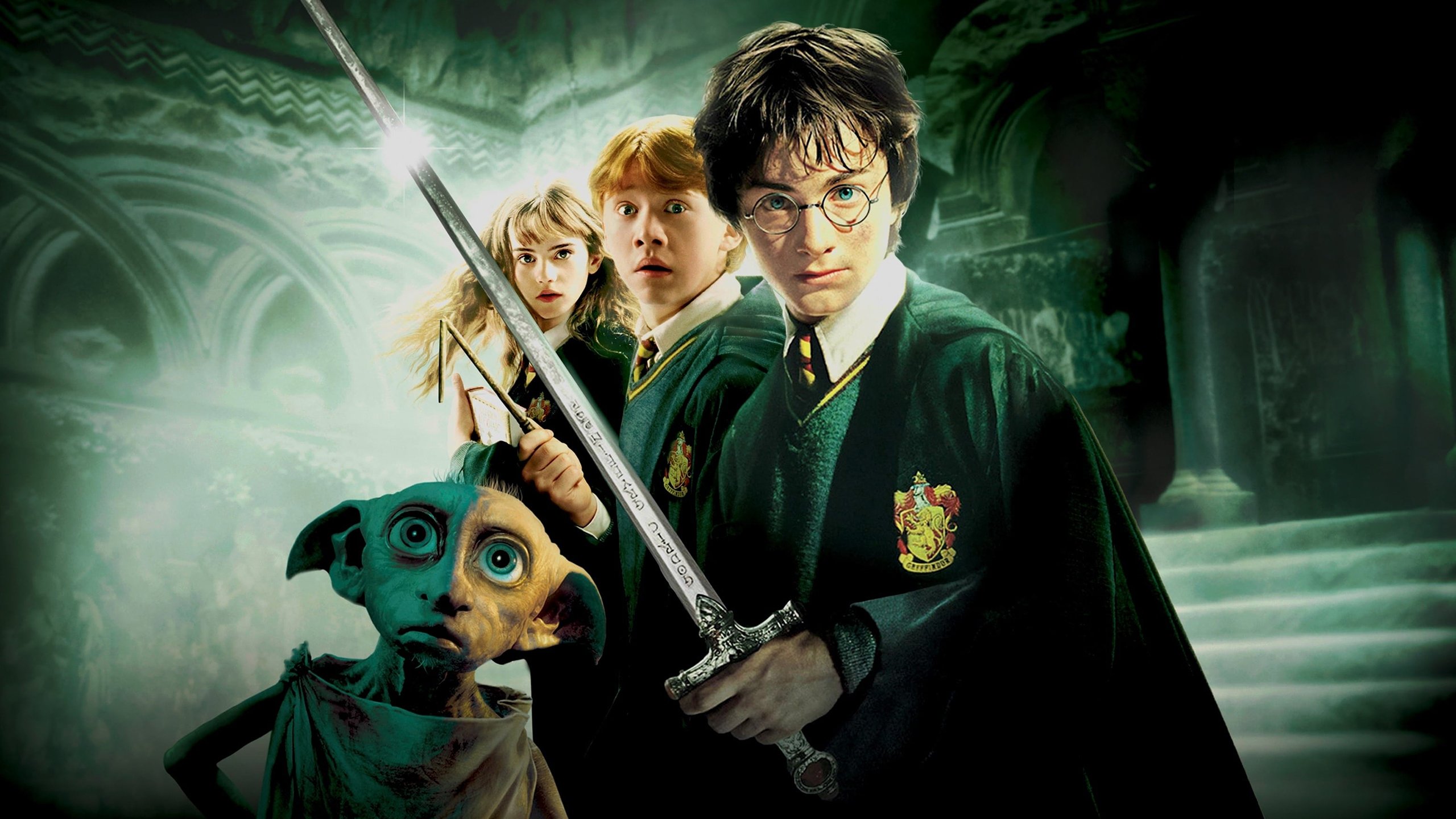
The first instalment of Harry Potter film series had the alibi of novelty and the burden of establishing a world; the second has neither. It came with the audience already converted, the studio already committed and the cast already signed, and its entire job is to repeat a formula that had just taken $974 million without appearing to repeat it. It does not quite manage that, and it is not obvious that it tries.
Columbus, retained on the strength of the first film, keeps the picture squarely in family-friendly territory: the wonder foregrounded, the shadows deferred, the tone pitched, as before, at the age of its eleven-year-old protagonists. Only the more careful viewer will catch the detail or two that points a shade darker — the blood daubed on the corridor wall ("the Chamber of Secrets has been opened; enemies of the heir, beware"), the cat Petrified and hung by its tail from a torch bracket, the word "Mudblood" spat as an insult, the first hint that Hogwarts is not merely dangerous but institutionally ugly. It is the earliest flicker of the saga's political spine, and it lasts about four seconds.
Same again, only longer
The fidelity to Rowling is, if anything, more total than before. The Deathday party, the duelling club, the Polyjuice sequence, the Whomping Willow, the spiders of the Forbidden Forest, the Basilisk and its plumbing, the mandrakes screaming in their pots — all of it transcribed, almost all of it from the novel, almost none of it dramatised. The first film could afford to illustrate, because the audience was meeting everything for the first time; the second has to show it, and largely settles for ticking it off. At 161 minutes it is the longest film in the series, nine minutes longer than its predecessor, and it earns almost none of them. Where Philosopher's Stone had one inspired Kloves invention — the chess match — this one has almost nothing that plays as cinema rather than as adaptation.
What genuinely differs is the growth around the edges. The trio are visibly older, marginally looser, and Radcliffe in particular has stopped reading his lines as if they were on a card. The supporting world widens: Dobby the house-elf, rendered in CGI that drew the inevitable Jar-Jar comparisons; Jason Isaacs as Lucius Malfoy, all silk and sneer; Shirley Henderson's Moaning Myrtle, an unexpectedly melancholy joke. Columbus's own Amblin inheritance surfaces as slapstick — the rogue Bludger, the Cornish pixies, the pratfalls — and the rhythm of Home Alone briefly takes over the middle act. It is not a bad thing, but it is a familiar one, and familiarity is the whole problem.
The cast, and what it is carrying
The most interesting part of the film remains its cast, and here the sequel has one advantage the original lacked: it can hand the screen to a new performer worth the price of admission on his own. Kenneth Branagh's Gilderoy Lockhart — self-promoting celebrity wizard, fraudulent memoirist, preening coward — is the best thing in the picture by some distance, and some would argue that an egomaniacal character whose entire act is a well-rehearsed performance is not that much different from the famous actor himself. Branagh plays the vanity without the wink, which is much harder than it looks.
Richard Harris returns as Dumbledore in what became the final role of a long career; he died on 25 October 2002, three weeks before the film opened, and there is something faintly valedictory in his cadence now that we know it. Rickman, Smith, Coltrane, Griffiths, Shaw, Margolyes, Walters and Mark Williams are the repertory company again — again well above the film's station, again deployed in a handful of minutes each. Against that, the plotting is Scooby-Doo mechanics in gold leaf: a mystery whose solution is a diary and a lavatory.
The industry around it
The comparison is instructive. Hollywood's family slate in 2002 was either CGI animation or thin live-action comedy: Ice Age, Lilo & Stitch, Scooby-Doo, Men in Black II, Stuart Little 2, Spy Kids 2, The Santa Clause 2, Treasure Planet. Live-action family fantasy had exactly one serious occupant, and it was Jackson's The Two Towers. The nearest true analogue to Potter was Spider-Man — a $821 million comic-book picture aimed at the same twelve-year-olds — and even that was a ride rather than a saga.
And yet the numbers tell a stranger story. Chamber of Secrets was the biggest film in the world in 2002 outside North America, taking $617 million internationally against The Two Towers' $584 million, and fourth-biggest in America behind Spider-Man, The Two Towers and Attack of the Clones. It broke the UK's own opening record, set by its predecessor, with £18.9 million including previews, on its way to £54.8 million. It earned an A+ CinemaScore — the only film in the eight to do so. In the same season, Stuart Little 2 stalled at $170 million against a $120 million budget and Treasure Planet lost Disney some $74 million. A British boarding-school picture with a castle on the poster was out-earning the entire hand-drawn tradition that had raised it.
The Academy, meanwhile, had already made up its mind. The film took three BAFTA nominations, six Saturns and the Critics' Choice award for Best Family Film, and not a single Oscar nomination — the only instalment in the series to be shut out at that stage. Ebert gave it four stars; Rolling Stone called it over-long and too faithful to the book; both were right.
Verdict
Chamber of Secrets is the most redundant entry in the series and, on its own terms, an honest piece of work. It is overlong, faithful to a fault and never once surprised by its own material — a holding pattern dressed as a sequel, competent and expensive and incurious. But it kept the machine running through the year the machine was most likely to stall, and it handed a great actor one of the best comic roles of his career. Columbus's decision to stand down afterwards, and to let Alfonso Cuarón make Azkaban, arguably the best film of the eight, was the most valuable thing anyone did on it.
RATING: 7/10
Blog in Croatian https://draxblog.com
Blog in English https://draxreview.wordpress.com/
InLeo blog https://inleo.io/@drax.leo
Substack https://draxster.substack.com/
BTC donations: 1EWxiMiP6iiG9rger3NuUSd6HByaxQWafG
ETH donations: 0xB305F144323b99e6f8b1d66f5D7DE78B498C32A7
BCH donations: qpvxw0jax79lhmvlgcldkzpqanf03r9cjv8y6gtmk9
This thoughtful review gets right to the heart of why Chamber of Secrets functions as such an unusual sequel: it holds on to almost everything that fans cherished, yet it seldom provides a genuinely fresh cinematic justification for keeping those elements in place. The praise for Branagh is entirely deserved—Lockhart is responsible for a great deal of the film's comic energy. I likewise appreciated the industry context that was provided; Potter's dominance appears all the more striking when it is set alongside its competition.