Film Review: Sin City (2005)
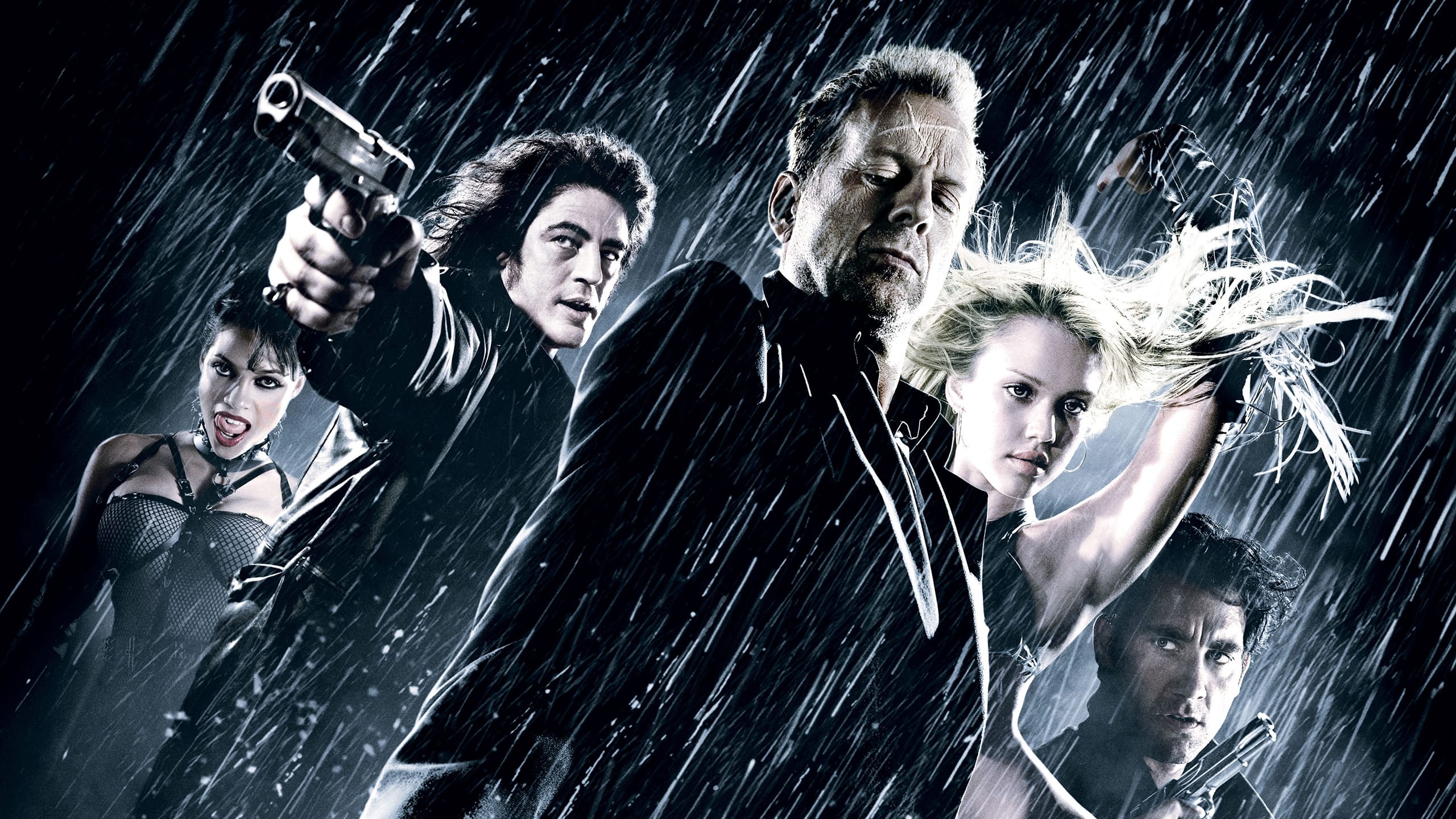
Sin City arrived with an unusual credit: "Shot and cut by Robert Rodriguez", followed by "Special guest director: Quentin Tarantino". Both are true, and both tell you what kind of object this is. Rodriguez, having quit the Directors Guild of America rather than surrender the "directed by" card to a single name, insisted on sharing it with Frank Miller — a cartoonist who had spent the better part of a decade being chewed up and spat out by Hollywood after RoboCop 2 and RoboCop 3. Tarantino, meanwhile, took a day off to shoot the Dwight–Cardinal Roark car sequence for a dollar, because he wanted to see whether the thing could be done at all.
The answer, in 2005, was that it could. Rodriguez's method was not adaptation in any conventional sense; it was transcription. Plots, characters, atmosphere and — crucially — the actual panels of Miller's graphic novels were lifted wholesale, then reproduced on a digital backlot in Austin, with the actors performing against green screens under high-definition cameras that had barely been used for feature work. The black-and-white photography, punctured by isolated stabs of colour (a pair of blue eyes, a yellow monster, a red dress), was not decoration. It was the whole argument of the film.
Because it is an argument. Miller's Basin City is a metropolis of permanent night, where corruption is not a plot point but a climate, and where the only remaining moral currency is personal violence. Rodriguez understands that to soften this would be to betray it. The structure — three interlocking noir vignettes, narrated by men who are already dead or might as well be — refuses the tidy three-act courtesy that a studio would ordinarily demand. Bruce Willis's Hartigan, Mickey Rourke's Marv, Clive Owen's Dwight, all built like brutalist architecture, are given the dignity of their own grotesquerie. Rourke in particular, his face a sculpture of scar tissue and prosthetics, delivers something close to a career's worth of ruined promise in a single performance.
And yet the film's greatest strength is also the source of its central weakness. Fidelity of this order is a stunt, and stunts have a short half-life. Sin City is not so much a film of Miller's work as a film inside it, and it never quite steps outside to look at what it has built. The voiceover — the genre's pulpiest register — is delivered as flat monotone by almost every narrator, which is faithful to the lettering on the page and enervating on the ear. Repetition sets in early: another bruiser walks into another bar, another woman is threatened, another debt of honour is paid in blood. The violence is cartoonish, and the phrase is doing double duty. Yes, it is drawn; yes, it is also numbing, and its extremity was smuggled past the MPAA precisely because monochrome made it read as surreal rather than visceral. A colour film this bloody would have been trimmed.
There is also the question of women. Jessica Alba's Nancy, Rosario Dawson's Gail, Jaime King's Goldie and Wendy, Devon Aoki's near-silent Miho: the film's women are whores, victims or avengers whose authority is sexual and whose bodies absorb the punishment. Miller's defenders call this mythic. Its critics call it a boy's-own bestiary with a lingerie budget. Both are right, and the honest reviewer has to hold both at once.
Which brings us to Miller himself, because Sin City is unthinkable without him and also marks the moment his influence on Hollywood became structural rather than merely advisory. The Dark Knight Returns and Batman: Year One had already supplied the grammar for a generation of comic-book films — the clipped narration, the broken-backed hero, the city as sewer — and Christopher Nolan's trilogy would quarry them openly, as would Zack Snyder's Batman v Superman, which lifts whole compositions from them. Miller's aesthetic, muscular nihilism dressed in noir tailoring, became the default register of the 2000s superhero picture. He is also, of course, a reactionary, and the film's nostalgia for a 1950s pulp order, in which a man's fists were the last court of appeal, carries that politics without ever arguing for it.
Rodriguez, for his part, was at the height of his creative power here. The one-man-band model — writer, shooter, cutter, composer, effects supervisor — had been refined from El Mariachi through From Dusk Till Dawn and Spy Kids, and Sin City is its most complete expression: a director in total command of a wholly invented visual world. Cannes put it in competition and handed him its Technical Grand Prize. It is difficult now to remember how far he would subsequently fall, into remake-and-sequel piecework and franchise custodianship, but Sin City is the record of a man operating at his ceiling.
The method also proved contagious. 300, the following year, took the same green-screen/digital-backlot approach to Miller's Thermopylae, and Starz's Spartacus series ran with it for four seasons — the same flattened, sepia-lit, comic-book frames, the same arterial spray rendered as a graphic gesture rather than a fluid. Within five years the technique had passed from innovation to house style to television shorthand, which is the usual fate of a genuine formal breakthrough.
What it did not survive was a decade's delay. Sin City: A Dame to Kill For (2014), with Miller and Rodriguez co-directing and Miller writing new material rather than adapting it, arrived to the sound of a shrug. Josh Brolin replaced Owen, Jamie Chung replaced Aoki, the late Michael Clarke Duncan was succeeded by Dennis Haysbert, and the film's guiding principle was that if it isn't broken, don't fix it — which produced an effect of pure déjà vu. Eva Green's Ava Lord, a femme fatale stripped to her essence and then out of her clothes, is the one live wire in an otherwise moribund picture; the rest is CGI-resurrected panels and a final segment so inert that the audience's appetite for another forty minutes in Basin City can be measured against the heroine's appetite for another day of life. It took $39 million worldwide against a $65 million budget, and it seriously compromised the reputation of the film that preceded it.
Nine years on from 2005, the sequel looks like an experiment in what happens when a style is mistaken for a subject. The original, though, still holds: a formally audacious, genuinely unpleasant, occasionally magnificent piece of work that argued its own case so forcefully that nothing since has quite needed to. If it is not the best film of the first decade of this century, it is among the most singular — and the most instructive about how far cinema will go in pursuit of a drawing.
Rating: 9/10
Blog in Croatian https://draxblog.com
Blog in English https://draxreview.wordpress.com/
InLeo blog https://inleo.io/@drax.leo
Substack https://draxster.substack.com/
BTC donations: 1EWxiMiP6iiG9rger3NuUSd6HByaxQWafG
ETH donations: 0xB305F144323b99e6f8b1d66f5D7DE78B498C32A7
BCH donations: qpvxw0jax79lhmvlgcldkzpqanf03r9cjv8y6gtmk9
Robert Rodriguez's audacious digital experimentation brings the noir visuals of Miller's panels to life. The amazing gritty characters, and especially Mickey Rourke's performance, really helps the film, which is very much driven by its visual style. However, it does highlight the issues with adapting this. By directly translating the two dimensional and hyper masculine style of the comic, the adaptation treats the text as a holy scripture that shouldn't be changed. This has led to a lack of depth in the drama.