Film Review: The Bourne Identity (2002)
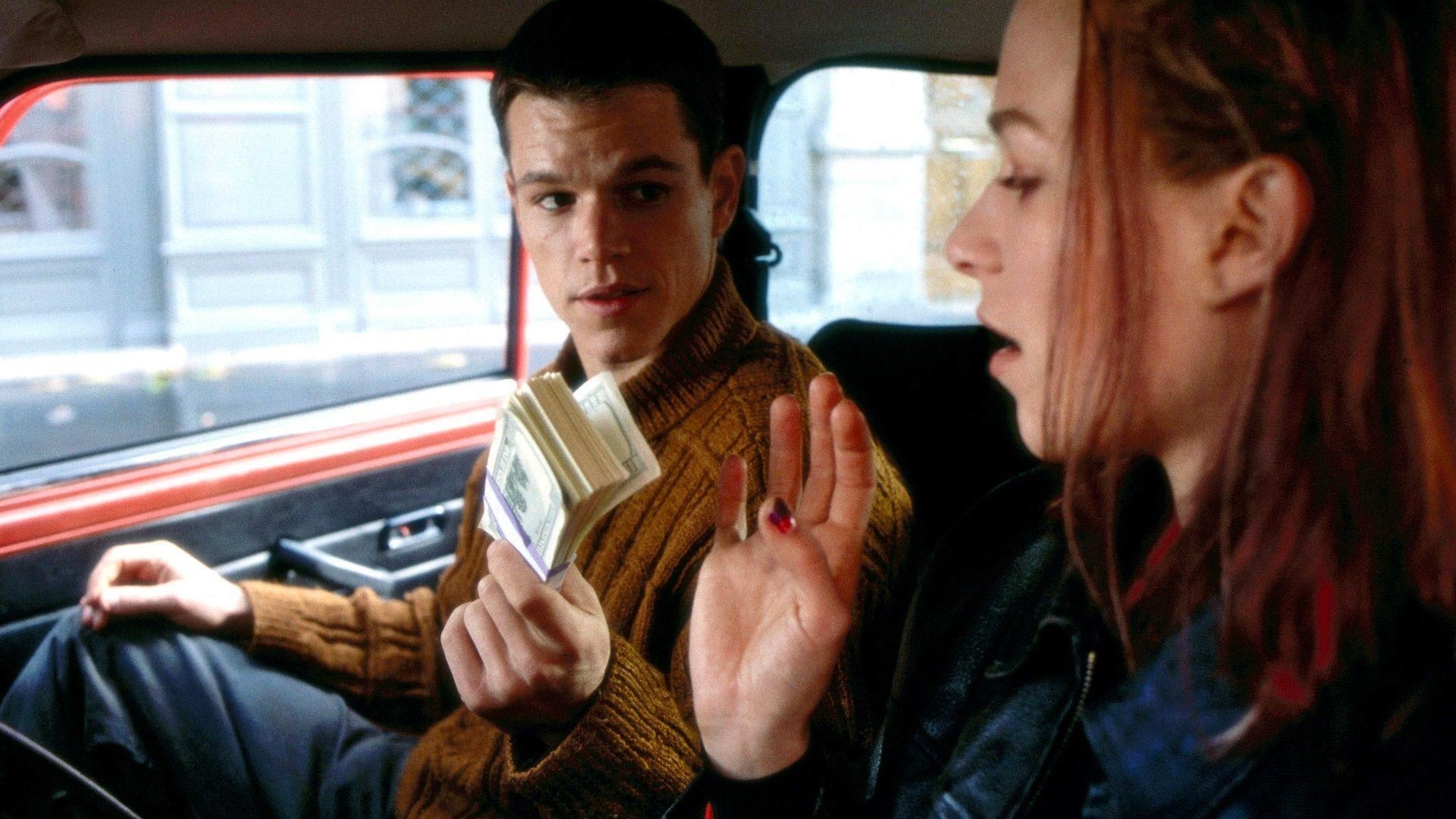
Doug Liman's The Bourne Identity opens with a body in the water: face down, shot twice in the back, hauled out of the Mediterranean by Italian fishermen who assume they are retrieving a corpse. Within ten minutes he has broken a man's arm in a diner, and within twenty he has produced a Swiss bank account number from a subcutaneous capsule and walked out of a Zurich branch with a fortune in assorted currencies. It is an efficient piece of storytelling. It is also, from the very first reel, an act of quiet vandalism against the novel it borrows its title from.
Robert Ludlum's 1980 book is a paranoid Cold War cathedral. Its Bourne is not a nice man; he is a genuinely frightening creature, and the reader's central pleasure is the doubt over whether the amnesiac waking up in Marseille is a hero or the monster the novel keeps calling Cain. The Zurich account number is not a plot convenience — it is an artefact of a specific era's faith in secrecy, in numbered vaults, in the idea that a state could bury a man inside a bank. Ludlum built his villainy around Carlos the Jackal, a real and seemingly untouchable figure. The conspiracy was baroque, multi-national, and enormously long. The book has architecture. The film has a running time.
What Tony Gilroy's screenplay does is keep the premise and discard the machinery. Carlos is deleted and replaced by Treadstone, an in-house CIA black-ops programme; the villain becomes a bureaucratic abstraction rather than a person with a biography. The plot is not so much updated as hollowed, then stuffed with the standard-issue beats: a car chase, a fight in a stairwell, a hostage, a European hotel, a girl. Bourne here fights not terrorists but his former superiors, a cabal of middle-aged men in good suits who have decided he is a loose end. That is Liman's political framing, and it is explicit: the American state is the enemy, the agency is a corporate boardroom of villainy, and the "Deep State" is invoked as a mood rather than dramatised as an argument. It is a reading that has aged well — 2002 to Abu Ghraib to Snowden is a straight line — but the film asserts it instead of earning it. Nobody in the film has a coherent motive beyond institutional self-preservation, and the paranoia that ought to crackle through the corridors of power never does. The villains are not sinister. They are merely administrative.
The clumsiness of the Cold War-to-cynicism transplant shows in the details. A severed African dictator subplot is bolted to the front like a prosthetic. The novel's Marie is a Canadian economist and a wary, pragmatic ally; Franka Potente, an actress of real presence, is reduced to a driver and a warm body who exists to be disposed of later. Clive Owen's Professor gets one scene and a speech about the price of a watch. And the violence has been scrubbed clean for a PG-13 certificate: no blood, no mess, no consequence. Men are shot and simply stop. In the book, people come apart.
Liman does put the European locations and the larger budget to some use — the Zurich bank sequence is properly tense, the embassy scramble has a decently ragged energy, and the pen-in-the-stairwell fight is well staged. But it is all shot with a glossy sheen and paced to a metronome of entirely predictable beats. Then there is Julia Stiles, who arrives as Nicky Parsons, a rising star of the moment fresh off Save the Last Dance, and is given three scenes, almost no dialogue, and no arc whatsoever. She is an information kiosk in a corridor. A piece of furniture, and a better piece of furniture would at least have had something to lean on.
Now the comparison the film cannot survive. Roger Young's 1988 ABC miniseries is not a great piece of television — Richard Chamberlain, then in his mid-fifties, is far too old for the part, and the CIA's secret apparatus is embodied by men who read as harmless senior citizens rather than steely mandarins. But it is faithful. It keeps the surgeon, the bank, the hunt, the Carlos conspiracy, the bluntness of the violence (startling by network standards). It adapts the book. The 2002 film does not adapt the book at all — it reboots it, wearing Ludlum's title as a costume, and then has the effrontery to be praised for its intelligence. Fidelity is not the same as quality, and the miniseries is the weaker work technically. But it is the honest one, and the film's reputation rests on the assumption that nobody in the audience has read the source.
So why did it work? Three reasons, none of them artistic. First, Universal's marketing machine ran a campaign of considerable sophistication, selling a "thinking man's action hero" and a stripped-back realism that flattered the audience for liking it. Second, timing: it arrived in the same year as Die Another Day, with its invisible car and CGI kitesurfing, and offered itself as the anti-Bond — a spy who is a body rather than a martini. The audience wanted a Bond replacement that didn't require them to be smug about it. Third, and most decisive, Matt Damon. At thirty-one, with Good Will Hunting and The Talented Mr Ripley behind him, he was a genuine star of the moment, and his blandness — the rounded face, the ordinary build — was repackaged as realism. He is good in the role. He is also the reason the role exists in this shape.
The result is a competent, bloodless, faintly hollow thriller that treats its source as a set of ingredients and its audience as people who have not read it. Four out of ten. The good news, for the series, is that The Bourne Supremacy abandons the pretence of adaptation altogether — and is noticeably better for it.
RATING: 4/10
Blog in Croatian https://draxblog.com
Blog in English https://draxreview.wordpress.com/
InLeo blog https://inleo.io/@drax.leo
Substack https://draxster.substack.com/
BTC donations: 1EWxiMiP6iiG9rger3NuUSd6HByaxQWafG
ETH donations: 0xB305F144323b99e6f8b1d66f5D7DE78B498C32A7
BCH donations: qpvxw0jax79lhmvlgcldkzpqanf03r9cjv8y6gtmk9
that 1988 miniseries is a deep cut to pull out here, honestly I totally forgot Richard Chamberlain played him