Film Review: The Fast and the Furious (2001)
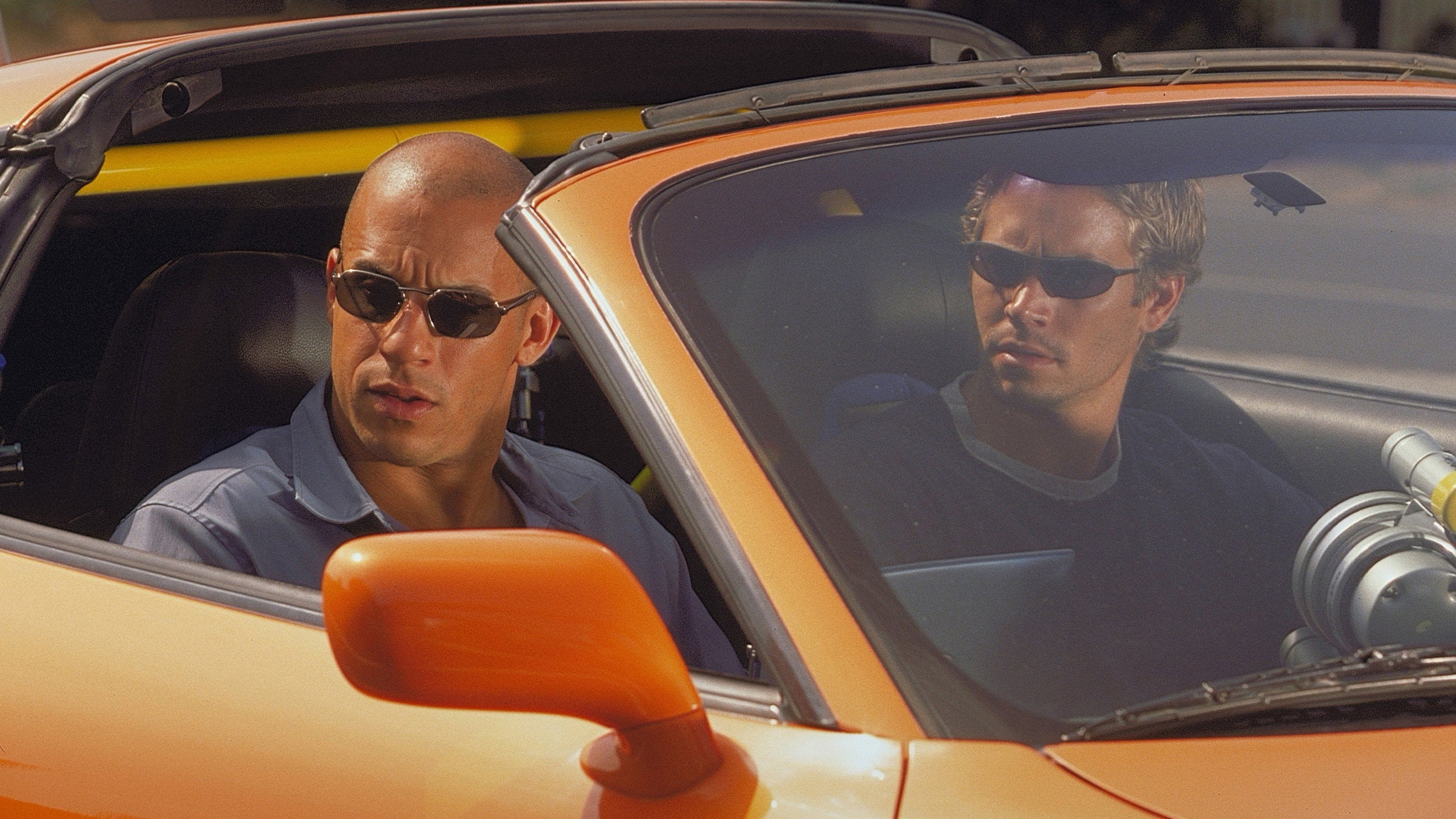
This is the first of ten. Over the pieces that follow, the series will be taken in the order in which it was released, each instalment judged against what it was trying to be and against what the industry around it was doing — which, in the case of these particular films, turns out to be a large part of the story. The first instalment is also, unavoidably, the one that has to carry the most context, because everything that later came to seem inevitable about the Fast Saga was, in June 2001, still a considerably longer shot than the one Warner Bros. was placing the same autumn on a boy wizard.
A magazine article and a borrowed title
The film's origins are, by the standards of a modern tentpole, almost laughably modest. The Fast and the Furious was not adapted from a novel, a comic or a video game. It was adapted from a two-thousand-word magazine article: "Racer X", written by Kenneth Li for the May 1998 issue of Vibe, which documented the Dominican street-racing scene that had migrated from Southern California to Washington Heights in upper Manhattan. The piece followed a racer named Rafael Estevez, and Dom Toretto is a thinly veiled transposition of him — the same charisma, the same code, the same subculture of Japanese-engined imports, quarter-mile sprints and police raids on industrial estates.
That was the film's genuine novelty, and it is worth dwelling on, because the series would spend the next two decades shedding it. This was a picture anchored in something real: an actual, verifiable, contemporaneous youth movement that the audience could walk out of the cinema and find on a dual carriageway that same night. The script's other spine — the heists in which articulated lorries are hijacked on the open highway at speed — was reportedly drawn from genuine Los Angeles police reports of the period, and the import-tuner aesthetic, all oversized rear wings and nitrous purge, was photographed from life rather than designed in a studio. The makers even consulted the scene they were depicting. There is a rough, unpolished authenticity to the racing here that the later, digitally inflated instalments would trade away in exchange for scale.
Even the title was not their own. The studio licensed it from a forgotten 1955 American International B-picture of the same name, produced by Roger Corman and directed by John Ireland and Edward Sampson, about a stolen Jaguar. The project had earlier been developed under the title Redline. So the most durable action franchise of the century began with a borrowed name, a magazine clipping and a police blotter.
The film itself
The plot is Point Break with the surfboards swapped for drag racing, and the resemblance is not incidental — it is structural. Brian O'Conner (Paul Walker), a young mechanic with a gift for getting into trouble, is in fact an undercover policeman, infiltrated into the racing subculture in order to investigate the truck heists. Dom Toretto (Vin Diesel) is the brooding gang leader who takes him in and whose trust Brian earns by rescuing him from the police. The undercover officer who goes native, the charismatic outlaw who becomes his mirror, the mentor, the boss who does not understand, the girlfriend whose principal function is to be threatened: it is all here, lifted wholesale from Kathryn Bigelow's 1991 film, and the ending — Brian quietly handing Dom the keys to his father's 1970 Charger and letting him drive off into the dark — is a direct restaging of Utah letting Bodhi ride the wave.
Rob Cohen directs with a journeyman's competence and a genuine feel for the night-time city, and the action is staged with a clarity that later entries would abandon: two set pieces in particular, drawn self-consciously from Spielberg's Duel and George Miller's The Road Warrior, carry real physical weight. The attractive cast does an enormous amount of heavy lifting. Diesel, years from self-parody, radiates a magnetic stillness; Walker's blandness becomes an asset, a blank surface onto which the audience can project its own entry into Dom's world; Michelle Rodriguez and Jordana Brewster make more of thin material than it deserves. The script, credited to Gary Scott Thompson, Erik Bergquist and a young David Ayer, is riddled with holes — the procedural mechanics collapse under the mildest scrutiny — but it is quotable, and the characters are memorable in the way pulp characters are memorable: by gesture and silhouette rather than psychology.
What is most striking, from the vantage point of 2026, is how small it all looks. The budget was roughly $38 million, the shooting largely nocturnal and confined to Los Angeles, and the climax a single race between two cars on a railway level crossing. Compare that with what followed. Part five alone, with a $160 million budget, dragged a bank vault through the streets of Rio; part six raced a tank down a Spanish motorway; part seven put a car between two Abu Dhabi skyscrapers; part nine sent a Pontiac into orbit. The first film does not even have a proper villain until its final third. Against that backdrop, the original plays like a scrappy independent that happened to catch a wave no one had seen coming — and its unorthodox, deliberately unresolved ending is the sole reason there is a franchise at all. It is a rare case of an ambiguous final beat accidentally becoming a business model.
Two franchises, one year
The comparison with the other franchise that launched in 2001 is instructive. Harry Potter and the Philosopher's Stone premiered in November of that year, two months after 11 September, into an autumn that badly wanted comfort. It carried a $125 million budget, was backed by a global bestseller with a built-in readership of millions, and had been planned from the first frame as the opening of a multi-film adaptation with a fixed studio, a fixed screenwriter, a fixed production designer, a fixed composer and an author on the payroll with contractual script approval. It duly took $974 million and a then-record opening weekend.
The Fast and the Furious had none of that assurance. No source novel, no franchise plan, no established audience, and two leads whose stars were still ascending. Where Potter was architecture — a decade laid out in advance — this was improvisation, and its sequels would be invented one at a time, often in response to whichever cast member had become available. Both properties would come to dominate the following two decades; only one of them arrived knowing exactly what it was. There is a certain irony in the fact that the Potter films, for all their industrial perfection, aged with their cast into a fixed and finite story, while the Fast Saga, for all its chaos, simply kept going — absorbing the death of one of its leads into its own mythology and reconstituting itself as a heist series, a spy series and finally a science-fiction one.
The decade of failed imitators
The film's commercial success spawned a decade of knock-offs that failed for the same reason, and the reason was structural rather than budgetary. Torque (2004), Biker Boyz (2003), Redline (2007), The Fast and the Furious's own diminishing-returns sequels, and eventually Need for Speed (2014) all mistook the symptoms — chrome, neon, a nine-figure budget, a poster with a car on it — for the cause, which was a specific subculture photographed before anyone else had photographed it, and a cast the audience wanted to keep watching. The imitators bought the look and missed the loyalty. It is telling that the only thing capable of competing with a Fast film turned out to be another Fast film.
The knock-on effect was considerable. The franchise mainstreamed the import-tuner scene into a global consumer phenomenon, spawning a video-game line, a Universal Studios ride, an aftermarket parts boom and a soundtrack series that put Ja Rule and Ludacris on the charts. The licence, as ever, is where the money actually lives.
Verdict
The Fast and the Furious is a well-made, faintly ramshackle B-picture whose cast, chemistry and genuinely novel subject matter are far above its station. It plays it safe at every turn — the plot borrowed, the title borrowed, the romance functional — and in this instance the safety was not timidity but pragmatism. Its genuine achievement is that it found something real and photographed it honestly, then had the nerve to end on a note that demanded continuation. Everything the series would later become — the family rhetoric, the globe-trotting, the physics-defying spectacle — is visible here only as a seed.
It is, in the end, one of the more pleasant surprises Hollywood has produced in this century — which is a low bar, but it clears it with something to spare.
RATING: 6/10
Blog in Croatian https://draxblog.com
Blog in English https://draxreview.wordpress.com/
InLeo blog https://inleo.io/@drax.leo
Substack https://draxster.substack.com/
BTC donations: 1EWxiMiP6iiG9rger3NuUSd6HByaxQWafG
ETH donations: 0xB305F144323b99e6f8b1d66f5D7DE78B498C32A7
BCH donations: qpvxw0jax79lhmvlgcldkzpqanf03r9cjv8y6gtmk9
This film review perfectly captures the odds that the Fast Saga faced to be successful. With its origins stemming from a mere 2,000 word magazine article on street racing, it's incredible to think what the franchise has become today. It's impossible to predict that in 2001 it would become a multi-film juggernaut capable of rivaling some of the most iconic films in cinematic history. Great background info provided!