When an AI Hallucination Almost Became a War
A U.S. intelligence report that was “entirely false” nearly sent American forces onto a Chinese ship in the Middle East this spring. Planes were already in the air. Armed personnel were preparing to board. Then someone checked the source of the claim.
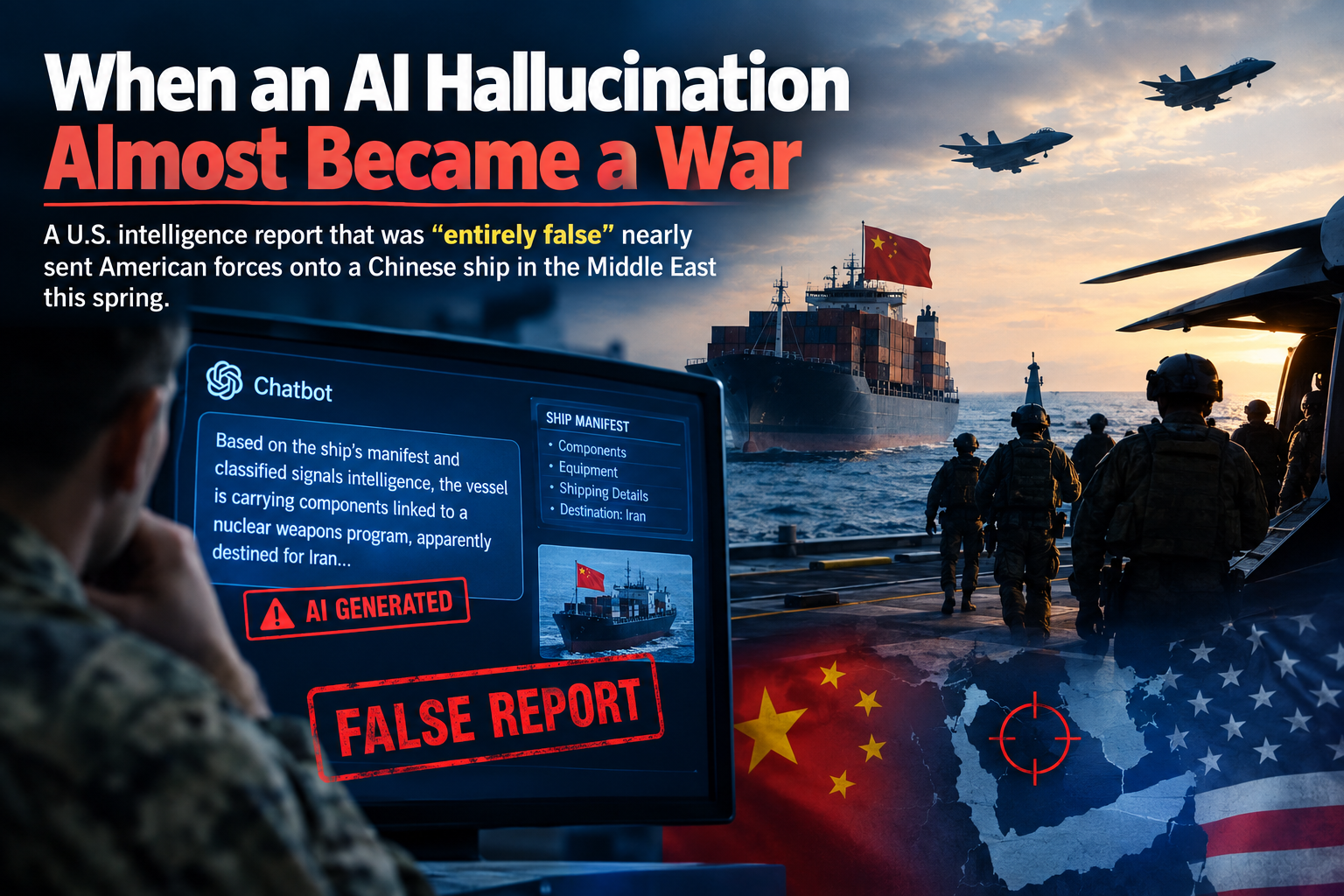
According to an exclusive CNN report published September 18, 2026, a Special Operations Command analyst used a chatbot to analyze a ship’s manifest. The tool mixed open-source information with classified signals intelligence and concluded the vessel was carrying components linked to a nuclear weapons program—apparently destined for Iran during the ongoing war. The assessment moved through official channels and was treated as credible. Four sources familiar with the episode told CNN the military swung into action. Two said troops were readying to board. Aircraft were already airborne.
Officials halted the operation only at the last moment after discovering the report had been generated with AI help and that the chatbot had misidentified the cargo. CNN could not determine what the ship was actually carrying. One source called the report “entirely false.” Another said it “almost started a war.” Intercepting a Chinese-flagged vessel in that environment could have spiraled into a direct confrontation between two nuclear-armed powers.
The incident happened against a backdrop of rapid Pentagon AI adoption. Defense Secretary Pete Hegseth has pushed an acceleration strategy to field AI-enabled tools and cut bureaucratic friction. Sources told CNN that internal military systems are often commercial models with a thin official coating, that younger analysts sometimes treat chatbot output as authoritative, and that there is no uniform standard for verifying AI-assisted intelligence. One former official put it bluntly: “AI allows you to get to a bad idea faster.”
This is not a story about superintelligent machines plotting war. It is a story about sloppy workflow at high stakes: an analyst feeding sensitive data into a system known to hallucinate, packaging the result as an intelligence product, and watching it travel far enough that aircraft left the ground. Large language models invent plausible-sounding details. They do not know when they are wrong. In consumer apps that is annoying. In targeting and boarding decisions it is existential.
Several questions remain unanswered. Which model was used—commercial or government-built? What was the real cargo? How many similar reports have circulated without being caught? Has the Pentagon issued new rules after this near-miss? Central Command did not immediately comment in the initial coverage.
The lesson is not “never use AI.” It is that unverified machine output cannot be allowed to become the last word before force is used. Human review has to be mandatory, not optional, when the cost of a hallucination is a shooting incident with China. Speed is valuable. Getting the cargo wrong is not.
If this report holds, it will be cited for years as the case study of what happens when militaries treat chatbots like analysts instead of draft assistants. The operation was stopped in time. The next one might not be.
As a general rule, I'm skeptical of CNN when their reporting is based on anonymous sources. We'll see if this gets confirmed by a more reliable source.
0.00 SBD,
0.18 STEEM,
0.18 SP
I thought CNN could be trusted .
Normally, I would consider them mostly reliable on tech subjects, but with the AI doomer hype cycle making the rounds right now, I'm not so sure about this story... Fits the doomsday narrative a little too well.
Ahh ! True too !