I HAD ₹0… SO I STARTED WITH A SKILL
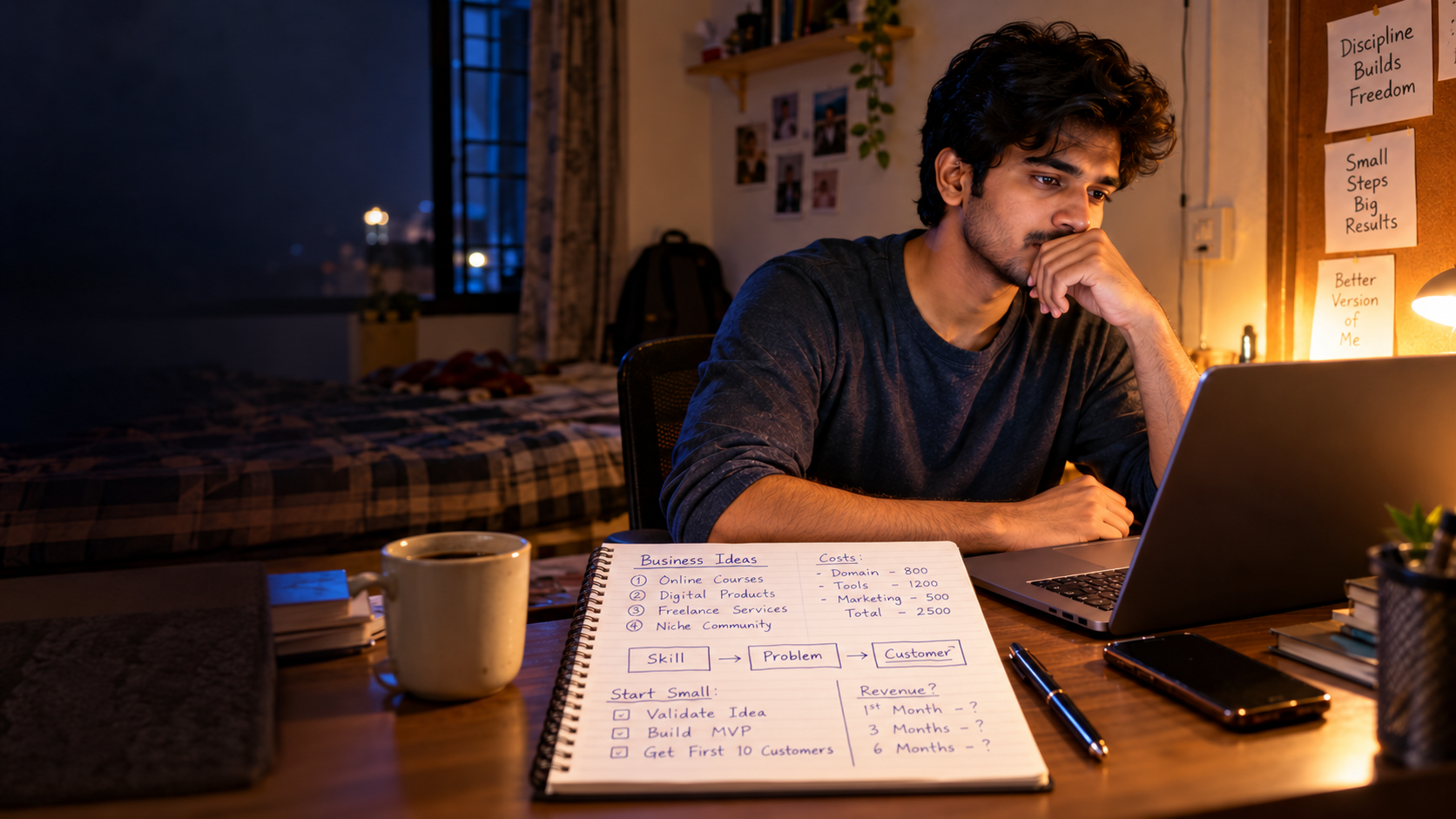
A few months ago, I was sitting with a friend and we somehow started talking about money.
You know how these conversations usually go.
One person says,
“Bhai, I want to start something of my own.”
And the other person immediately asks,
“Kitna investment chahiye?”
That’s exactly what happened.
My friend looked at me and said,
“I really want to start a business, but I don't have money.”
I asked him,
“How much money do you need?”
He thought for a few seconds.
“Maybe ₹50,000… or ₹1 lakh.”
I smiled and asked,
“For what?”
He started listing things.
“Website…”
“Logo…”
“Office maybe…”
“Ads…”
“Some software…”
“Maybe a laptop…”
“Then I'll need money for marketing…”
I stopped him.
“Wait.”
He looked at me.
I asked,
“What exactly are you planning to sell?”
He didn't have an answer.
And honestly, that conversation made me think about something.
Maybe we have misunderstood what “starting a business” actually means.
We often imagine a business as a building.
An office.
A team.
A website.
A logo.
A fancy Instagram page.
Paid advertisements.
Professional equipment.
And, of course, money.
So we keep telling ourselves:
“I'll start when I have enough money.”
But what if that's the wrong starting point?
What if a business doesn't start with money?
What if it starts with a problem?
“But I Don't Have Any Business Idea.”
My friend said exactly that.
“I don't know what business I can start.”
So I asked him something very simple.
“What can you do?”
He said,
“Nothing special.”
I asked again.
“Seriously. What do people ask you for help with?”
He thought for a while.
Then he said,
“Well… I'm pretty good at making Excel sheets.”
I laughed.
“That's it?”
He said,
“Yeah.”
I asked,
“Do you think every small business owner is good at Excel?”
He said,
“No.”
“Do you think some business owners waste hours making reports, cleaning data, preparing sheets and tracking sales?”
He said,
“Obviously.”
I asked,
“Then why can't you help them?”
He went quiet.
That was the moment something clicked.
He was looking for a business idea.
But he already had something useful.
He just didn't recognize it as a business.
Your Skill Can Be Your First Investment
This is something I wish more people understood.
You don't necessarily need to create something completely new.
Sometimes you simply need to become useful to someone.
Maybe you're good at:
- Video editing
- Graphic design
- Excel
- Writing
- Social media
- Photography
- Website creation
- AI tools
- Research
- Translation
- Teaching
- Accounting
- Customer support
- Data entry
- Presentation design
You might look at your skill and think,
“Who would pay me for this?”
That's exactly the question you should ask.
But don't stop there.
Ask:
“Whose problem can I solve with this?”
That's a much better question.
Imagine This
Let's say you're good at video editing.
You don't have ₹1 lakh.
You don't have a studio.
You don't have expensive cameras.
You don't have a huge portfolio.
But you have a phone, a laptop and an editing skill.
So instead of thinking:
“How do I build a video-editing company?”
Think:
“Can I help one creator edit their videos?”
That's it.
One person.
Not 100 customers.
Not a company.
Just one customer.
You could find a small creator on Instagram or YouTube.
Look at their content.
Maybe their videos are good, but the editing isn't great.
You can create a small sample.
Then send them a simple message:
“Hey, I came across your videos. I really like your content. I noticed your editing could be improved a little, so I made a short sample to show you what I mean. If you like it, I'd be happy to help you with future videos.”
Maybe they won't reply.
That's okay.
Send another message to someone else.
Maybe the second person ignores you.
That's okay too.
Maybe the tenth person says:
“Sure, let's try one video.”
Congratulations.
You have your first potential customer.
Your First ₹500 Is More Important Than Your First ₹1 Lakh
I think beginners sometimes focus too much on the big number.
They say:
“I want to make ₹1 lakh per month.”
Nothing wrong with that.
But when you're starting from zero, I think a better target is:
“Can I make my first ₹500 from my skill?”
Why?
Because ₹500 isn't really about the money.
It's proof.
Proof that somebody looked at something you can do and said:
“Yes, I'll pay you for this.”
Then you can try for ₹1,000.
Then ₹2,000.
Then ₹5,000.
Slowly, you understand what customers actually want.
You understand pricing.
You understand communication.
You understand deadlines.
You understand rejection.
You understand how to deliver work.
And most importantly…
you start thinking like a business owner.
“But Isn't It Really Zero Investment?”
Here's where I want to be honest.
When people say:
“Start a business with zero investment.”
I don't completely agree with that statement.
Because nothing is truly free.
If you don't invest money, you'll probably invest:
Time.
You'll invest:
Learning.
You'll invest:
Patience.
You'll invest:
Energy.
And sometimes you'll invest your ego.
Because you're going to hear “no.”
A lot.
You might message 20 people and get 18 ignored.
Someone might say your price is too high.
Someone might ask for free work.
Someone might disappear after saying they're interested.
Someone might criticize your work.
And there will probably be a day when you think,
“Why am I even doing this?”
That's part of starting.
Don't Spend Money Before You Understand the Customer
This is another mistake I see people making.
They have an idea.
And immediately they start spending.
₹5,000 on a logo.
₹10,000 on a website.
₹15,000 on tools.
Then money on ads.
Then subscriptions.
And after spending all that money, they finally ask:
“Will anybody actually buy this?”
That question should come first.
Not last.
Before spending money, try to validate the idea.
Talk to people.
Find out what they need.
Offer a simple service.
Get one customer.
Then improve.
If you earn something, reinvest a part of it.
That's much safer than spending everything before you know whether your idea works.
Here's the Simple Formula
If I had to start from zero today, I'd keep it ridiculously simple.
Find a skill.
↓
Find a problem.
↓
Find someone who has that problem.
↓
Offer a simple solution.
↓
Get your first customer.
↓
Do excellent work.
↓
Ask for feedback.
↓
Improve.
↓
Find the next customer.
That's it.
No complicated business plan on day one.
No fancy office.
No pretending to be a CEO.
Just solve a real problem for a real person.
And Here's the Part Nobody Talks About
Starting with almost no money can actually teach you something valuable.
It forces you to become creative.
If you have money, you can solve problems by spending.
Don't know how to get customers?
Run ads.
Don't know how to build something?
Hire someone.
Don't know how to create content?
Pay a creator.
But when you don't have money…
You have to figure things out.
You learn.
You experiment.
You make mistakes.
You search for answers.
You talk to people.
You become resourceful.
And that resourcefulness can become one of your biggest business advantages later.
My Friend Asked Me One Last Question
After our conversation, my friend asked:
“So you're saying I can actually start without ₹50,000?”
I said,
“I'm saying something slightly different.”
He looked at me.
I said:
“Don't start by asking how much money you need.”
“Start by asking what problem you can solve.”
He smiled.
Then he opened his laptop.
And started making an Excel sample.
Nothing dramatic happened that day.
No company was registered.
No office was opened.
No investor came.
No ₹1 lakh appeared in his bank account.
Just one person sitting with a laptop…
trying to turn a skill into something useful.
And honestly?
That's probably how many businesses should begin.
Not with a big announcement.
Not with a fancy office.
Not with a huge investment.
But with a simple thought:
“I know how to do something. Someone has a problem. Maybe I can help.”
That's enough to take the first step.
If You Had ₹0 Today…
Imagine you woke up tomorrow with:
₹0 in your business account.
But you had:
📱 A smartphone
💻 A laptop
🌐 Internet
🧠 Your existing skills
⏰ 2–3 hours every day
What would you try to sell?
Not what would you dream of selling.
Not what looks cool on Instagram.
What could you actually do for someone today?
That's the question I'd start with.
Because maybe your first business isn't hiding inside a brilliant idea.
Maybe it's hiding inside a skill you already have…
but have never considered valuable.
And sometimes, your first investment isn't money.
It's simply deciding to start.
What skill would you turn into a business if you had to start with ₹0?
I'd genuinely love to hear your answer. 👇