India Pharmaceutical Packaging Market Size, Share, Growth Opportunities and Industry Report 2026–2034
Market Overview & Summary
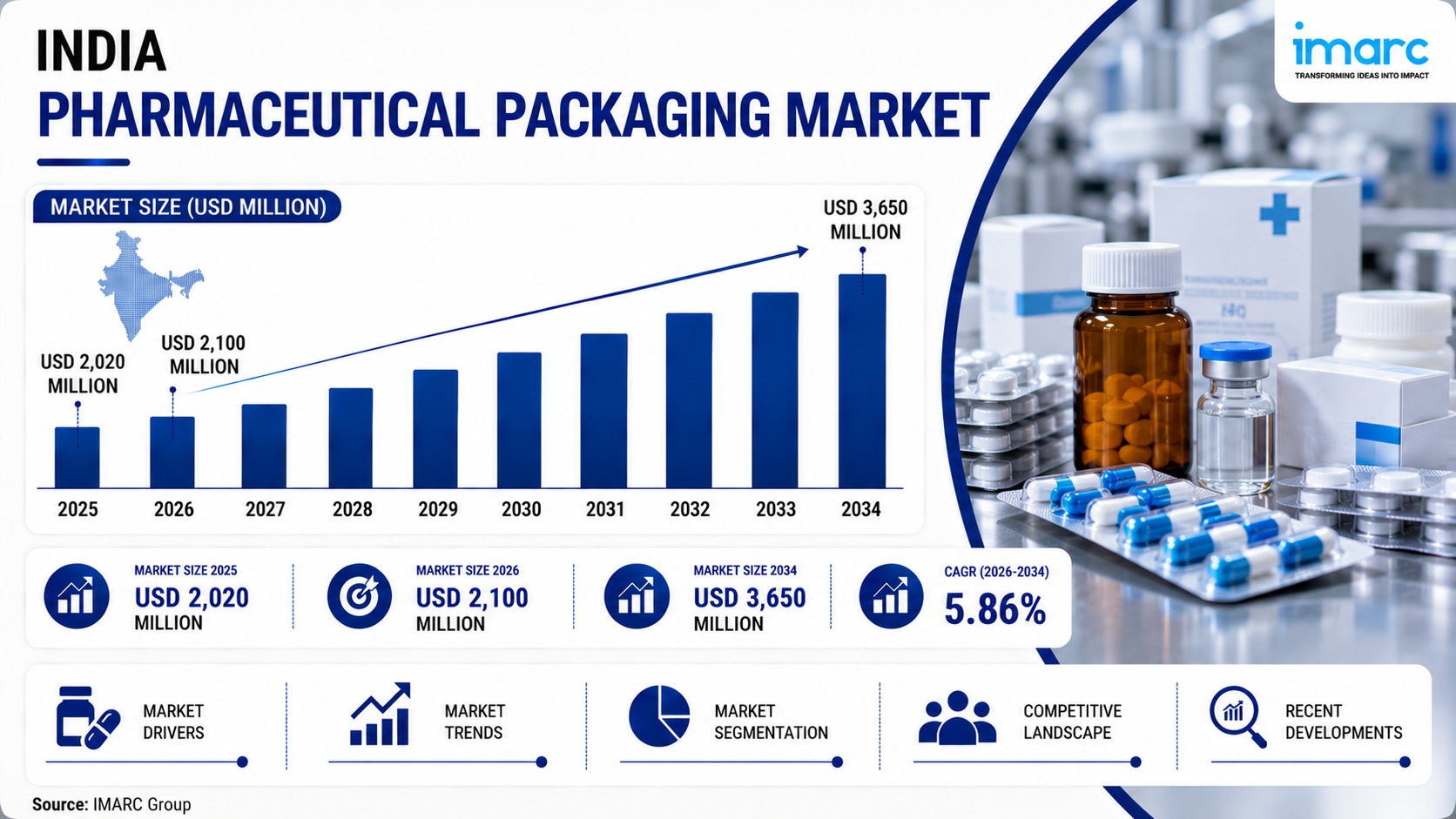
The pharmaceutical packaging market in India size reached USD 2,020 Million in 2025 and expanded to USD 2,100 Million in 2026. Looking forward, the market is projected to reach USD 3,650 Million by 2034, exhibiting a steady compound annual growth rate (CAGR) of 5.86% during the 2026–2034 forecast period. The industry is executing a highly strategic, margin-accretive pivot. As the Indian pharmaceutical sector transitions from producing high-volume, low-cost solid oral generics to manufacturing high-value, complex biosimilars and sterile injectables, the packaging ecosystem is undergoing a radical technical overhaul. The era of commoditized containment is over. The market is now dictated by absolute barrier integrity, chemical inertness, and digital traceability, with heavy investments flowing into specialized Cyclic Olefin Polymers (COP), mono-material recyclable blisters, and auto-injector architectures designed for the booming home-healthcare demographic.
Market Size & Forecast
- Market Size (2025): USD 2,020 Million
- Market Size (2026): USD 2,100 Million
- Projected Market Size (2034): USD 3,650 Million
- CAGR (2026 - 2034): 5.86%
- Leading Regional Market: West and Central India
Key Market Trends
- The Shift to Cyclic Olefin Polymers (COP) and Cyclic Olefin Copolymers (COC):
As Indian pharmaceutical giants scale their biologics, oncology, and mRNA portfolios, traditional glass vials are facing limitations due to heavy weight, breakage risks, and tungsten/alkali leaching, which can denature sensitive proteins. Consequently, the market is witnessing a massive pivot toward COP and COC vials and pre-filled syringes. These advanced medical-grade plastics offer glass-like transparency, absolute shatter resistance, and an ultra-inert surface, making them critical for highly viscous or pH-sensitive biotech formulations.
- Transition to Mono-Material Blisters to Meet EPR Mandates:
The historic reliance on non-recyclable, multi-layered blister packs (such as PVC laminated with aluminum) is becoming a massive regulatory liability under India's stringent Extended Producer Responsibility (EPR) guidelines. To achieve circularity without compromising the moisture-vapor transmission rate (MVTR), packaging engineers are aggressively transitioning to mono-material solutions—specifically all-PET or fully aluminum-based blister architectures that can be processed by standard recycling infrastructure.
- Rise of Active Packaging and Moisture Scavengers:
To ensure the efficacy of highly moisture-sensitive Active Pharmaceutical Ingredients (APIs) in India’s harsh, humid tropical climate, passive barriers are no longer sufficient. The market is rapidly adopting "active packaging" matrices, where desiccants, oxygen scavengers, and moisture-absorbing polymers are chemically embedded directly into the walls of the plastic bottles and closure caps, eliminating the need for loose silica gel canisters and preventing accidental ingestion.
- Serialization 2.0 and Blockchain-Linked Track & Trace:
Moving beyond basic QR codes, pharmaceutical packaging is integrating complex serialization protocols linked to blockchain architectures. Driven by the US FDA’s Drug Supply Chain Security Act (DSCSA) and the EU Falsified Medicines Directive (FMD), Indian exporters are deploying multi-level aggregated serialization (from the primary blister to the tertiary shipping pallet). This ensures an immutable, tamper-proof digital ledger of the drug's journey from a manufacturing plant in Gujarat to a pharmacy in New York.
Grab a sample copy of this report: https://www.imarcgroup.com/india-pharmaceutical-packaging-market/requestsample
Strategic Market Dynamics
Growth Drivers
- The Upcoming "Patent Cliff" and Biosimilar Export Boom:
Between 2025 and 2030, an unprecedented volume of blockbuster biologic and complex small-molecule drugs will lose patent protection globally. Indian contract development and manufacturing organizations (CDMOs) are aggressively expanding capacity to capture this multi-billion-dollar biosimilar market. Unlike basic tablets, these high-value liquid therapeutics mandate premium packaging—specifically sterilized, ready-to-fill (RTF) pre-filled syringes, cartridges, and auto-injectors—triggering explosive value growth for the packaging sector.
- Mandatory Domestic Serialization by CDSCO:
The regulatory environment within India is drastically tightening to combat the proliferation of spurious drugs. The Central Drugs Standard Control Organisation (CDSCO) has mandated the integration of Barcodes/QR codes on the top 300 pharmaceutical brands to ensure authenticity. This domestic regulatory hammer forces legacy pharmaceutical companies to heavily invest in advanced primary and secondary packaging machinery capable of high-speed variable data printing.
- Explosion of Self-Administration and Home Healthcare:
The post-pandemic shift toward managing chronic diseases (such as diabetes, rheumatoid arthritis, and autoimmune disorders) outside the hospital setting has created massive demand for patient-centric packaging. There is robust volumetric growth in ergonomic auto-injectors, wearable infusion pumps, and smart blister packs with microchip-enabled compliance trackers that remind elderly patients to adhere to their dosing schedules.
- Localization of Premium Glass and Polymer Manufacturing:
To insulate the domestic supply chain from geopolitical shocks and reduce import lead times, global packaging titans (like Schott, Gerresheimer, and SGD Pharma) are aggressively expanding their manufacturing footprint within India. The localized firing of specialized Type 1 borosilicate glass tubing and the domestic extrusion of high-barrier films drastically lower procurement costs for Indian drugmakers, accelerating the adoption of premium packaging formats.
Market Restraints
- Stringent Extractables and Leachables (E&L) Validation Delays:
Upgrading to a new, advanced packaging material is not a swift process in the pharmaceutical industry. Any change in primary packaging requires rigorous, highly expensive Extractables and Leachables (E&L) testing to prove that the new polymer or glass does not interact with the drug formulation. This stringent validation process can delay the commercial rollout of innovative packaging formats by up to 24–36 months.
- Extreme Capital Intensity of Sterile "Ready-to-Use" (RTU) Lines:
The industry is moving toward RTU packaging (washed, depyrogenated, and sterilized vials/syringes delivered in nested tubs) to minimize contamination risks at the drug manufacturing facility. However, producing and handling these RTU formats requires packaging suppliers to operate ultra-high-grade cleanrooms and deploy robotic handling systems, necessitating massive capital expenditures that squeeze out smaller, regional players.
Explore the Full Report with Charts, Table of Contents, and List of Figures: https://www.imarcgroup.com/india-pharmaceutical-packaging-market
Deep-Dive Segment Insights
Product Insights
- Plastics & Polymers (Blister Packs, Bottles, Caps & Closures)
- Glass (Vials, Ampoules, Syringes, Cartridges)
- Paper & Paperboard (Secondary Cartons, Labels)
- Aluminum (Foil for Blisters, Tubes)
Key Insight: While Plastics & Polymers command the largest share by volume due to the sheer scale of the domestic solid-oral generic market, the Glass segment is driving the highest value realization. The transition toward ready-to-fill (RTF) borosilicate glass syringes and cartridges for complex liquid formulations is structurally raising the average selling price (ASP) of pharmaceutical packaging.
Application Insights
- Oral Medications
- Injectable Medications
- Nasal Medications
- Others (Topical, Ocular)
Key Insight: Oral Medications remain the foundational volume base. However, Injectable Medications dictate the premiumization tier. The exponential rise in insulin analog delivery systems, GLP-1 weight-loss agonists, and lyophilized oncology drugs positions the injectable segment as the undisputed growth engine for high-margin packaging formats.
Region Insights
- West and Central India
- South India
- North India
- East India
Key Insight: West and Central India operate as the undisputed epicenter of the market. This dominance is permanently anchored by the massive concentration of multinational pharmaceutical corridors, active pharmaceutical ingredient (API) SEZs, and a highly integrated vendor ecosystem stretching across Ahmedabad, Vadodara, Mumbai, and Pune, facilitating zero-friction procurement logistics.
Recent News and Developments (2025–2026)
- Launch of World's First Wood-Based Pharmaceutical Plastic (November 2024): Highlighting the sector's aggressive pivot toward absolute sustainability, UPM Biochemicals, Selenis, and Bormioli Pharma collaborated to introduce pharmaceutical bottles partially constructed from wood-based plastics. Utilizing BioPET integrated with UPM's BioMEG, this breakthrough curtails fossil resource dependency while meeting strict medical-grade USP compliance.
- Massive Expansion of Local Borosilicate Glass Capacity (Early 2025): Global pharmaceutical glass giants significantly expanded their manufacturing footprint in West India. Schott Glass India and Gerresheimer accelerated capacity expansions at their Gujarat and Maharashtra facilities, specifically targeting the localized production of premium Type-I FIOLAX® tubing and ready-to-use (RTU) sterile vials to meet the surging export demand of Indian CDMOs.
- CDSCO Enforcement on Track & Trace (2025-2026): Following the mandate requiring top pharmaceutical brands to carry QR codes, regulatory bodies increased spot audits on packaging lines. This enforcement drove an unprecedented procurement cycle for secondary packaging lines equipped with high-speed camera inspection systems and cryptographic serialization software, creating a massive revenue boom for end-of-line packaging automation vendors.
Customization Note: If you require any specific information not covered within this report's scope, we will provide it as part of the customization.
Request Report Customization: https://www.imarcgroup.com/request?type=report&id=5432&flag=E
Frequently Asked Questions (FAQs)
Q1. What is the India pharmaceutical packaging market size in 2025 and 2026?
Ans. The India pharmaceutical packaging market size reached USD 2,020 Million in 2025 and grew to USD 2,100 Million in 2026.
Q2. What is the projected market size and growth rate by 2034?
Ans. The market is projected to reach USD 3,650 Million by 2034, exhibiting a steady compound annual growth rate (CAGR) of 5.86% during the 2026–2034 forecast period.
Q3. Which region dominates the pharmaceutical packaging market in India?
Ans. West and Central India absolutely dominate the market, propelled by the dense clustering of massive pharmaceutical manufacturing facilities, API producers, and robust export-oriented infrastructure across the Gujarat and Maharashtra industrial corridors.
Q4. What are the core technological trends driving the market?
Ans. The market is fundamentally shifting toward Cyclic Olefin Polymers (COP) for biologics, mono-material recyclable blister packs to meet EPR mandates, active packaging with built-in moisture scavengers, and deep blockchain-linked serialization to ensure absolute supply chain integrity.
Q5. Why is the injectable segment experiencing such rapid value growth?
Ans. The injectable segment is surging due to the upcoming global "patent cliff" for major biologics, which Indian CDMOs are rushing to manufacture. These complex, high-value liquid therapeutics require expensive, premium packaging solutions like sterile pre-filled syringes, cartridges, and auto-injectors.