Waving — the strange discipline of knowing when to stop performing goodbye
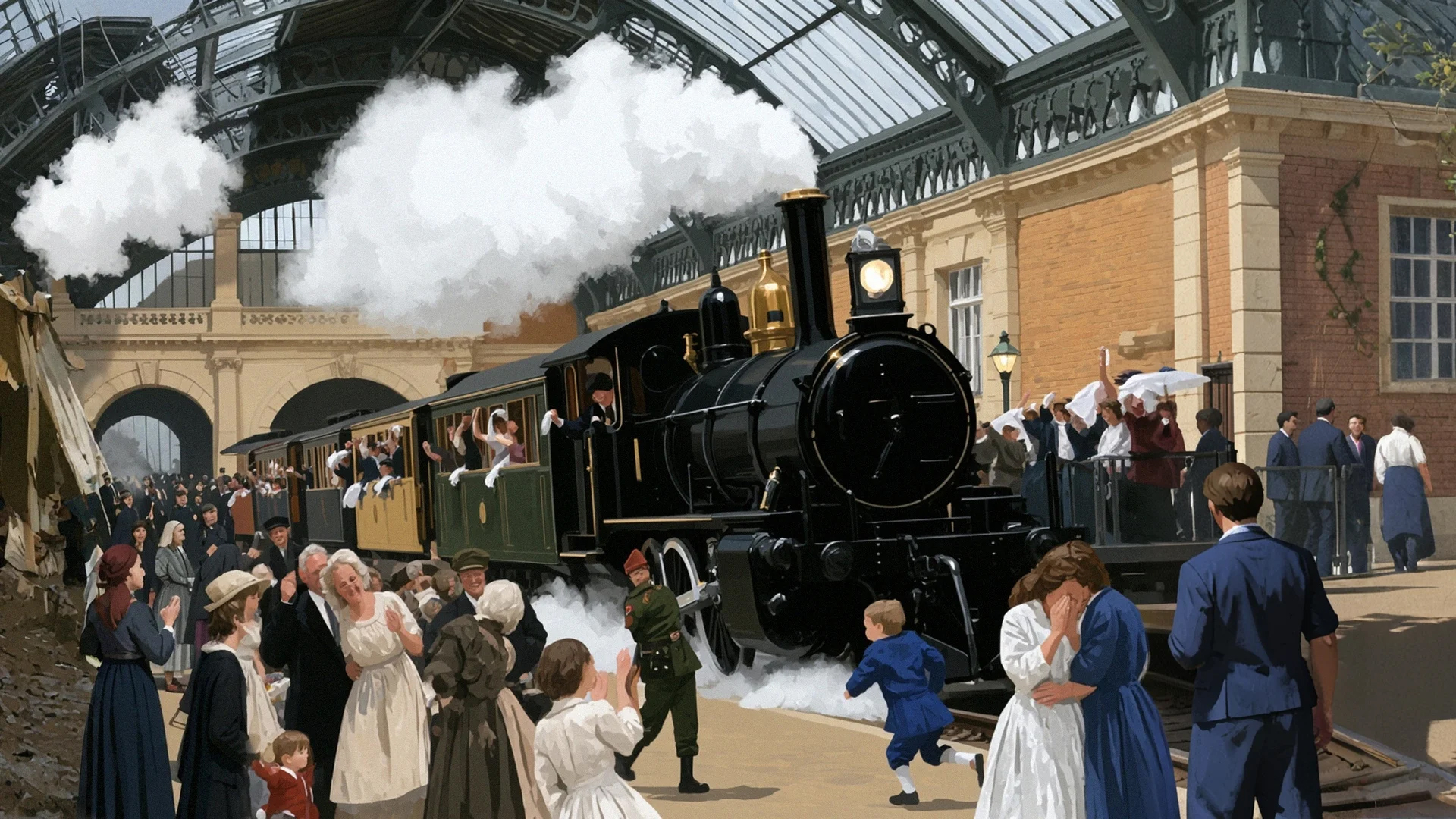
When the Hand Comes Down
I've watched this happen on enough platforms to know it isn't really about the goodbye.
It's what happens after. The hand that stays up a little too long, at nothing at all.
I've done it myself. Held my arm up at a window that was already gone, because stopping too fast would've been its own kind of statement.
Everyone seems to solve it differently — like it's arithmetic nobody's compared notes on.
There's a woman on platform two, doing it right now.
Her hand is already up by the time she notices it's moving.
He's still laughing through the glass about something. Probably the flask she forgot to pack — the thing they'd been going back and forth about for ten minutes on the platform. Then another window is where his face was. Then another. Then nothing she recognizes.
She knew it a window or two ago, if she's honest.
The train is only sound now, gone around the curve. Everyone else on the platform is already turning back toward the stairs, eyes following the noise instead of her.
Her hand hasn't caught up.
The air is hot metal and paper cups gone lukewarm. Somewhere behind her, a trolley wheel catches on the same loose tile, again and again, someone dragging it without noticing the rhythm they've made. A voice on the speaker reads out a platform change in the same flat register it uses for everything — arrivals, warnings, a lost child's description.
She could lower her arm now. Nothing's stopping her.
Except that stopping this soon would mean admitting something. That this wasn't as big as she let it look a second ago, waving like he was leaving the country and not just going two stations up the line, back Thursday. That she can, in fact, just turn it off.
So it stays up. A little foolish now. Waving at the curve, at the idea of a train more than the train itself.
Not just platforms, either. A hand can rest on a doorframe long after an argument's already over. The fight's done. The hand hasn't heard yet.
A man by the tea stall is doing something like it too, at the edge of her vision, lips moving, counting toward some number only he knows.
Further down, a boy is waving with both hands at a train that's already long gone. Nobody's told him yet that there's supposed to be a right time to stop.
Near the bench, an older couple lower their arms at the exact same moment, without needing to check with each other. Forty years of practice, maybe. Lucky.
A teenage girl a few feet away yanks her hand down after barely two seconds, glancing sideways as she does it. As if she's just been seen wanting something. The hand goes into her pocket a moment later, and stays there.
She checks — quickly, and hates herself a little for checking — whether anyone's watching her the way she just watched the girl.
No one is. The platform has already moved on without her. Which should make this easier. It doesn't, quite.
Her hand comes down partway. Hesitates there, like it isn't sure it's been given permission. Then finishes coming down on its own, a few seconds later. The same way it went up, without asking her first.
She looks at her own palm for a moment, faintly surprised to find it empty.
Her shoulder aches, a little, now that there's nothing left to hold up.
The hum is gone now. Just the ordinary noise underneath it — pigeons, the trolley wheel, someone's radio too loud near the stairs.
She picks up her bag. Checks the time, though she already knows it, more or less. Walks toward the stairs, past the tea stall, without checking whether the man's arm has come down yet too.
Nothing happened, really.
Just a hand, coming down, on a schedule nobody wrote but her.