Dubai Weather: 12 Months of Heat, Cold, Rain and Some Surprises
Dubai is known as a city of sun, heat and not much rain. That is mostly true. But if you stay here for some time, you start to notice the weather is not always that simple.
I looked at one full year from September 2025 to August 2026 to see how much the temperature actually changes.

Artistic picture of Dubai from the sea showing some of the city's iconic landmarks in different weathers
The difference between winter and summer is bigger than many people think. There was also one period in March when the weather became very active, with heavy rain, strong winds and rough seas in some parts of the UAE.
Dubai's weather month by month
| Month | Monthly high | Monthly low | What stood out |
|---|---|---|---|
| September 2025 | 43.7°C (110.7°F) | 28.6°C (83.5°F) | Still very much summer. Heat stayed strong but started going down near the end. |
| October 2025 | 40.0°C (104.0°F) | 25.9°C (78.6°F) | Change became noticeable. Nights got cooler but days could still reach 40°C. |
| November 2025 | 34.9°C (94.8°F) | 19.4°C (66.9°F) | Much more comfortable. Evenings cooler and outdoor life easier. |
| December 2025 | 32.4°C (90.3°F) | 13.5°C (56.3°F) | Real winter feeling at night. Some rain and stronger winds appeared. |
| January 2026 | 28.1°C (82.6°F) | 14.7°C (58.5°F) | Coldest month for low temperature. Some windy periods made the sea rough. |
| February 2026 | 32.5°C (90.5°F) | 15.9°C (60.6°F) | Temperatures started rising again. Winter conditions still possible at night. |
| March 2026 | 35.4°C (95.7°F) | 19.8°C (67.6°F) | The most unusual month. UAE had unstable weather with heavy rain, strong winds and rough seas. |
| April 2026 | 40.2°C (104.4°F) | 25.9°C (78.6°F) | Summer returned quickly. Big difference from March. |
| May 2026 | 42.5°C (108.5°F) | 24.5°C (76.1°F) | Heat got serious again. Daytime temperatures often in the 40s. |
| June 2026 | 45.1°C (113.2°F) | 28.2°C (82.8°F) | Proper summer arrived. Nights became much warmer too. |
| July 2026 | 48.2°C (118.8°F) | 30.3°C (86.5°F) | Hottest point of the year. Airport recorded 48.2°C (118.8°F). |
| August 2026 | 47.5°C (117.5°F) | 31.9°C (89.4°F) | Still extreme summer. Even the monthly low stayed near 32°C. |
The chart tells the story better
Looking at numbers one by one, it is easy to miss the change.
On the chart, it is clear.
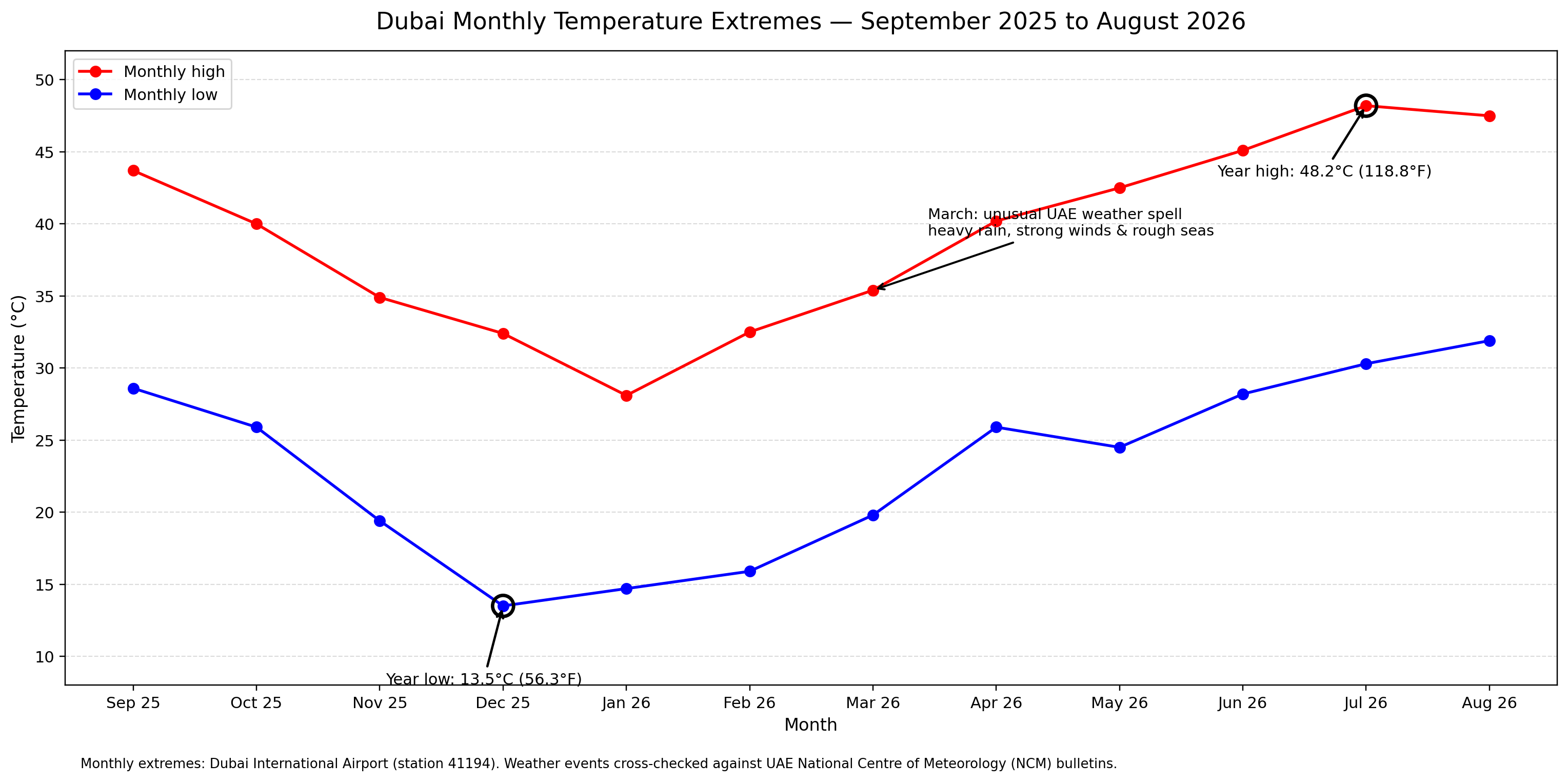
High temperatures fall from 43.7°C in September to low 30s by December. Winter minimum drops into the teens. Then it climbs again and does not stop until July and August.
The biggest difference was between the 14.7°C (58.5°F) low in January and the 48.2°C (118.8°F) high in July.
That is 33.5°C (60.3°F) difference.
14.7°C is not freezing. But for Dubai it can feel cold if you are used to the normal heat.
Then July comes.
At 48.2°C, it is a totally different kind of weather.
March was the unusual month
The heat did not surprise me the most.
March did.
The UAE had several unstable weather periods during March. The National Centre of Meteorology (NCM) issued warnings about clouds, rainfall, strong winds, dust and rough seas.
The most active time was around the last week of March.
For Dubai, NCM bulletins on March 25–27 described rain and winds reaching 60 km/h (about 37 mph). The Arabian Gulf was moderate to rough, with waves reaching 8 feet.
That is quite different from the normal Dubai picture.
Other parts of the UAE saw heavier rain. NCM figures reported by Emirates News Agency showed Ajman had 93.3 mm on March 23. On March 26, Ras Al Khaimah, in the up north had 77.5 mm.
Some totals across the March 21–28 period went above 200 mm in some areas.
So March was exceptional. But I would not say Dubai itself got 150 mm or broke a record. Those claims were in earlier versions but I could not properly verify them. The bigger totals were in other parts of the UAE.
The sea was part of it too
Dubai's coast usually looks calm, especially in summer.
But when wind picks up, the Arabian Gulf changes fast.
NCM's March bulletins for Dubai described the sea as moderate to rough with waves 6 to 8 feet. Strong winds also caused dust and lower visibility.
There were rough sea periods earlier too. In January, NCM described the Gulf as rough to very rough with waves around 9 to 10 feet.
So if you see Dubai from the sea, the weather story looks different from the normal picture.
The 48.2°C at Dubai Int'l Airport in July earlier this year is the highest in this 12-month data. But that does not mean it is an all-time Dubai record.
Dubai has recorded higher temperatures before.
Same for March rain. The March 2026 event was exceptional and described as one of the heaviest March rainfalls in decades, yet it was not close to the April 2024 UAE rainfall. NCM confirmed 254 mm in Al Ain region in less than 24 hours during that event.
What to expect if you come to Dubai
Dubai does not have four equal seasons like many other countries.
There is a long hot season, a comfortable winter period, and transitions in between.
From June to September, heat is the main story. July and August are hard if you are not used to mid-40s.
From November to March, weather is much easier. People spend more time outside, sit in cafés, walk on beaches and enjoy the city.
But winter is not perfect every day. Fog, rain, strong winds and rough seas can still happen.
And transition months can surprise you. One week feels comfortable and the next already feels like summer is back.
Simple conclusion
Looking at the whole 12 months, the interesting part is not just that Dubai gets hot.
Everybody knows that.
It is the range.
We went from 14.7°C (58.5°F) to 48.2°C (118.8°F) at Dubai International Airport in this 12-month period.
We also had fog, rain, strong winds and rough seas, including a very active weather spell in March.
So if you are coming to Dubai, yes, bring your sunglasses.
But if you are staying through winter, keep a jacket somewhere.
You might actually need it.
Most importantly: do not panic, you'll see people in warm weather wearing winter clothes next to people wearing swim suits, those wearing the winter clothes are of two groups: the snowflakes, and those whose jobs need them to stay in air-conditioned rooms that with the lack of too much mobility would feel much colder. Either way, for a visitor, by the time you gain the 'Dubai experience', you'll be on your way to your next destination.
Disclaimer - the above data is informative and indicative derived from more than one authoritative source; it should be used as reference and not treated as absolutely correct. Official data when needed can be found on the UAE's NCM website (ncm.dov.ae), or Dubai Int'l Airport station data from this website.
Dubai's hot temperature is really hot!
0.00 SBD,
0.04 STEEM,
0.04 SP