Ask Better Without Oversharing: A Redaction-First Template for Community Help Posts
The Risk of Oversharing in Troubleshooting
The fastest route to obtaining useful assistance from an online community is sharing a tightly constructed, hyper-accurate example—not your entire life story.
When users encounter technical friction, panic frequently induces the "evidence dump." They paste unredacted server logs, upload full-screen captures revealing confidential bookmarks, and share highly specific project details that have zero bearing on the actual diagnostic process. This oversharing does not accelerate a solution; it merely exposes the user to severe operational and privacy risks.
A truly helpful post provides the community with just enough architectural structure to reason about the issue. It explicitly does not require raw account names, proprietary database structures, personal scheduling details, or a chaotic screenshot of every application you currently have open. The core skill is ruthlessly deciding which minute details mathematically alter the potential answer, and which details exist merely to identify you.
Define the Desired Outcome First
Before you even begin collecting screenshots or copying error codes, force yourself to write a single sentence defining the exact result you require. A laser-focused question prevents the accidental transmission of irrelevant, sensitive material.
A weak question reads: “Why is this database broken?”
A vastly superior question reads: “Why does the public-facing directory display the legacy title after I modified the asset name and executed a hard refresh?”
The superior iteration names the specific digital object, the expected behavior, the observed anomaly, and the singular action already attempted. It provides the community with a definitive starting point without ever exposing the proprietary account structure, the actual URL of the directory, or the sensitive asset itself.
The Minimum Useful Example Framework
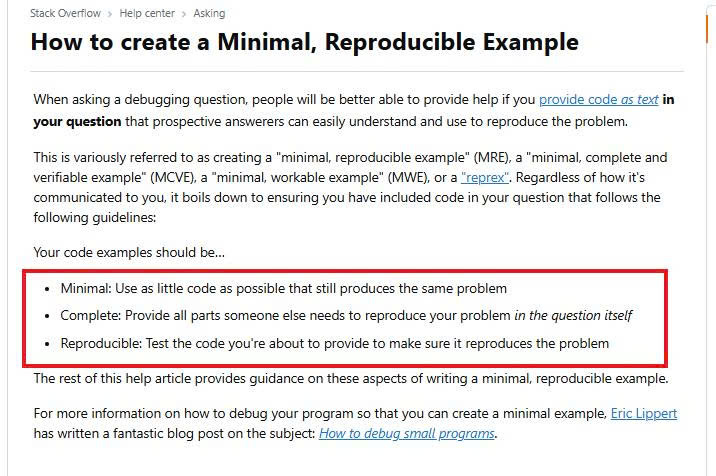
A Minimum Useful Example (MUE) is the absolute smallest, safest data sample that still accurately reproduces the problematic behavior. It must contain five distinct elements.
Goal: What specific transaction you are attempting to complete.
Expected Result: The exact outcome you logically anticipated.
Observed Result: The precise anomaly that occurred instead.
Relevant Conditions: The specific device class, browser family, subscription tier, or regional setting—but only if those variables demonstrably alter the behavior.
Executed Attempts: The exact two or three troubleshooting checks you have already finalized.
Do not arbitrarily inject details simply because they are easily accessible. The exact manufacturer of your laptop rarely matters for a CSS rendering issue. However, it matters immensely for a hardware-specific graphics driver failure.
Whenever feasible, engineer a completely fresh test sample. Attempt to reproduce the anomaly utilizing a disposable dummy title, an entirely blank test file, or a public asset devoid of any proprietary metadata. A sanitized sample is infinitely easier for external developers to comprehend, and it allows you to safely abandon the post online long after the crisis is resolved.
The Three-Column Redaction Protocol
Subject every single detail to a strict classification pass before clicking publish. The objective is not the blind deletion of all data; the objective is the preservation of diagnostic value while aggressively mitigating exposure.
Keep Exact: Preserve verbatim error wording, the strict chronological order of actions, and public feature nomenclature.
Generalize Aggressively: Replace specific client names with generic placeholders. Swap an exact timestamp for "shortly after the morning update."
Remove Completely: Eradicate all passwords, recovery tokens, internal database IDs, proprietary draft documents, and session cookies.
Generalization is your most powerful tool. Transforming a highly confidential project name into Project Alpha preserves the necessary relational logic. Replacing an exact proprietary domain with organization-managed-portal maintains the crucial access context without broadcasting your internal architecture to the open web.
Be highly suspicious of seemingly harmless data combinations. A specific job title, combined with a small geographic town, a specific event date, and a highly unusual device configuration can instantly identify a user even when each individual detail appears benign.
Structural Integrity Through Consistent Stand-Ins
Redaction is useless if it destroys the underlying pattern causing the error.
If three separate assets behave differently, you must maintain three distinct stand-ins. If database capitalization triggers the error, your sanitized stand-ins must preserve that exact capitalization structure.
High-quality stand-ins maintain relational logic. ConfidentialClientName must consistently become ExampleGroup throughout the entire post. Do not casually switch labels mid-paragraph. A proprietary internal folder tree should be sanitized to Root > ActiveProjects > SampleAsset. If numerical scale impacts a formatting error, ensure your sanitized dummy values utilize a mathematically similar scale.
Never invent a successful test that you did not actually execute. If you cannot safely reproduce a scenario, explicitly state that limitation.
Forensic Screenshot Sanitization
Treat a screenshot as raw, potentially toxic data, not a decorative visual aid.
A careless full-screen capture routinely exposes far more than the targeted error dialog. Browser tabs, internal corporate bookmarks, pending email notifications, account avatars, visible file paths, and background messaging windows are all instantly broadcast to the public.
Demand a tight, highly restrictive capture of the relevant panel exclusively. Close all unrelated applications and tabs before initiating the capture. Utilize built-in export functions when they generate cleaner, smaller assets. If you utilize an editing tool to draw a black box over a sensitive region, rigorously verify the final flattened image export. Many modern screenshot utilities use removable layers that a malicious actor can simply delete.
If text alone is sufficient, type the exact error code. Do not upload an image merely to prove the error exists.
Discovery Separation via External Directories
Navigating the fragmented ecosystem of specialized developer forums and software communities frequently requires external indexing. Utilizing an aggregator like 주소타임 주소모음 accelerates the discovery of relevant help portals by bypassing generic search engine noise.
However, you must maintain a strict separation between discovery and interaction. A centralized directory excels at pointing a researcher toward a potential community, but it provides zero protection once you begin typing your request. Treat the collection merely as an orientation point. Once you arrive at the target forum, you must independently deploy your redaction protocols based on that specific community's visibility and archival rules.
Structured Evidence Presentation
Community experts can diagnose issues exponentially faster when your post follows a rigid, logical hierarchy.
Outcome: A single sentence defining the desired result.
Delta: A stark contrast between the expected and observed results.
Reproduction: A numbered, sequential list of steps starting from a known baseline state.
Environment: A highly curated summary of only the conditions capable of altering the outcome.
Validation: A precise log of attempted fixes and their specific results.
Boundaries: Explicitly state what proprietary data you cannot share. This prevents endless, unhelpful requests for confidential material.
Defensive Follow-Up Protocols
A reply requesting additional data from a community member is not automatically reasonable or safe.
Demand justification. A competent helper should easily articulate exactly why a specific server log segment or configuration setting is mathematically necessary for their diagnosis.
Provide the absolute minimum additional detail required. If an expert requests a full application log, do not comply. Search for the specific error event, sanitize that isolated block, and share only that fragment. If a user abruptly requests direct account access, remote desktop control, or demands a private encrypted messaging session, terminate the interaction instantly. Route all deep administrative issues through the platform's official, documented support channels.
The ultimate value of community help lies in structural clarity, not indiscriminate exposure. Preserve the logical pattern, aggressively strip away your identity, and provide the community with a narrowly defined question they can actually solve.