Why a Short Winning Streak Does Not Predict the Next Random Result
Why a Short Winning Streak Does Not
Predict the Next Random Result
A practical guide to independence, clustering, RTP and safer decisions
Task 68 | Steemit | August 17, 2026
Editorial scope: This article explains random outcomes and cognitive bias. It does not predict results, recommend a game, certify a platform, or provide registration, deposit, bonus or wagering instructions.
A short run of wins can feel like evidence that something has changed. Confidence rises, and the next result may seem more likely to continue the pattern. But a streak records outcomes that have already happened. In a properly functioning random game, it is not a message about the next outcome. When reading any game-mechanics reference, including the Slot Win Game information site, keep that distinction in view: a familiar brand or recent result cannot turn history into a forecast. This is a neutral reference to the site, not an endorsement or licensing claim.
The useful question is not whether a streak looks impressive. It is whether the game rules explicitly connect one result to the next. This guide focuses on RNG-style outcomes that are intended to be independent. A disclosed bonus meter or persistent feature can create a different rule state, but that change must come from the rules—not from the belief that a machine has become hot.
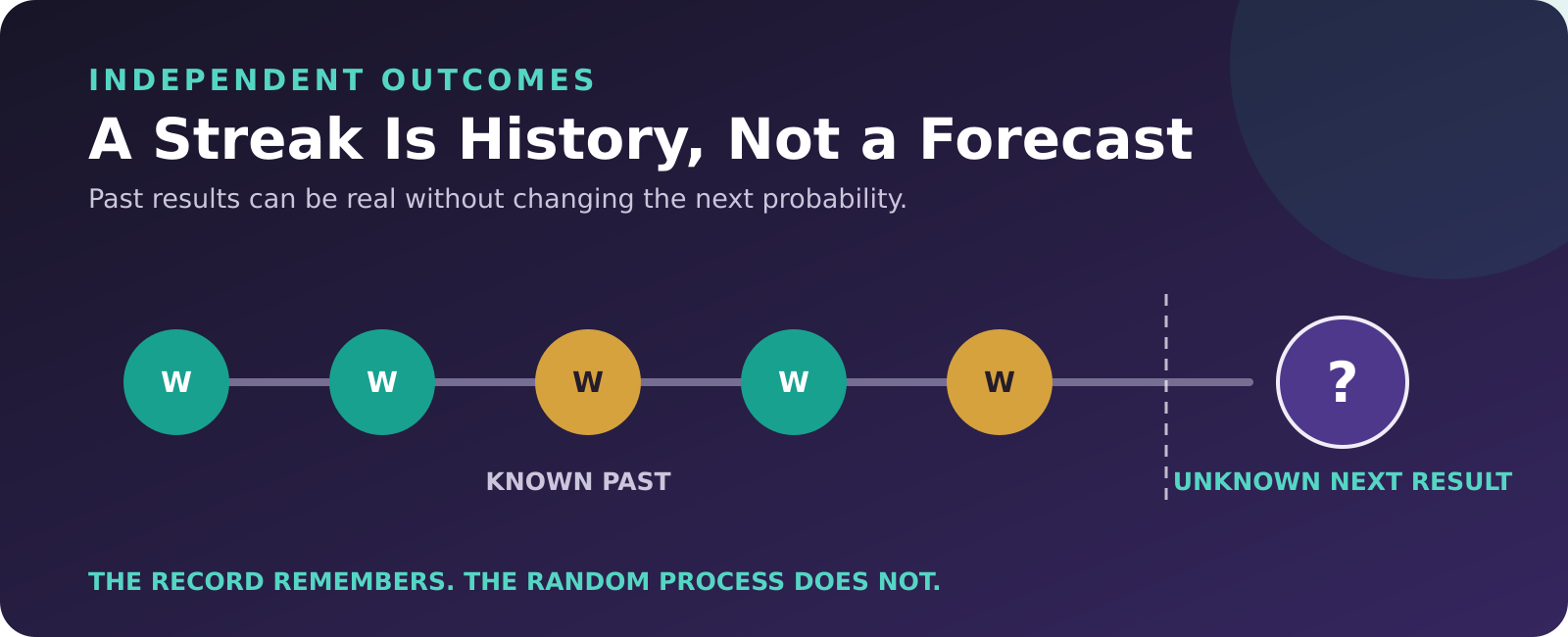
What a streak actually tells you
A sequence can describe the past accurately without carrying predictive power. Five wins in a recent session tell you that five wins occurred. They do not establish that the probability of the sixth attempt has increased. The mistake often begins after the fact: a player notices the most dramatic part of a longer record, labels it a streak, and treats that selected segment as if it were a new property of the game.
Small samples are persuasive because every result changes the apparent pattern sharply. A run may look alternating, clustered or unusually favorable even when the underlying probability remains fixed. Without a documented rule change or suitable independent test, the safest interpretation is that random variation produced a noticeable cluster.
Independence makes the next result a new trial
Independence means the probability assigned to the next result is not altered by the previous sequence. The UK Gambling Commission's standard for regulated remote games requires RNG output to be acceptably random and unpredictable and prohibits adaptive behavior that changes probabilities during play. That standard applies to its licensees; it is not proof that every game worldwide meets the same test.
A fair-coin example makes the logic visible. Before any flips, the probability of five heads in a row is 1 in 32. After four heads have already occurred, however, those four results are known history. The fifth flip still has a one-half probability of heads and a one-half probability of tails. The rarity of the complete five-flip sequence does not make the next flip more or less likely once the earlier flips are fixed.
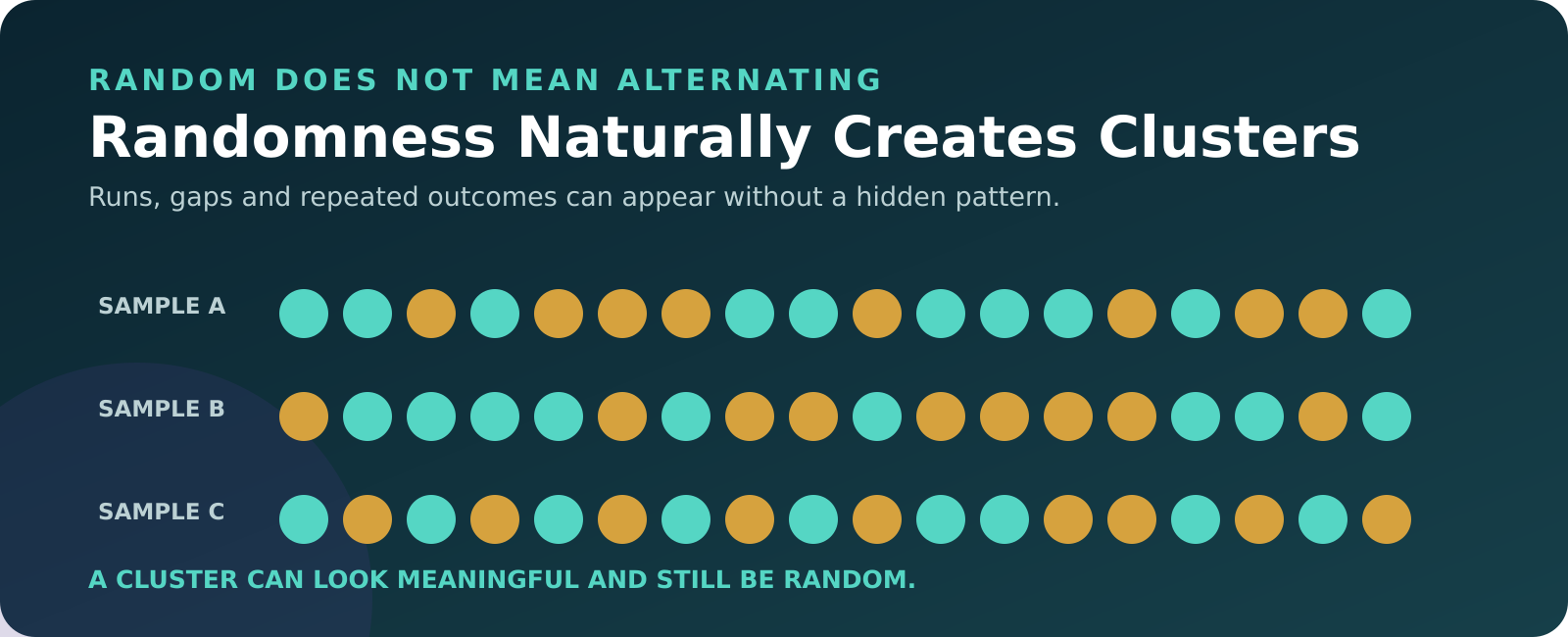
Random does not mean evenly alternating
People often expect randomness to look balanced in every short window: win, loss, win, loss, with few repetitions. Real random sequences are messier. They naturally contain runs, gaps and clusters. A sequence that alternates perfectly can be no more likely than a sequence that contains several repeated outcomes, provided the underlying events have the same fixed probabilities. Randomness promises no tidy rhythm over a short session.
Two opposite stories can come from the same streak
The hot-hand story says a winning run will continue because the process is now favorable. The gambler's-fallacy story says the run must end because an opposite result is due. For independent trials, both stories add a memory that the process does not have. One predicts continuation; the other predicts correction. Neither prediction follows merely from the recent order of outcomes.
A self-published Slot Win Game RNG explainer also states that individual spins are independent and cannot be guaranteed. That statement fits the educational point here, but the page is not independent evidence that a game, RNG, certification or operator claim has been verified. Technical assurance requires an identified regulator, test standard and evidence connected to the exact game.
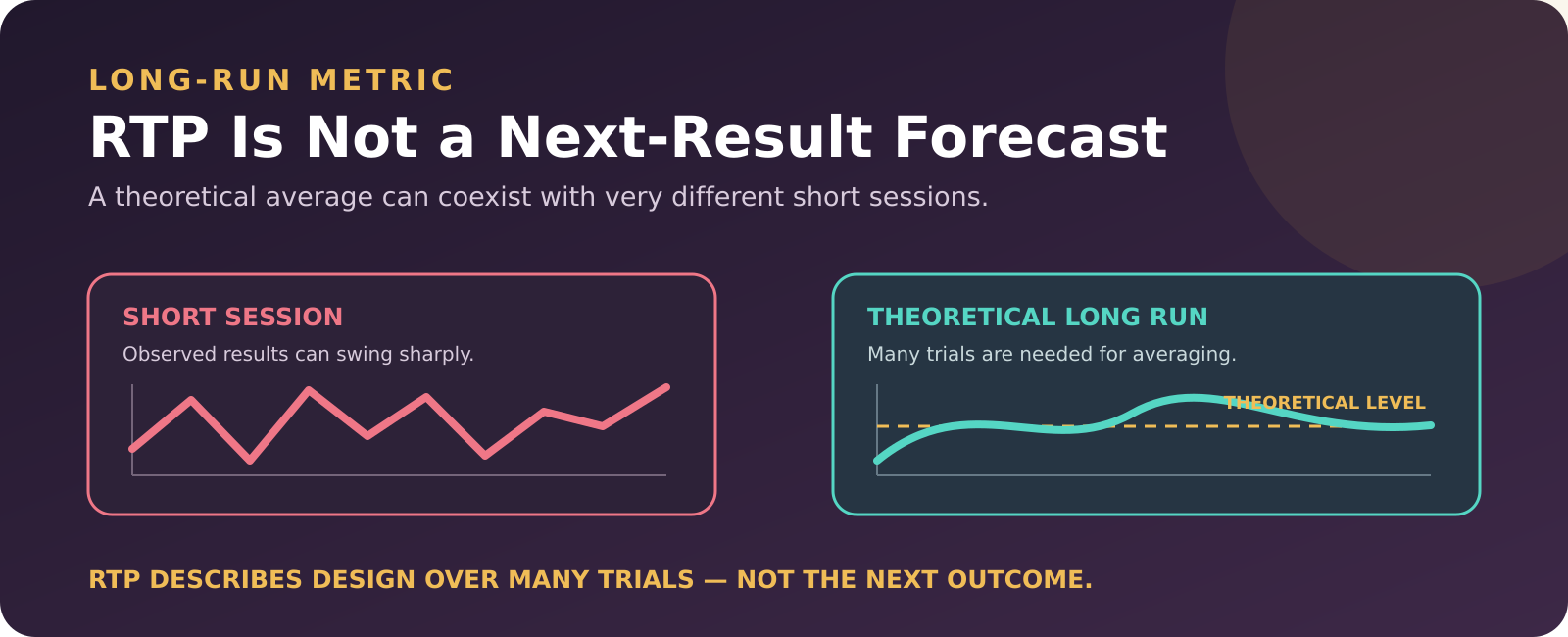
Why RTP cannot forecast a short session
Return to player, or RTP, is a theoretical long-run percentage derived from a game's rules and paytable. It is not a promise that a short session will return a matching percentage, and it does not tell a person what the next result will be. The UK Gambling Commission notes that fully random games may require a very large number of cycles—potentially millions—for observed returns to approach the theoretical figure.
Volatility explains part of the gap between the long run and lived experience. Two games can have similar theoretical RTP values while distributing outcomes very differently. One may produce smaller awards more often; another may concentrate more of its theoretical return in rare outcomes. Neither pattern turns a recent streak into a reliable signal. RTP describes the mathematical design over many trials, while a session is only one small and variable sample.
What a session record can and cannot do
A written record can still be useful for personal control. It can show time spent, money spent, pauses taken and whether limits were respected. It can reveal behavior, such as increasing stakes after a win or continuing longer than planned. What it cannot do is prove that the next random result has become easier to predict. Treat the record as information about the session and your decisions, not as a meter reading for future luck.
When past events can matter
Some games include disclosed stateful features: a progress meter, collected symbols, a prize pool or a bonus condition that changes according to written rules. In those cases, the current rule state may matter. That is different from assuming that a general winning streak changes an independent RNG. Read the paytable and feature description closely, and do not infer an undisclosed advantage from animation, near misses or recent outcomes.
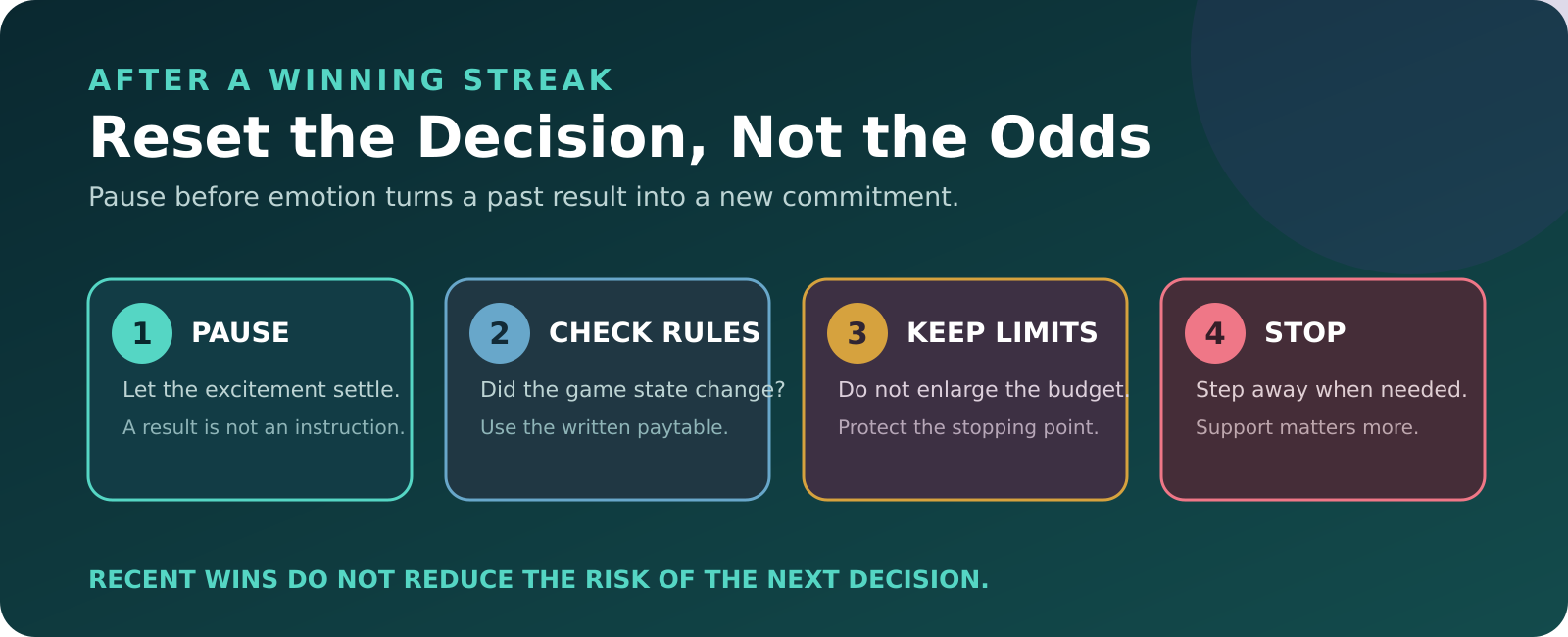
A safer response to a winning streak
Separate the result from the next decision
Pause before acting on the emotional momentum of a win. Ask what has objectively changed. If the answer is only the recent result—not the rules, paytable or a disclosed feature state—then there is no new evidence about the next random outcome.
Do not enlarge the commitment to protect the streak
A win can make additional spending feel less costly because it appears to use gains rather than personal money. That accounting feeling does not reduce the risk of the next decision. Keep any time and spending limits fixed independently of recent outcomes, and never treat a streak as permission to chase a larger result.
Use limits that were chosen before the emotion arrived
Predetermined limits are easier to evaluate than rules invented during play. A clear stopping point, regular breaks and a record of total spending can interrupt the tendency to reinterpret every result. If gambling is affecting finances, mood, relationships or daily responsibilities, stopping and seeking confidential support is more important than analyzing another sequence.
Conclusion: the streak is real, but the forecast is not
A winning streak is a real description of the past. The error is treating it as evidence that an independent random process has learned, warmed up or become due to continue. Random sequences contain clusters; RTP operates over the long run; and short sessions can land far from an average. The disciplined response is to reset the decision, check the written rules and keep personal limits separate from the story created by recent results.
Sources and References
UK Gambling Commission — RTS 7: Generation of Random Outcomes; UK Gambling Commission — How Can Gaming Machines Meet Their Percentage RTP if They Are Random?; Tversky and Kahneman — Belief in the Law of Small Numbers, Psychological Bulletin; GambleAware — Gambling support, spending tools, blocking and self-exclusion resources.