"I'll Know It When I See It": Why Bedroom and Price Filters Can't Capture What Buyers Actually Want

This is something almost every agent hears sooner or later. The buyer has filled out the intake sheet, answered all the questions and selected a list of properties. By the fourth or fifth viewing, they will shrug and smile slightly before saying, "I will know it when I see it."
Of course, this can be perceived as vague language or as a sign that the buyer has not thought carefully enough about what they want. However, in reality, this is one of the most sincere things a buyer can say. This shows how difficult it is to describe those elements that matter most to them using search criteria alone.
However, the whole system of property search, including portals, CRM filters and the shortlists that agents create manually, revolves around precisely these fields: price, number of bedrooms and bathrooms, square footage and location. These are attributes that are easy to store, sort and compare. For many buyers, however, they are only loosely connected to the reasons they ultimately choose one home over another.
This article will focus precisely on this paradox: why filters fail to capture buyers’ real preferences, what buyers actually respond to when they walk into a home and feel drawn to it and why the next generation of recommendation engines should focus more on taste than on data.
Why buyers can't tell you what they want
There is a temptation to believe that the answer lies in better questions. If the buyer cannot describe their taste, perhaps the agents just have to ask better questions. This can help, but only to an extent, because the problem does not lie in the questions. The problem lies in how human preferences work.
Psychologists have long noted that people are generally not good at explaining the reasons behind their own choices. People first have an intuition about something they prefer and then come up with an explanation later on. The buyer who falls in love with a house because of the way afternoon light falls on the staircase may later explain the choice by pointing to an additional room or the school district. The reason they give may be genuine, but it does not tell the whole story.
Preferences are also likely to be revealed by contrast rather than described in the abstract. People generally cannot describe what type of kitchen they want ahead of time, but they can respond immediately to three kitchens in a row. Their taste emerge through comparison and become clearer as buyers see more options. What this means is that the buyer does not have a fully detailed specification stored in their mind that waits only to be elicited. They build it as they go.
This is the reason why buyers who start out with a simple list of requirements often end up making unexpected choices. The checklist was only an initial guess. Their real preferences emerge one reaction at a time.
The cost of filtering on the wrong things
When search and recommendation rely entirely on structured attributes, the damage is quiet but real.
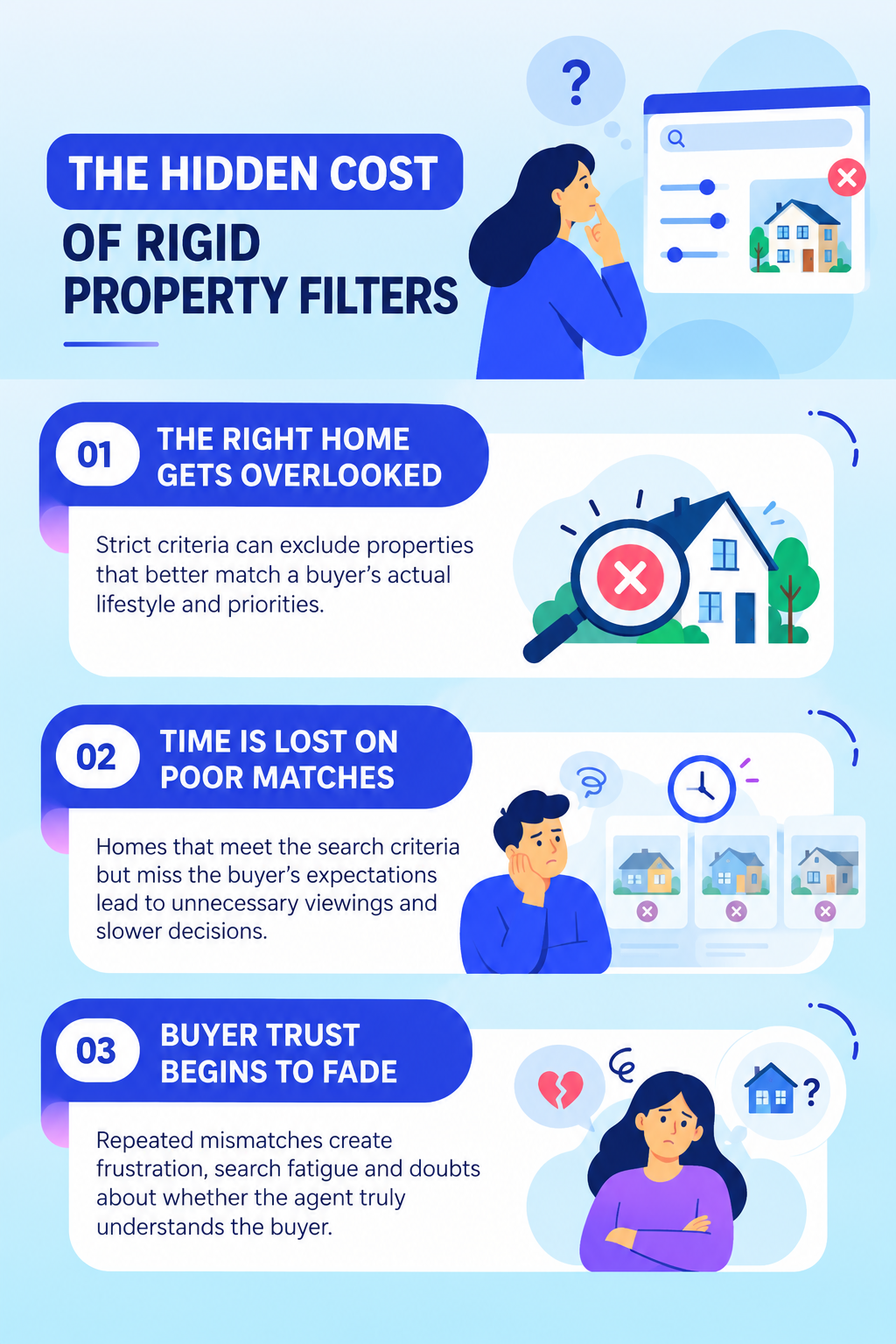
The right home never makes the list
The buyer who insisted on three bedrooms will never be shown the house with two bedrooms and an ideal study, even though that may well have been the house they would have loved. The buyer who decided on a firm search radius will never be shown the house that lies just outside it, but has the garden they desire. Filters exclude properties based on fixed rules, but those rules cannot identify which exceptions matter.
The wrong homes eat up everyone's time
The other type of mistake occurs equally often. A buyer gets a list of houses that meet the criteria, views several houses, but feels no connection with any of them. Each one takes the buyer an afternoon and the agent a block of time in their calendar. If the shortlist has been made based on the wrong signals, then the task is one of elimination, not quickly finding the right home.
Buyers lose confidence in the process
Undoubtedly, one of the biggest costs is emotional. A purchaser who continuously sees properties that seem perfect on paper but are not quite right in person feels disillusioned with the process and eventually begins to doubt whether the agent understands them. Fatigue kicks in. Some buyers stop searching for a while, while others quietly switch to another agent or platform, hoping for a fresh start.
The problem in all these cases remains the same: the system is optimized for what it can measure, rather than what the buyer actually responds to.
What buyers reveal without saying a word
Here is the encouraging part. Despite the difficulties buyer faces in defining their own taste, they express it constantly through actions.
When the buyer goes through listing photos, they do not show an equal level of interest in each photo. They pause on some rooms, return to certain angles and quickly pass over other photos. In the listings they save or mark as favorites, there may be common qualities among the homes, even if the buyer would never explicitly list them. When they click through to a neighborhood page or floor plan, they reveal what they are trying to understand.
In several dozen exchanges, patterns emerge that are not discernible from any intake form. The buyer who saves listings with large windows, light color schemes and open floor plans has made their taste known. The buyer who continually lingers over images of offices, quiet streets and extra rooms has revealed a lifestyle priority. The buyer who continually clicks on listings within walking distance of parks and coffee shops, regardless of price and size, has expressed a preference for a particular kind of neighborhood life.
This is the building block of taste. It is visual, contextual and cumulative and it is exactly the kind of information traditional filters cannot capture.
From attributes to taste
The new approach to property recommendation takes this behavioral and visual trail as the principal signal, rather than an afterthought, asking instead which listings are similar to those that this buyer has interacted with.
This is the same shift that has happened in other recommendation domains, like music, movies and shopping. When services like Spotify or Netflix make recommendations, they are often not driven by categories alone. They learned that two songs in the same genre can sound nothing alike and that two songs with different genres can be liked by the same person. The signal that matters most is not genre alone but patterns of engagement.
Real estate is now reaching the same realization and AI makes it practical. Modern models can analyze listing photos using computer vision to recognize qualities that people react to but rarely put into words: how bright a space is, its style, its layout, the materials used and its mood. Combined with the buyer's behavior, these models can build a picture of what that buyer tends to like and identify homes that match those preferences, including ones that would never survive a traditional filter.
The result is a different kind of shortlist. Instead of a list of homes that check boxes, the buyer gets homes that are like the ones that they've already responded to and a few thoughtful surprises that extrapolate the pattern. It's less of a search and more of feeling understood.
Lifestyle is the missing variable
Visual taste is only part of the story. Just as important is the buyer's lifestyle, the practical shape of the life they want to lead.
Two buyers with identical budgets and bedroom counts may have very different needs. One buyer may need a short commute and a train station within walking distance, while the other may want a garden and a quiet cul-de-sac. One buyer may want a vibrant street with restaurants downstairs, while another may want a view and silence. They may have similar stated criteria, but their ideal homes will be located in different parts of the city.
Lifestyle preferences are seldom shared in the intake form, but they often reveal themselves through actions. The areas where the buyer continues to explore, the amenities they view, the commute times they check and the features they save all reveal their preferred way of life. A machine-learning system that learns to understand these clues could recommend properties based on the lifestyles those properties make possible.
This is where recommendation becomes really valuable to agents. An agent that knows that a buyer is interested in walkable communities and light-filled open interiors can curate with confidence and can open a viewing by saying, "I think you'll like this one and here's why." That's a very different opening from, "this one meets your criteria."
What agents gain from understanding taste
The benefits for brokerages are practical rather than abstract.
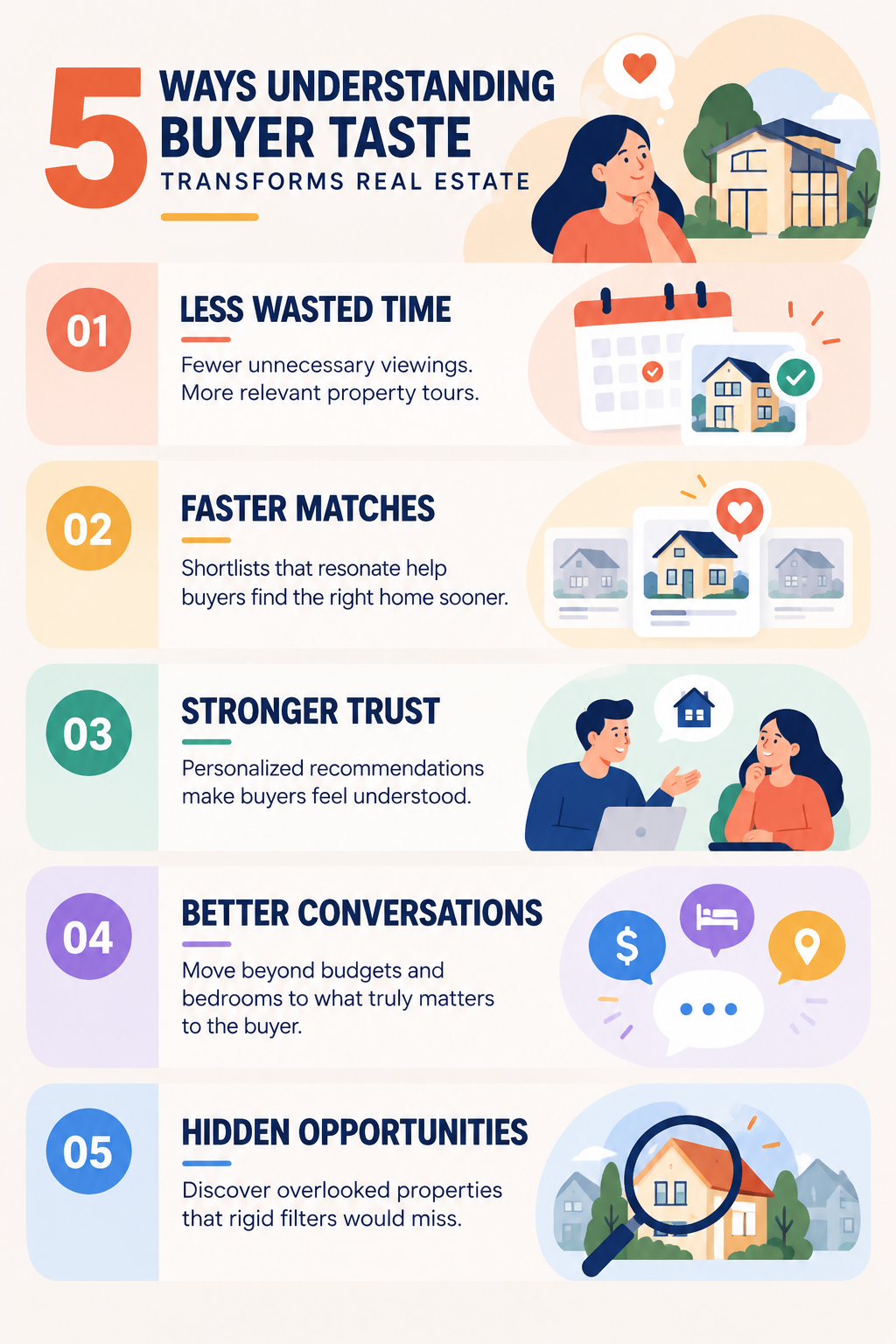
Fewer wasted viewings
If the shortlist is a true reflection of the buyer’s taste, more of the viewings will result in real interest. Buyers can find the right home after fewer viewings and agents spend less time on properties that were never going to be right for the buyer.
Faster convergence
Rather than gradually whittling down a larger number of choices, buyers rapidly zero in on a smaller number of homes that really speak to them. Shorter searches mean fewer buyers become fatigued and drift away.
Stronger relationships
A buyer who feels understood trusts their agent more. Recommendations that seem to anticipate their taste create the impression of an advisor who truly pays attention.
Better conversations
It helps realtors have something concrete to discuss because they know how the buyer reacts to light, layout or neighborhood characteristics. Communication shifts from property specifications to what the buyer is actually looking for in a home.
Discovery of overlooked inventory
Some of the best matches include houses that would not appear in a conventional search. By using taste-based matching, brokerages can identify properties that do not strictly fit the criteria but are a good fit for a particular buyer.
Keeping judgment in the loop
The error lies in using taste-based recommendations to replace an agent’s judgment. An algorithm can detect patterns, but it cannot sit across from a buyer and sense hesitation, hear the concerns of a partner or understand the circumstances behind a decision.
The ideal way to deploy visual and lifestyle matching is as a tool that enhances the agent’s own judgment. It helps bring up properties that the agent may have overlooked, provides evidence to support their hunches and saves time that would otherwise be spent creating shortlists manually. The agent continues to be the interpreter and guide.
However, brokerages should also think through how these tools learn. Preferences should be viewed as suggestions that a buyer could amend; they should not be rigid tags. If a buyer starts moving from a minimalist style toward a warmer one, the system recommendations should be adjusted accordingly. In addition, transparency is important. Buyers are generally comfortable with personalized suggestions when they understand that the recommendations reflect the homes they have been exploring.
Practical steps for this quarter
There is no need to replace the technology stack to begin shifting from property attributes to taste. A few actions are enough for you to begin.
Add a taste question to intake. In addition to the usual criteria, ask the buyer to recall a house they loved, in any city and at any point in their life. Ask what they liked about it. Their answers can reveal more than just the number of bedrooms they want.
Show before you ask. Rather than asking buyers to describe their preferences abstractly, give them a selection of contrasting interiors and see how they respond. Even those buyers who can’t define a style can often point to the one they prefer.
Review saved homes together. It is a good practice to review any favorite properties of a buyer and try to find out what they have in common. Many things that buyers did not notice before become apparent.
Widen the shortlist deliberately. Add one or two houses that don’t necessarily meet all criteria specified by the buyer but match their revealed taste and explain why you included them. Monitor buyer reactions.
Measure viewings per offer. Note the number of house showings taken by the average buyer before making an offer. If the number is high, there may be room to improve your shortlisting process.
Evaluate tools that read images and behavior. When evaluating recommendation tools, look for AI-driven real estate property recommendation platforms that learn from photography and engagement, not just from the structured fields on a listing.
Teaching the search to see
"I'll know it when I see it" is not a failure of communication but rather an accurate description of how people pick their homes. Preferences reside in light, flow, proportion and the imagined shape of daily life and these do not fit neatly into a box on a search form.
The solution to decades of trying to build better boxes is simple – stop putting taste in a box altogether and start learning it based on what the buyer does – what they linger on, save and keep coming back to.
The brokerages that take this path will not only provide better curated shortlists to their customers. They will be able to give their buyers a rare experience in such a stressful situation – the experience of feeling understood before they can fully express what they are looking for.