What performance of PV inverters can a regenerative grid simulator test?
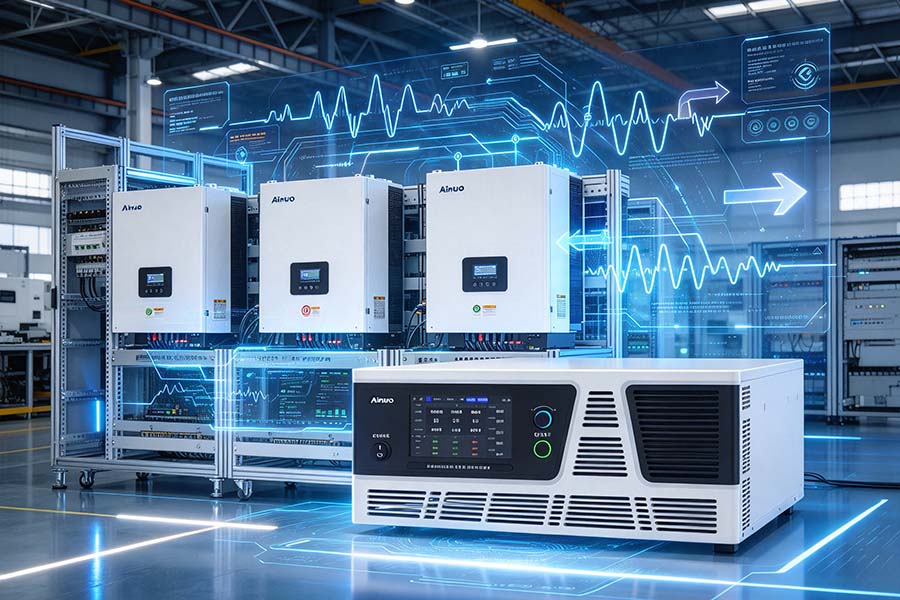
Photovoltaic (PV) inverters play a critical role in converting solar-generated DC power into AC power that can be used by the electrical grid. As solar energy adoption grows, ensuring inverter efficiency, grid compatibility, power quality, and operational reliability becomes increasingly important. A regenerative grid simulator provides a controlled testing environment that enables engineers to evaluate PV inverter performance under normal, abnormal, and dynamic grid conditions.
Unlike conventional grid simulators that primarily supply AC power, a regenerative grid simulator can also absorb and return power to the grid or a shared DC bus, depending on its architecture. This capability supports energy-efficient testing of grid-connected inverters, particularly in high-power applications.
So, what performance parameters of photovoltaic inverters can a regenerative grid simulator test? This guide explores the key electrical characteristics, grid-support functions, protection mechanisms, and advanced operating behaviors that engineers can evaluate using a regenerative grid simulator.
1. AC Output Voltage and Frequency Response
One of the fundamental tests for a PV inverter is its response to changes in AC grid voltage and frequency. Real-world grids experience fluctuations caused by changing loads, renewable energy generat ion, switching events, and grid disturbances. A regenerative grid simulator allows engineers to reproduce these conditions in a repeatable test environment. Key parameters include:
- Voltage regulation: How the inverter responds to changes in grid voltage within its specified operating range.
- Frequency response: Whether the inverter maintains stable operation as grid frequency varies.
- Operating range: The voltage and frequency limits within which the inverter can connect to and operate with the grid.
- Dynamic response: How quickly the inverter adjusts its output following voltage or frequency changes.
By programming different voltage and frequency profiles, engineers can assess whether a PV inverter operates as intended and complies with applicable grid-connection requirements.
2. Power Quality and Harmonic Distortion
Power quality is a major consideration for grid-connected photovoltaic systems. Inverters use power electronic switching to convert DC electricity into AC electricity, which can introduce harmonics and other unwanted disturbances if not properly controlled.
A regenerative grid simulator can support power-quality testing by providing controlled grid conditions and enabling repeatable evaluation of inverter behavior.
Important performance indicators include:
- Total harmonic distortion (THD): Measures the harmonic content of the inverter’s AC current or voltage.
- Individual harmonic components: Identifies distortion at specific harmonic orders.
- Power factor: Evaluates the relationship between active and apparent power.
- Reactive power capability: Assesses the inverter’s ability to supply or absorb reactive power.
- Current waveform quality: Helps identify waveform distortion and abnormal current behavior.
Measurements should be taken with appropriate power analyzers and measurement equipment. The grid simulator establishes the required test conditions, while the measurement system quantifies the inverter’s performance.
3. Low-Voltage Ride-Through (LVRT) and High-Voltage Ride-Through (HVRT)
Voltage disturbances can occur when faults, switching operations, or other events affect the electrical grid. Depending on the applicable grid code, a PV inverter may be required to remain connected during specified voltage disturbances rather than disconnecting immediately.
A regenerative grid simulator can reproduce these disturbances by generating controlled voltage dips and voltage swells. Typical tests include:
- Low-voltage ride-through (LVRT): Evaluates inverter behavior during temporary reductions in grid voltage.
- High-voltage ride-through (HVRT): Evaluates operation during temporary increases in grid voltage.
- Voltage recovery response: Examines inverter behavior as voltage returns to its normal range.
- Fault-current response: Evaluates current injection and limiting behavior during simulated grid disturbances, where supported by the test setup.
- Protection coordination: Checks whether the inverter’s protection and ride-through settings respond appropriately.
Engineers can compare the inverter’s measured response with the relevant grid-code voltage-time profile and required operating behavior. Exact test requirements depend on the inverter type, jurisdiction, and applicable standard.
4. Active and Reactive Power Control
Modern PV inverters often provide more than DC-to-AC power conversion. They may also support grid voltage regulation, frequency response, and power management through active and reactive power control.
A regenerative grid simulator enables engineers to establish different grid conditions and evaluate the inverter’s response to control commands. Key tests include:
- Active power control: Verifies the inverter’s ability to adjust real-power output according to a setpoint.
- Reactive power control: Tests the ability to supply or absorb reactive power within the inverter’s operating limits.
- Power factor control: Evaluates operation at commanded leading, lagging, or near-unity power factors, as applicable.
- Volt-var response: Tests reactive power adjustment in response to changes in grid voltage.
- Frequency-watt response: Evaluates active power adjustment in response to grid-frequency changes.
- Power ramp-rate control: Measures how quickly output power increases or decreases.
These tests help determine whether the inverter can follow control commands accurately, maintain stable operation, and provide the grid-support functions required by the application.
5. Grid Frequency Disturbance and Frequency Support
High levels of renewable energy generation can change the operating characteristics of power systems. Grid-connected inverters may therefore be required to respond to frequency deviations and support grid stability.
A regenerative grid simulator can generate programmable frequency profiles to assess inverter behavior under different operating conditions.
Performance tests may include:
- Overfrequency response: Evaluates inverter behavior when grid frequency rises above its nominal value.
- Underfrequency response: Assesses behavior during a reduction in grid frequency.
- Frequency-watt control: Measures active-power adjustment based on a defined frequency-power characteristic.
- Frequency ramp response: Evaluates operation during gradual changes in grid frequency.
- Frequency recovery: Checks how the inverter behaves as frequency returns to the normal operating range.
Where required by the applicable grid code, these tests can also examine response thresholds, time delays, recovery behavior, and the coordination of frequency-control functions.
6. Anti-Islanding Protection
Islanding occurs when a portion of the electrical grid becomes electrically isolated from the utility source while distributed energy resources continue supplying power to the isolated section. Unintentional islanding can create safety and power-quality concerns.
A regenerative grid simulator can contribute to anti-islanding testing by establishing controlled voltage and frequency conditions and supporting test sequences designed to evaluate inverter disconnection behavior.
Depending on the test configuration, the evaluation may cover:
- Inverter response to abnormal grid conditions.
- Disconnection behavior following specified disturbances.
- Interaction between inverter controls and the test system.
- Reconnection behavior after grid conditions return to acceptable limits.
However, a regenerative grid simulator alone does not necessarily complete an anti-islanding test. Standardized anti-islanding procedures may require a dedicated RLC load network, switching equipment, and additional instrumentation. The complete test setup must follow the applicable test standard.
7. Grid Impedance and Weak-Grid Performance
PV inverters may operate in grids with different electrical characteristics, including systems with relatively high source impedance or low short-circuit strength. Such conditions can affect control stability, voltage regulation, and current quality.A regenerative grid simulator with suitable impedance-emulation capabilities can help engineers evaluate inverter performance under weak-grid conditions.
Potential test areas include:
- Grid impedance sensitivity: Examines how changes in simulated source impedance affect inverter operation.
- Control-loop stability: Identifies oscillations or instability associated with grid interactions.
- Voltage fluctuation response: Evaluates inverter behavior under changing grid voltage conditions.
- Resonance and harmonic interactions: Investigates potential interactions between inverter controls, grid impedance, and harmonic components.
These tests are particularly relevant to inverters intended for distributed solar installations, microgrids, and grids with high renewable-energy penetration. The simulator must support the required impedance range and dynamic behavior for these tests to be meaningful.
8. Transient Response and Dynamic Performance
In addition to steady-state measurements, PV inverter testing must consider how quickly and reliably the device responds to changing electrical conditions.
A regenerative grid simulator can generate repeatable disturbances that reveal the inverter’s transient behavior.
Typical evaluations include:
- Voltage step response: Measures inverter behavior after a sudden voltage change.
- Frequency step response: Examines the response to an abrupt change in grid frequency.
- Current overshoot: Identifies excessive transient current during disturbances.
- Settling time: Measures how long the inverter takes to reach a stable operating condition.
- Transient stability: Evaluates whether the inverter returns to stable operation after a disturbance.
- Control interaction: Investigates interactions between voltage regulation, reactive power control, and other inverter functions.
High-speed measurement equipment is often required to capture these responses accurately. The simulator’s transient performance, waveform fidelity, and control bandwidth should be matched to the test objectives.
9. Grid Synchronization and Reconnection
Before a grid-connected PV inverter exports power, it must synchronize with the electrical grid according to its control design and applicable requirements.
A regenerative grid simulator can create controlled voltage and frequency conditions to evaluate synchronization and reconnection behavior. Relevant test parameters include:
- Voltage and frequency acceptance windows.
- Synchronization under varying grid conditions.
- Reconnection delay following a grid disturbance.
- Output-current behavior during reconnection.
- Power ramp-up after reconnection.
These tests help engineers verify that the inverter reconnects under permitted conditions and resumes power export in a controlled manner.
10. Reverse Power Flow and Regenerative Operation
One of the main advantages of a regenerative grid simulator is its ability to handle power flow in both directions, when the system is designed for that purpose. This is particularly valuable when testing high-power PV inverters that would otherwise require substantial energy dissipation during long-duration or repeated tests.
In a regenerative test setup, the simulator can typically supply programmed AC power to the device under test and absorb power returned by the test system. Depending on the architecture, absorbed energy may be returned to the facility supply or circulated through a shared DC bus. Relevant evaluations include:
- Bidirectional power-flow operation: Verifies system behavior during power sourcing and absorption.
- Power exchange stability: Assesses stable operation during changes in the direction or magnitude of power flow.
- Energy recovery: Evaluates the test system’s ability to recover returned energy.
- High-power test efficiency: Reduces the need to dissipate all absorbed energy as heat.
- Long-duration testing: Supports repeated test sequences with lower energy waste, subject to equipment ratings and thermal limits.
It is important to distinguish the regenerative capability of the grid simulator from the power-conversion capability of the PV inverter. Regeneration primarily improves the efficiency and flexibility of the test setup; it does not, by itself, establish the inverter’s compliance or efficiency rating.
11. Efficiency and Operating Performance
PV inverter efficiency is a key factor in solar power system performance. However, efficiency testing requires more than a programmable AC grid source.To evaluate conversion efficiency, engineers generally need accurate measurements of DC input power and AC output power under defined operating conditions. A regenerative grid simulator can provide the controlled AC grid conditions needed for these measurements.
Depending on the test setup, performance evaluations may include:
- Conversion efficiency: Compares DC input power with AC output power.
- Part-load performance: Measures efficiency at different output-power levels.
- Rated-power operation: Evaluates operation near the inverter’s specified output rating.
- Standby and idle behavior: Measures power consumption when the inverter is not exporting significant power.
- Dynamic efficiency: Examines efficiency under changing operating conditions, where the measurement method supports reliable results.
A suitable DC source, power analyzer, and measurement procedure are required to obtain meaningful efficiency results. The regenerative grid simulator supports the AC-side test environment but does not replace the equipment needed to measure DC input power.
12. Compliance With Grid Codes and International Standards
PV inverters must meet the grid-connection requirements applicable to their target markets. These requirements may cover voltage and frequency operating ranges, ride-through behavior, power quality, reactive power control, and anti-islanding protection.A regenerative grid simulator can help engineers execute repeatable test profiles associated with relevant standards and grid codes.
Depending on the application and test configuration, these may include:
- IEEE 1547 and IEEE 1547.1: Interconnection and conformance testing requirements for distributed energy resources in applicable North American markets.
- UL 1741: Safety and evaluation requirements for inverters, converters, controllers, and interconnection system equipment in applicable markets.
- IEC 62116: Test procedures for islanding prevention measures used with utility-interconnected photovoltaic inverters.
- IEC 61727: Characteristics of the utility interface for photovoltaic systems.
- Regional grid codes: Country- or utility-specific requirements for voltage and frequency response, ride-through, and grid-support functions.
The exact standards and editions applicable to a product depend on its intended market, certification pathway, and system configuration. A simulator’s ability to reproduce a waveform does not automatically mean that the complete test setup or inverter is certified to a particular standard.
How to Choose a Regenerative Grid Simulator for PV Inverter Testing
Selecting the right regenerative grid simulator is essential for accurate and repeatable inverter evaluation. Engineers should consider the following specifications.
| Selection criterion | Why it matters |
| AC voltage and frequency range | Must cover the inverter’s rated conditions and required disturbance profiles. |
| Rated power and current | Must accommodate the device under test and expected transient demands. |
| Four-quadrant operation | Supports the required combinations of voltage, current, active power, and reactive power. |
| Programmable waveforms | Enables voltage dips, swells, frequency variations, and other test profiles. |
| Transient response and bandwidth | Determines how accurately and quickly the simulator reproduces dynamic events. |
| Harmonic generation and measurement support | Helps establish controlled power-quality test conditions. |
| Grid impedance emulation | Enables weak-grid and grid-interaction testing when required. |
| Regenerative power handling | Determines how returned energy is absorbed and potentially recovered. |
| Protection and safety features | Supports controlled operation during abnormal conditions and test faults. |
| Automation and data integration | Improves repeatability, test throughput, and reporting. |
The final choice should be based on the inverter’s power rating, required test standards, disturbance profiles, and intended application. Engineers should also confirm whether additional equipment—such as a programmable DC source, power analyzer, impedance network, or dedicated anti-islanding test load—is needed.
Conclusion
A regenerative grid simulator can support a broad range of photovoltaic inverter performance tests, including AC voltage and frequency response, harmonic distortion, LVRT and HVRT, active and reactive power control, frequency support, synchronization, transient response, and selected grid-code compliance procedures. With suitable auxiliary equipment, it can also contribute to anti-islanding, weak-grid, and efficiency testing.
Its regenerative capability makes it especially useful for high-power and repeated testing because returned energy can be absorbed and potentially recovered rather than dissipated entirely as heat.
For engineers and PV inverter manufacturers, the key is to match the simulator’s voltage, power, bandwidth, waveform-generation, and regenerative capabilities to the specific test requirements. A properly configured test system provides a repeatable way to characterize inverter performance, identify control issues, and prepare products for reliable grid integration.