Ring Stacking for Summer: How to Build Balanced Beach-Friendly Combinations Without Overdoing It
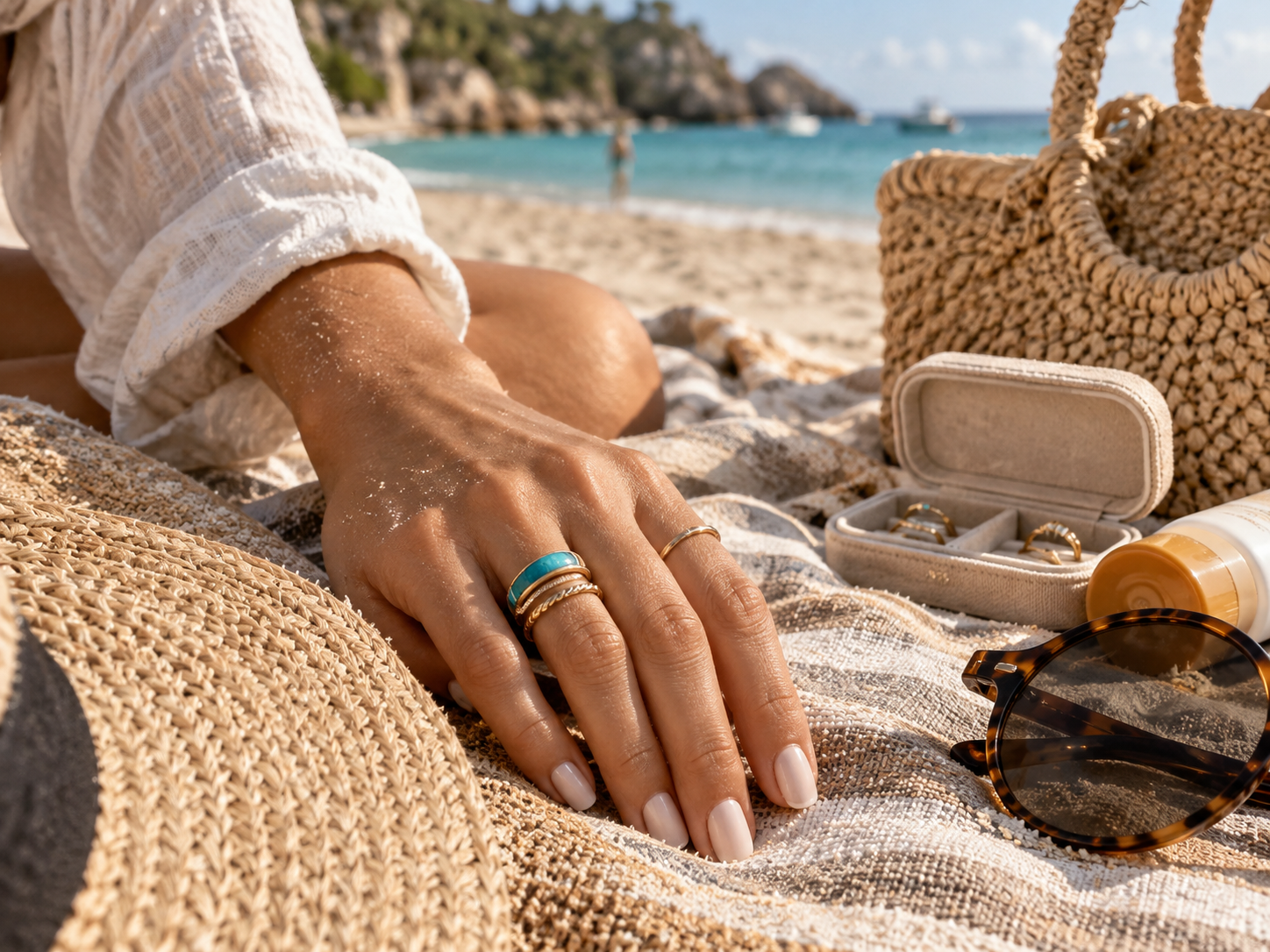
Stacking rings can transform a simple summer outfit without requiring large or formal jewelry. Two or three narrow bands can add texture beside a linen sleeve, repeat the metallic tone of sandals or a bag, or introduce a small amount of color beside a swimsuit. The appeal lies in flexibility: the same individual rings can look restrained when worn separately and more expressive when combined.
Yet a successful stack is not simply the largest number of rings that fit on the hand. Beach conditions reward a lighter approach. Heat, sunscreen, sand, towels, woven bags, and frequent changes between swimming, walking, eating, and dressing all affect comfort. A good summer stack balances visual rhythm with enough empty space to let the hand move naturally.
Think in terms of visual weight
Every ring has visual weight, even when it is physically light. Width, color, texture, shape, shine, and decoration determine how strongly it attracts attention. A polished wide band appears more dominant than a thin smooth band. A vivid enamel ring may draw more attention than several narrow metal rings. A twisted or sculptural shape creates more movement than a completely plain surface.
The easiest stacks usually combine pieces of different visual strength instead of making every ring compete. One ring can lead, while the others support it. For example, a textured band may be combined with two smoother rings. A colored enamel ring can become the focal element while narrow metal bands keep the arrangement connected to other accessories.
This hierarchy matters especially with simple beach clothing. Linen, crochet, cotton, swimwear, and lightweight cover-ups often leave the hands visually exposed, so jewelry becomes conspicuous quickly. A small amount of variation is enough.
A useful three-part stacking formula
- One anchor piece: the ring with the strongest texture, color, width, or decorative feature.
- One quiet companion: a simpler band that supports rather than competes.
- Optional contrast: a third ring that changes width, texture, or metal tone without introducing another dominant motif.
This formula is not a rule that every hand must follow. Its value is that it provides a starting point. If the arrangement already looks complete after two rings, the third is unnecessary.
Leave space between focal points
One of the easiest ways to make stacked rings feel deliberate is to leave some fingers bare. Empty space prevents the hand from appearing visually crowded and can improve comfort when fingers are warm or active. It also makes each individual ring easier to see.
A common mistake is to treat every finger as a separate opportunity for decoration. That can work in editorial or highly styled settings, but it is less practical for a relaxed day involving towels, bags, sunscreen, and repeated hand movement. Concentrating two or three delicate rings on one area of the hand often creates enough detail.
Another approach is asymmetry. A small stack on one finger can be balanced by a single ring on another finger rather than mirrored exactly across both hands. Summer style often benefits from this looseness because it looks collected rather than mechanically coordinated.
Use different widths to create rhythm
When all stacked rings have the same width, the combination can read as one broad visual block. Changing the width slightly gives the eye separate elements to follow. A narrow ring beside a medium band creates contrast without needing additional ornament.
Texture works in a similar way. Smooth, twisted, lightly sculptural, and patterned surfaces can be mixed so long as the contrast remains controlled. If every ring has strong relief, colored details, and a complex profile, the stack loses hierarchy. One or two distinctions are usually sufficient.
People exploring rings that can be combined for summer styling can use this idea as a selection filter: look for pieces that have different roles inside a stack rather than choosing several rings that are individually striking in exactly the same way. Compatibility often comes from contrast, not duplication.
A smooth ring may look ordinary in isolation yet become essential when placed beside a more decorative piece. In a stack, supporting elements matter because they give the stronger design room to work.
Add color with intention
Beachwear naturally accommodates brighter colors. Turquoise, coral, orange, yellow, pink, green, and blue can relate to swimwear, sea tones, tropical prints, painted nails, woven bags, or casual sandals. Rings provide an easy way to introduce such color because they occupy little visual area.
A single colorful ring is often enough when the outfit already contains multiple hues. If the clothing is neutral, several smaller colored rings can create a more playful effect. The relevant question is whether color is acting as an accent or as the main theme.
For an accent, choose one ring with a strong hue and keep neighboring pieces quieter. For a color-led stack, repeat one or two tones rather than introducing every available shade. Repetition creates coherence even when individual rings have different shapes.
Metal tone can connect the stack to the outfit
Gold-tone rings create a warm visual effect and pair naturally with beige, cream, brown, olive, terracotta, and orange. Silver-tone rings feel cooler beside white, blue, grey, black, and many pastel combinations. These are useful tendencies rather than rigid color laws.
Mixed metals can also work. A relaxed summer outfit does not require every accessory to match perfectly. The easiest mixed-metal stacks usually contain some repeated feature—similar scale, a related shape, or one metal tone appearing elsewhere in earrings or a necklace. That repeated detail prevents the combination from looking accidental.
There is no need to force mixed metals solely for variety. If one metal tone already complements the outfit, staying within it can create a cleaner result. The point of stacking is not to demonstrate every styling technique at once.
Marine motifs need breathing room
Shells, waves, starfish, coral-like forms, and other ocean motifs suit beach settings naturally. Inside a ring stack, however, motifs work differently from simple bands. A recognizable shape attracts attention because the viewer reads it as an object rather than only a line or color.
For that reason, one marine motif can be enough. Surround it with narrow bands, or wear it separately while stacking simpler rings on another finger. Combining several large shell, starfish, and wave designs on the same hand can make the thematic reference overly literal.
A small shell detail can behave almost like texture and integrate easily. A larger sculptural marine ring is better treated as the anchor piece.
Comfort should set the upper limit
Visual balance matters, but physical comfort provides the real stopping point. Rings stacked tightly together can feel different after hours of wear than they did during a brief fitting. Heat and ordinary changes in the fingers may alter the sensation, while sunscreen can make surfaces slippery or collect between rings.
Move the fingers naturally before committing to a stack for the day. Hold a bag, grip a phone, bend the hand, and notice whether the rings press against neighboring fingers. A combination that looks attractive but interferes with ordinary movement is unlikely to remain enjoyable.
Raised shapes also deserve attention. A decorative ring that catches on towels, loosely woven crochet, or clothing may be better reserved for the dry, social part of the day rather than worn through every activity.
Do not treat a stack as swimming jewelry
Stacking can create the impression that rings are more secure because several pieces occupy the same finger. That is not a reliable safety mechanism. Water, movement, and changes in how the fingers feel can still make rings easier to lose. Multiple rings also create multiple items that would need to be recovered if something slips off.
Remove rings before swimming, diving, or water sports and place them in a secure container rather than loose on a towel. A compartmented jewelry case is useful because it keeps small pieces visible and separate.
This is especially important with stacks because casual removal can become chaotic. Three small rings placed on top of a beach bag are easier to overlook than one large statement piece. Build the storage routine into the styling plan.
Adapt the stack from daytime to evening
One advantage of modular jewelry is that the same pieces can change role as the day develops. A restrained daytime stack might consist of two thin bands. For dinner, a colorful or sculptural ring can be added to create more presence without changing the entire accessory set.
The reverse can work too. If the daytime outfit already uses a bright resin or enamel ring, evening styling might become cleaner by removing one or two smaller pieces and letting the colored ring stand alone. More formal does not necessarily mean more jewelry.
Three example approaches
Minimal linen look: combine a narrow smooth band with one slightly textured ring and leave the remaining fingers mostly bare. This works when the outfit is built around white, beige, cream, or light blue.
Color-led beach look: use one bright resin or enamel ring as the focal point and add a small neutral band elsewhere on the hand. The color can repeat a swimsuit or bag rather than matching every accessory.
Evening beach-club look: wear a more sculptural ring alone or beside one delicate band. If earrings and bracelets are already prominent, reduce the number of rings instead of adding another layer.
The best stack looks edited, not accumulated
Successful ring stacking is mostly an exercise in selection. Width, texture, color, motif, and metal tone all compete for attention, so the strongest combinations rarely maximize every variable. Decide what the stack is meant to emphasize, then let the remaining rings support that purpose.
For summer and beach wear, practical editing has another benefit: fewer, well-chosen pieces are easier to wear, remove, store, and clean. A balanced stack can still feel expressive while remaining appropriate for real activities rather than only for a photograph.
Start with two rings, evaluate the visual weight and physical comfort, then add a third only if it contributes something specific. That simple discipline creates combinations that feel personal without becoming crowded, and it allows individual rings to remain useful long after the beach day is over.