💻🎯 My Next Computer: Why I’m Saving Rs. 5,000 Every Month Instead of Buying in a Hurry Steemit Challenge Season 34 — Week 5 | Question 1
What are you saving for at the moment?
For me, the answer is simple:
I am saving for a computer.
But this is not going to be an ordinary “I want a new PC” post.
I want to explain why I need it, how much I expect to spend, how long it may take me to save enough money, and how I plan to use AI before finally buying it.
Because buying an expensive computer is not something I want to rush.
🖥️ Why Do I Want a Computer?
A good computer can become much more than a device for entertainment.
For me, it can be a tool for:
Programming.
Learning.
AI-assisted work.
Content creation.
Research.
Image and video-related tasks.
And many other things that I may want to explore in the future.
I have already started learning programming with AI, including trying to understand Python, although I still have a lot to learn.
AI helps me with basic programming tasks, explanations and problems that would otherwise take me much longer to solve.
A better computer could make this whole process more comfortable and capable.
So I am not looking at this purchase simply as:
“I want a powerful computer.”
I am looking at it as:
“I want a tool that can help me work, learn and create for years.”
💰 How Much Am I Trying to Save?
At the moment, I estimate that I may need somewhere between:
Rs. 500,000 and Rs. 1,000,000
That is a large amount of money for me.
And this is where the reality of saving becomes interesting.
I can currently save at least:
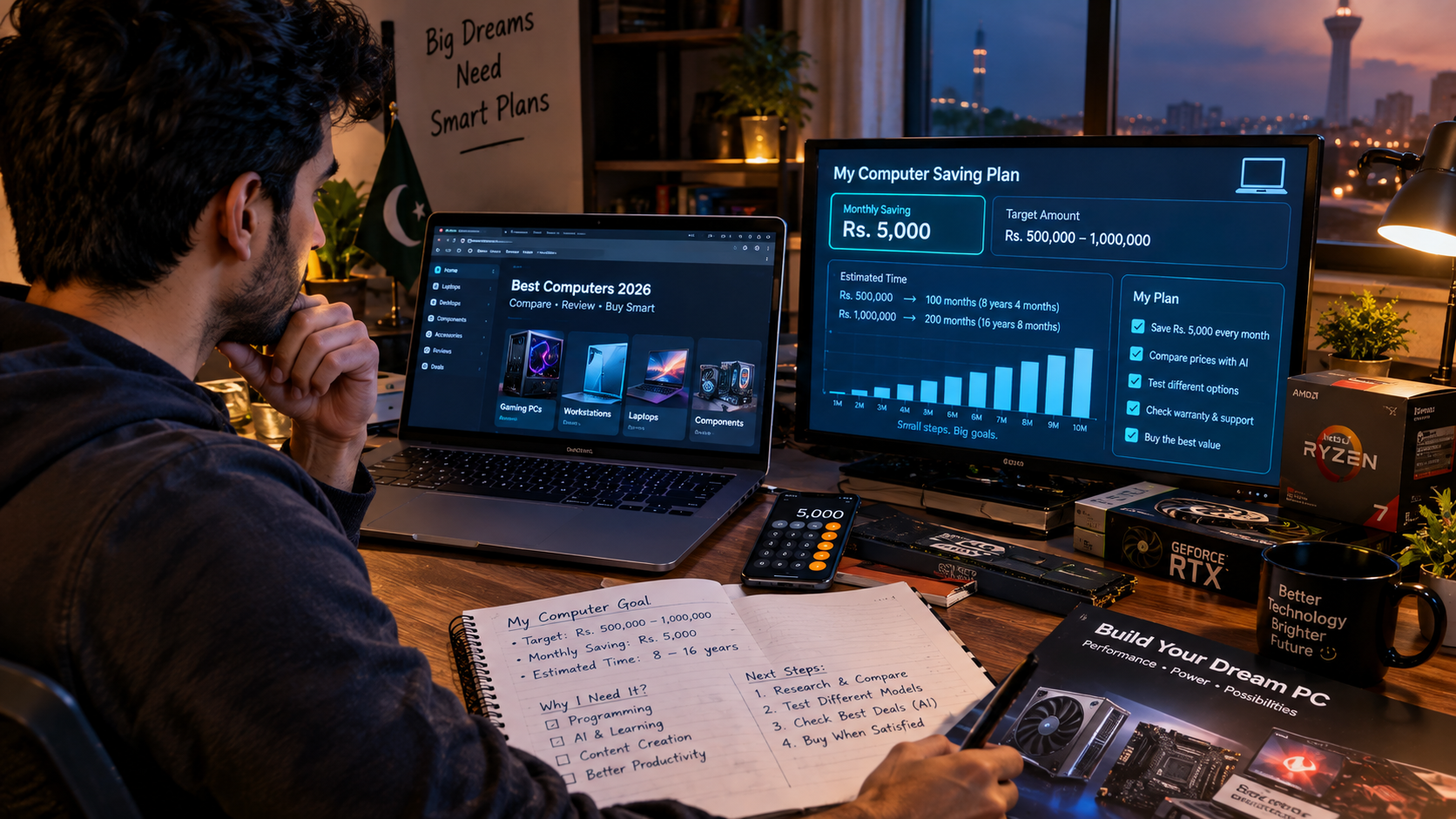
Rs. 5,000 per month
Let's do the calculation.
| Target | Monthly Saving | Approx. Time |
|---|---|---|
| Rs. 500,000 | Rs. 5,000 | 100 months |
| Rs. 750,000 | Rs. 5,000 | 150 months |
| Rs. 1,000,000 | Rs. 5,000 | 200 months |
That means my minimum target of Rs.500,000 could take around:
8 years and 4 months.
And a Rs.1,000,000 target could take approximately:
16 years and 8 months.
When I look at these numbers, one thing becomes very clear:
I cannot treat this like an impulse purchase.
This has to be a long-term plan.
🧠 Why I Don't Want to Buy in a Hurry
Technology changes quickly.
A computer that looks amazing today may not be the best choice several years from now.
Processors improve.
Graphics cards improve.
Memory becomes faster.
Storage becomes cheaper.
AI workloads change.
Software requirements change.
So if I am going to spend a large amount of money, I want to make sure that the computer I eventually buy actually satisfies my needs.
I don't want to buy something simply because the specifications look impressive.
I want to test it.
Understand it.
Compare it.
And then decide.
🖼️— SAVING FOR THE COMPUTER
🤖 How Will I Use AI Before Buying?
This is probably the part of the challenge I find most interesting.
The Steemit Challenge specifically asks whether I have checked with an AI chatbot such as ChatGPT or Claude to find the best deal.
For me, the answer is:
Yes — but I don't want AI to simply tell me “buy this computer.”
I want to use AI as a research assistant.
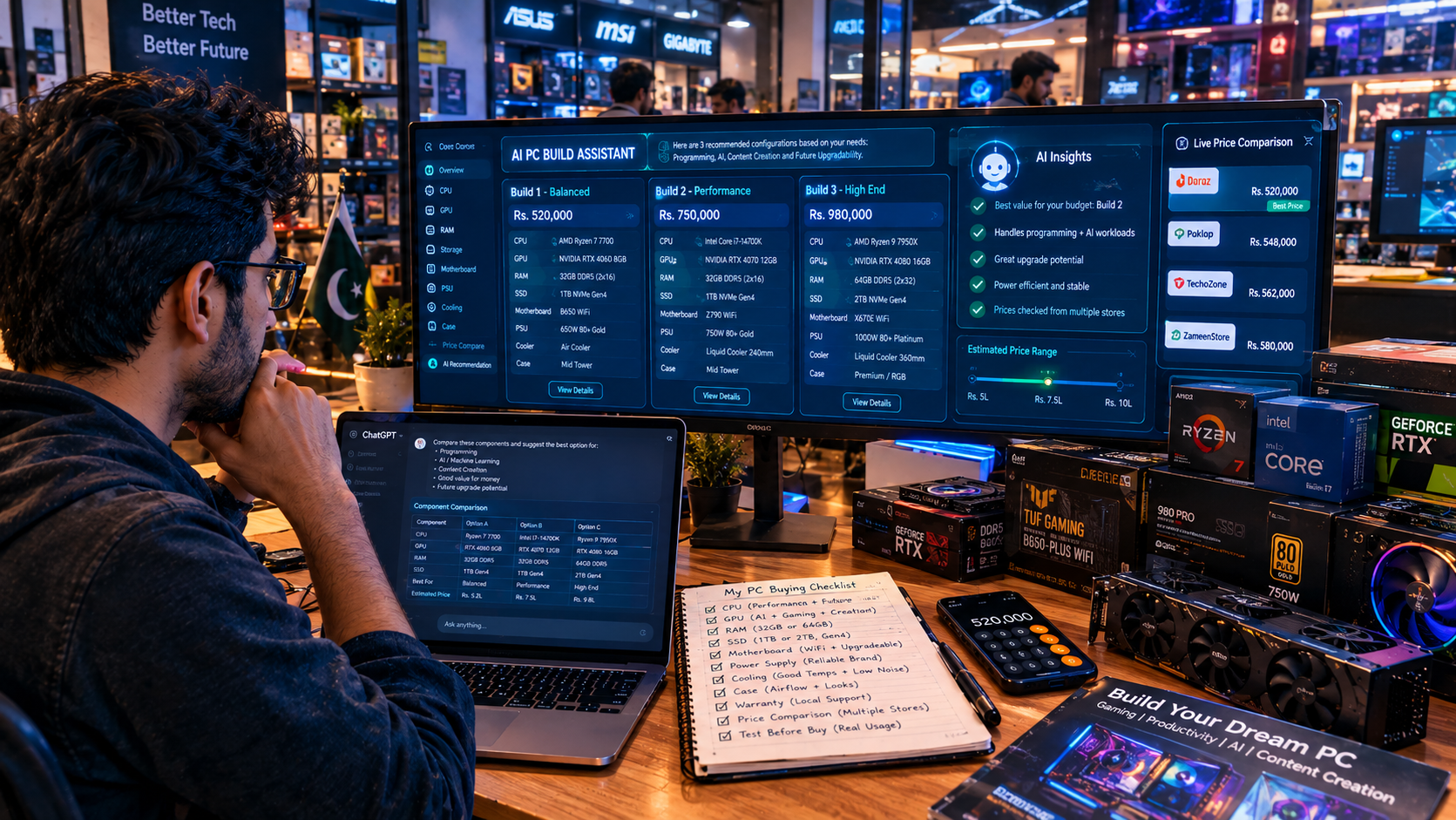
When I get closer to my target, I can give it my requirements and ask it to help me compare:
CPU.
GPU.
RAM.
Storage.
Motherboard.
Power supply.
Cooling.
Monitor.
Upgrade options.
Power consumption.
Warranty.
And overall value.
But there is something important:
I don't plan to buy a computer just because AI recommends it.
AI can help me make a shortlist.
Then I will do the testing and final comparison myself.
🔍 My Buying Rule: Test First, Buy Second
I don't currently have one fixed shop or website where I plan to buy the computer.
Instead, when the time comes, I want to check different options.
I may look at:
Local computer shops.
Online stores.
Different brands.
Different configurations.
Used and new options where appropriate.
And then I will compare the actual machines.
My plan is simple:
I will test first, and then buy the one that truly satisfies me.
I don't want to choose a computer only because someone says:
“This is the best PC.”
Best for whom?
A gaming PC may not be the best workstation.
A workstation may be unnecessary for a casual user.
A very expensive GPU may be useless if the person's workload doesn't require it.
So the best computer for me should be the one that matches my actual work and future plans.
⚙️ What Will I Actually Look At?
When the time comes, I don't want to focus on one specification.
I want to look at the whole system.
Processor
Will it handle the software I use?
Graphics
Do I actually need a powerful GPU for AI, editing or other tasks?
RAM
How much memory will I realistically need?
Storage
Do I need more capacity or faster storage?
Power Supply
Is it reliable enough for the components?
Cooling
Can the system handle long workloads safely?
Upgradeability
Can I improve it later instead of replacing everything?
Warranty
What happens if something fails?
These details may not look exciting.
But they can make a huge difference after the purchase.
🖼️— COMPARING COMPUTER COMPONENTS
💡 Saving Money Is Also About Avoiding the Wrong Purchase
This is something I am learning through the saving process.
Saving money isn't only about collecting more money.
Sometimes it's also about not wasting the money you already saved.
Imagine saving for years and then buying the wrong computer because:
A salesperson convinced you.
A YouTube video looked impressive.
A specification sounded powerful.
Or an AI chatbot recommended it.
That would be frustrating.
So I would rather spend more time researching before buying.
A slower decision can sometimes be a cheaper decision.
📈 My Saving Journey May Change
Another important thing is that Rs.5,000 is my minimum current saving ability.
I don't know whether I will always save exactly Rs.5,000 every month.
Maybe some months I can save more.
Maybe some months I can save less.
Maybe my income changes.
Maybe another important expense appears.
So I don't want to promise myself an unrealistic fixed deadline.
Instead, I want to keep the target flexible.
If my monthly saving increases in the future, the target date becomes shorter.
For example:
| Monthly Saving | Rs.500,000 Target | Rs.1,000,000 Target |
|---|---|---|
| Rs.5,000 | 100 months | 200 months |
| Rs.10,000 | 50 months | 100 months |
| Rs.20,000 | 25 months | 50 months |
| Rs.25,000 | 20 months | 40 months |
That makes something very clear:
Increasing the saving rate can change the timeline dramatically.
So I won't only think about saving.
I'll also think about improving my ability to earn.
🚀 The Computer Is Really a Long-Term Goal
This is another reason I'm comfortable with the long timeline.
I don't see the computer as a luxury purchase that I absolutely need tomorrow.
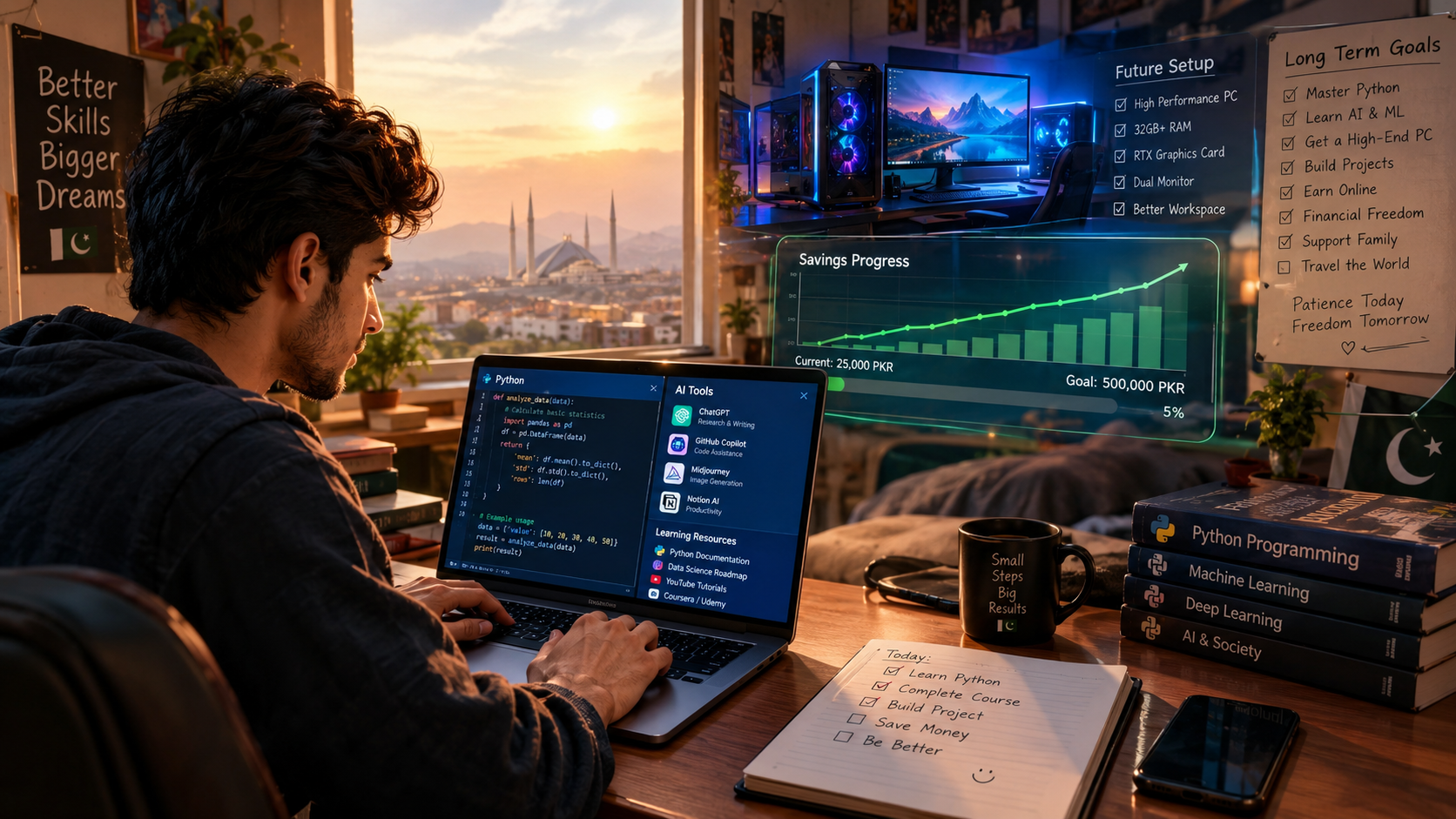
I see it as a long-term goal.
During the saving period, I can continue learning.
I can continue using the equipment I already have.
I can improve my programming knowledge.
I can become better at using AI.
I can learn what kind of hardware I actually need.
And by the time I am ready to buy, I may understand computers much better than I do today.
That could actually lead to a smarter purchase.
🖼️— THE LONG-TERM GOAL
🧠 AI Can Help Me Save Time Too
There's another connection to my everyday life.
I've already experienced how AI can help me with basic programming and repetitive tasks.
I don't always need to manually handle every small step myself.
I can focus on the main task while AI helps with simpler parts.
If AI makes a mistake, I remain the final decision maker and correct it.
That saves me time.
So when I eventually buy a stronger computer, I won't simply use it for entertainment.
I want it to become another tool in that workflow.
Programming.
AI.
Research.
Content creation.
Experimentation.
Learning.
And hopefully new opportunities I haven't even thought about yet.
🛒 Where Will I Buy It?
At the moment:
I haven't chosen one fixed seller.
And honestly, I think that's better.
When the time comes, I want to compare several places instead of becoming loyal to one shop before knowing whether it gives me good value.
I will compare:
Price
Specifications
Warranty
Reputation
After-sales support
Testing possibilities
Upgrade options
Overall value
And then I'll make the final decision.
The seller who gives me the combination I am actually satisfied with will get my money.
🤝 Why This Challenge Question Is Actually Useful
At first, I thought this Challenge Question was simply asking:
“What are you saving for?”
But after thinking about it, I realised it is really asking something much bigger:
How do we make a major purchase responsibly?
That's useful for almost anything.
A computer.
A phone.
A motorcycle.
A car.
Education.
A business.
A house.
The principles are similar:
Set a goal.
Understand the cost.
Save consistently.
Research the market.
Compare alternatives.
Use technology intelligently.
Avoid emotional buying.
Then make the decision.
That lesson won't expire when this Challenge Week ends.
🔮 What I Hope Happens
Maybe one day I'll publish another Steemit post and say:
“I finally bought the computer I was saving for.”
And perhaps I'll be able to look back at this post and see exactly how the journey started.
Maybe it will take a few years.
Maybe I'll reach the target faster.
Maybe my needs will change completely.
Maybe I'll discover that I don't need to spend the full Rs.1 million.
That's okay.
The point isn't to predict the future perfectly.
The point is to have a plan.
🤔 NOW I WANT YOUR OPINION
This is where I want to hear from you.
1. Is saving for several years for an expensive computer a sensible decision, or would it be better to buy a cheaper system earlier and upgrade gradually?
2. Would you trust AI to recommend the components for a computer worth Rs.500,000–1,000,000?
3. When buying expensive technology, what matters most to you:
Price?
Performance?
Brand?
Warranty?
Upgradeability?
Or long-term reliability?
And here's the question I really want to ask:
If you had Rs.500,000 to Rs.1,000,000 for a computer, would you spend it all at once on a high-end system—or build a good system gradually over time?
Tell me why.
Your experience might help someone else who is also saving for an expensive purchase.
💬 ONE LAST THOUGHT
For me, this isn't only about buying a computer.
It's about learning patience.
It's about understanding the difference between:
“I want this now.”
and
“I am willing to plan for something important.”
And perhaps that's one of the most useful things AI can help with too.
Not simply finding a product.
But helping us ask better questions before spending our money.
🙏 THANK YOU FOR READING
Thank you so much for taking the time to read my Week 5 Challenge post.
I appreciate everyone who stops by, shares their experience and gives another perspective.
Maybe your saving goal is completely different from mine.
Maybe you're saving for a phone.
A motorcycle.
A house.
Education.
A business.
Or something you've wanted for years.
Whatever it is, I hope you reach it.
❤️ Thank you for reading, and I hope we can all turn our goals into plans—and our plans into reality.
Stay Informed | Think Clearly | Grow Continuously 🚀
La tabla con 5 000 Rs al mes y 100 meses para llegar a 500 k muestra bien la escala del proyecto, eso es genial. No es lo mismo comprar a impulso que planear una herramienta que te acompañe años; la diferencia se nota. 💡
Absolutely. The real difference is in the mindset behind the purchase. A planned investment in a tool that can provide value for years is very different from spending impulsively. Breaking a large goal into smaller monthly amounts also makes it feel much more achievable and sustainable. 💡