How SaaS Companies Can Use AI to Build High-Converting Marketing Campaigns
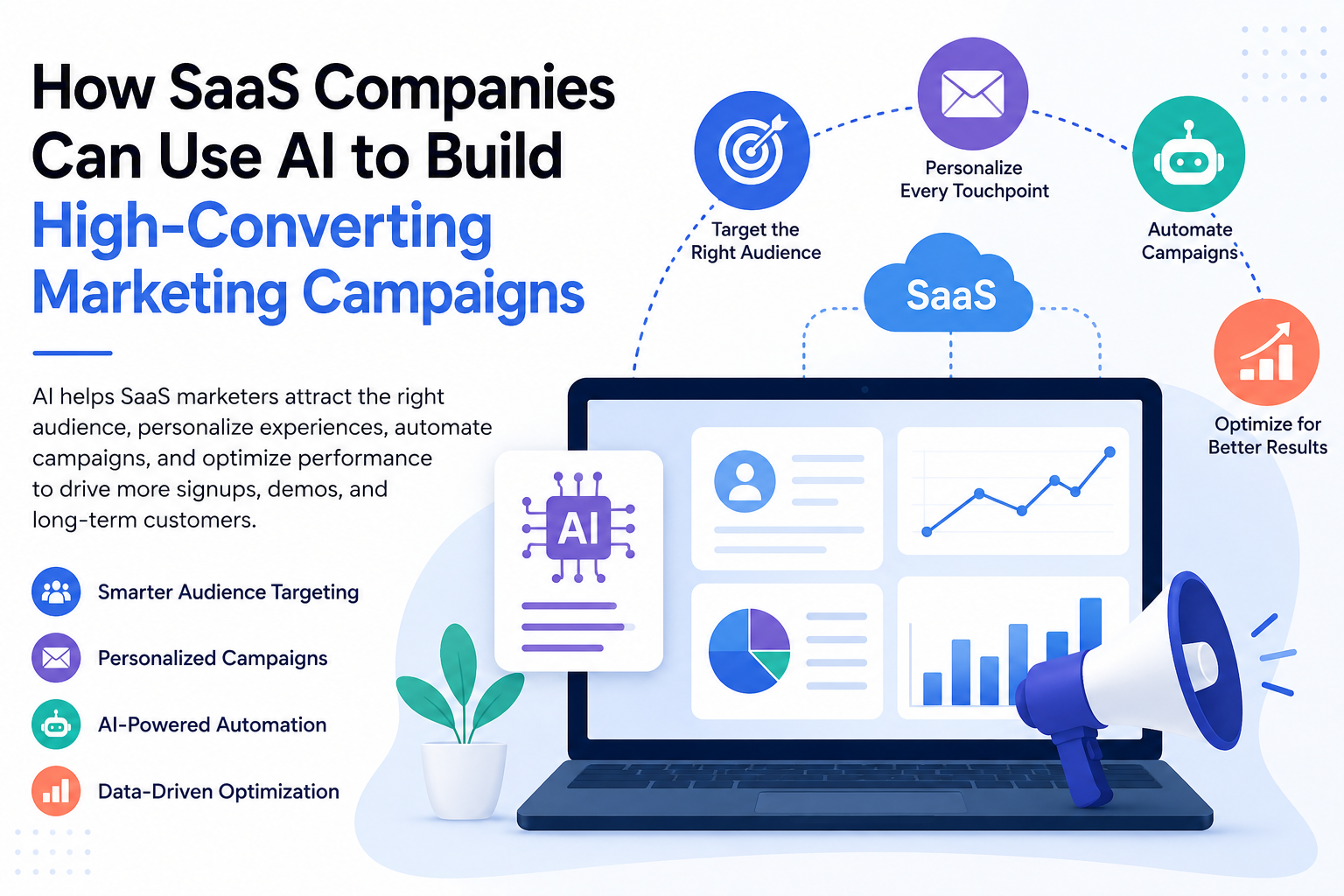
SaaS companies operate in one of the most competitive digital environments. New software products enter the market every day, customers have more choices than ever, and marketing teams are expected to generate qualified leads while controlling acquisition costs.
Artificial intelligence is changing how SaaS companies approach this challenge.
AI can help marketing teams understand customer behavior, identify promising prospects, personalize messaging, create campaign assets, automate repetitive tasks, and analyze performance. Instead of relying entirely on manual processes, SaaS marketers can use AI to make campaigns more relevant and responsive.
However, simply adding AI to a marketing strategy does not automatically produce better results. The real advantage comes from using AI strategically while keeping human creativity, judgment, and brand expertise at the center of the campaign.
Why AI Matters for SaaS Marketing
Traditional marketing campaigns often depend on predefined audiences, fixed messaging, and manual optimization. These methods can work, but they may become difficult to manage as a SaaS company grows.
AI allows marketing teams to process large amounts of information and identify patterns much faster.
For example, AI can analyze website visits, email engagement, product interactions, advertising data, and CRM information to identify customers who are more likely to convert.
IBM explains that AI marketing automation can analyze customer activity across channels, identify behavioral patterns, segment audiences, personalize content, and continuously optimize marketing activities. (IBM)
For SaaS companies, this creates an opportunity to move from broad campaigns toward more targeted and personalized customer experiences.
1. Define the Right Customer Before Building the Campaign
A high-converting campaign begins with a clear understanding of the target customer.
SaaS companies should identify their ideal customer profile before using AI to generate campaign content. Important factors can include:
- Industry
- Company size
- Job role
- Business challenges
- Technology requirements
- Purchasing behavior
- Budget
- Product needs
- Buying stage
AI can help marketers analyze existing customer data and discover patterns among their highest-value customers.
For example, if a SaaS company discovers that its most successful customers are mid-sized technology businesses with growing marketing teams, the campaign can be designed around the specific problems faced by that audience.
The more precise the audience definition, the easier it becomes to create relevant messaging.
2. Use AI for Customer Segmentation
Not every prospect is ready to buy.
Some visitors may only be researching a problem, while others may already be comparing software products. Treating both groups with the same message can reduce campaign effectiveness.
AI can help SaaS companies create dynamic customer segments based on behavior and intent.
A visitor who reads several educational articles could receive introductory content. Someone who repeatedly visits pricing and product pages could receive a product-focused message or demo invitation.
HubSpot's current AI marketing tools emphasize real-time audience targeting, personalization, and the use of customer data to create more relevant experiences. (HubSpot)
This type of segmentation helps marketers deliver the right message at different stages of the buying journey.
3. Personalize Campaign Messaging
Personalization is one of the strongest applications of AI in SaaS marketing.
Instead of creating one campaign for everyone, marketers can use AI to adapt messaging based on audience characteristics, interests, behavior, and customer journey stage.
For example, a SaaS company targeting marketing managers could focus on campaign efficiency and reporting. The same software promoted to a sales leader could emphasize pipeline growth and lead management.
AI can assist with creating different versions of:
- Email campaigns
- Landing pages
- Advertisements
- Calls to action
- Product descriptions
- Social media content
- Website messaging
The objective is not to create thousands of completely different campaigns. Instead, marketers can create reusable content elements that AI adapts to different audiences.
This can make campaigns feel more relevant without dramatically increasing the workload for marketing teams.
4. Create Better Campaign Content Faster
Creating campaign content can take considerable time.
A typical SaaS campaign may require a landing page, several emails, advertisements, social media posts, blog content, sales materials, and follow-up messages.
AI can help marketers generate initial drafts and variations much faster.
For example, marketers can use AI to brainstorm:
- Campaign headlines
- Email subject lines
- Ad variations
- Landing page copy
- Content ideas
- Social posts
- Calls to action
HubSpot's AI campaign tools currently support the creation of marketing assets across areas such as landing pages, emails, advertisements, and social content. (HubSpot)
However, AI-generated content should not simply be published without review. Human marketers should check the messaging for accuracy, originality, brand voice, clarity, and usefulness.
AI should accelerate the creative process, not remove editorial responsibility.
5. Build Smarter Lead-Scoring Systems
One of the biggest challenges for SaaS companies is determining which leads deserve immediate attention.
A person who downloads an introductory guide is not necessarily as valuable as someone who has visited a pricing page several times, attended a product webinar, and started a free trial.
AI can analyze these behavioral signals and help identify high-intent prospects.
A lead-scoring system might consider:
- Number of website visits
- Product-page activity
- Pricing-page visits
- Email engagement
- Demo requests
- Free-trial activity
- Webinar participation
- Content downloads
- Product usage
As more data becomes available, AI systems can help marketers identify patterns associated with stronger conversion potential.
This allows sales and marketing teams to focus their efforts on prospects who show stronger buying signals.
6. Use AI to Improve Email Campaigns
Email remains an important channel for SaaS customer acquisition and nurturing.
AI can help marketers personalize email content, generate subject-line variations, identify audience segments, and determine which messages may be most relevant to different groups.
For example, a SaaS company could create separate email sequences for:
New leads:
Educational content explaining the problem the software solves.
Engaged prospects:
Product features, case studies, and comparison content.
Free-trial users:
Onboarding guidance and product-use recommendations.
High-intent prospects:
Demo invitations, customer success stories, and conversion-focused offers.
AI can also help analyze engagement data and identify which types of messages perform better.
The important point is to use AI to make email communication more useful rather than simply sending more emails.
7. Optimize Landing Pages With AI
Getting visitors to a website is only one part of customer acquisition. SaaS companies also need to convert those visitors.
AI can help marketers test different headlines, calls to action, page structures, and content variations.
For example, a landing page could have different messaging for:
- Small businesses
- Enterprise companies
- Marketing teams
- Sales teams
- Technology departments
AI-powered personalization can help determine which versions are more relevant to different audiences.
HubSpot notes that AI-supported personalization can be used to tailor headlines, calls to action, and other website experiences while measuring their impact on conversions and engagement. (HubSpot)
This creates a continuous improvement process rather than treating a landing page as a finished asset.
8. Improve Advertising Performance
Paid advertising can quickly become expensive for SaaS companies.
AI can help marketers analyze campaign performance across audiences, advertisements, keywords, and conversion actions.
Instead of focusing only on clicks, marketers can evaluate deeper metrics such as:
- Cost per qualified lead
- Trial registrations
- Demo requests
- Trial-to-paid conversion
- Customer acquisition cost
- Revenue generated
AI can identify patterns in campaign data and help marketers determine where budget may be better allocated.
For example, an advertisement may generate many clicks but few qualified leads. Another advertisement may receive fewer clicks but generate customers at a much lower acquisition cost.
AI-assisted analysis can help marketers identify these differences more efficiently.
9. Use AI for B2B Audience Research
SaaS marketing is often B2B marketing, which means reaching the right decision-makers is critical.
Marketing teams can use AI to analyze target industries, identify common customer challenges, develop buyer personas, and organize audience research.
For campaigns targeting technology decision-makers, resources such as the https://www.eprofiletech.com/it-decision-makers/ can help marketers identify relevant B2B audiences for targeted outreach.
The key is to combine audience data with a clear value proposition. Having access to a target audience does not guarantee conversions. The campaign still needs useful messaging, relevant offers, and a strong reason for the prospect to take action.
10. Automate Customer Journeys
SaaS customer journeys are rarely linear.
A prospect might discover a company through search, read a blog post, watch a product video, subscribe to an email newsletter, visit a pricing page, leave the website, and return weeks later.
AI can help marketing systems respond to these changing signals.
For example:
Website visit -> Educational content -> Email signup -> Product content -> Pricing-page visit -> Sales notification
Another prospect might follow a completely different path.
AI-powered automation can help determine the next appropriate action based on customer behavior rather than forcing every prospect through exactly the same sequence.
IBM describes AI marketing automation as a system that can continuously analyze customer data and adjust marketing decisions based on behavioral signals. (IBM)
11. Measure What Actually Converts
A campaign should not be considered successful simply because it generates traffic or engagement.
SaaS marketers should connect campaign performance to business outcomes.
Important metrics include:
- Conversion rate
- Qualified leads
- Cost per lead
- Customer acquisition cost
- Free-trial signups
- Demo requests
- Trial-to-paid conversion
- Customer lifetime value
- Return on marketing investment
AI can help marketers identify relationships between these metrics and determine which campaigns contribute to actual revenue.
For example, Campaign A might generate 10,000 visitors but only 20 customers, while Campaign B generates 4,000 visitors and 50 customers.
Looking only at traffic would make Campaign A appear stronger. Looking at customer acquisition and conversion data tells a different story.
12. Create a Continuous Optimization Process
The most effective AI-powered campaigns should not remain static.
SaaS marketers can create a continuous cycle:
Launch -> Measure -> Analyze -> Test -> Improve -> Launch again
AI can help analyze campaign results and identify potential opportunities for improvement.
Marketers can test:
- Different headlines
- Different offers
- Different audiences
- Different landing pages
- Different email sequences
- Different advertising messages
- Different calls to action
Over time, these experiments can create a clearer understanding of what motivates the target audience.
HubSpot's current approach to AI-driven marketing similarly emphasizes continuous optimization, personalization, cross-channel execution, and real-time performance improvements. (HubSpot Knowledge Base)
AI Should Support Marketers, Not Replace Them
AI can automate many parts of a marketing campaign, but successful SaaS marketing still requires human judgment.
Marketers understand the brand, customer problems, competitive environment, and business objectives. They are also responsible for deciding whether an AI-generated recommendation makes sense.
Human oversight is particularly important when AI is used to generate customer-facing content or make decisions involving customer data.
The strongest model is therefore a partnership:
AI provides speed, analysis, automation, and scale.
Marketers provide strategy, creativity, context, and judgment.
Together, they can create campaigns that are more personalized and efficient without losing the human element.
Building a High-Converting AI Marketing Campaign
SaaS companies don't need to introduce AI into every marketing activity at once.
A practical approach is to start with one campaign and build from there.
Step 1: Define the objective
Decide whether the campaign is designed to generate awareness, leads, free trials, demos, or paying customers.
Step 2: Identify the ideal audience
Use customer data and research to define the people most likely to benefit from the product.
Step 3: Create the core message
Clearly explain the problem, the solution, and why the product is different.
Step 4: Use AI to develop campaign variations
Generate different content versions for emails, landing pages, advertisements, and social media.
Step 5: Personalize the experience
Use audience segments and behavioral signals to make messaging more relevant.
Step 6: Automate repetitive tasks
Connect campaign activities so that customers receive appropriate follow-ups based on their actions.
Step 7: Measure conversions
Track meaningful business outcomes rather than focusing only on impressions and clicks.
Step 8: Improve continuously
Use campaign data to identify what works, test alternatives, and refine the next campaign.
The Future of SaaS Marketing Is Intelligent and Human
AI is changing SaaS marketing by making it possible to analyze more data, personalize experiences, automate repetitive tasks, and optimize campaigns at greater speed.
But technology alone will not create high-converting campaigns.
The most successful SaaS companies will be the ones that combine AI capabilities with strong marketing fundamentals: a clear audience, useful content, compelling positioning, trustworthy communication, and a customer-focused strategy.
AI can help marketers understand customers better and respond to their needs more effectively. It can make campaign development faster and allow teams to experiment at a larger scale.
The future of SaaS customer acquisition is therefore not simply about using more AI. It is about using AI intelligently.
When data, automation, personalization, creativity, and human judgment work together, SaaS companies can build marketing campaigns that attract better prospects, create stronger customer experiences, and improve conversion opportunities.
References
IBM - Utilizing AI in Marketing Automation
Read the IBM guide
HubSpot - AI-Powered Marketing and Personalization
Explore HubSpot's AI marketing resources
HubSpot - Marketing Personalization
Learn about AI-powered personalization