How to Choose the Right Salesforce Implementation Partner
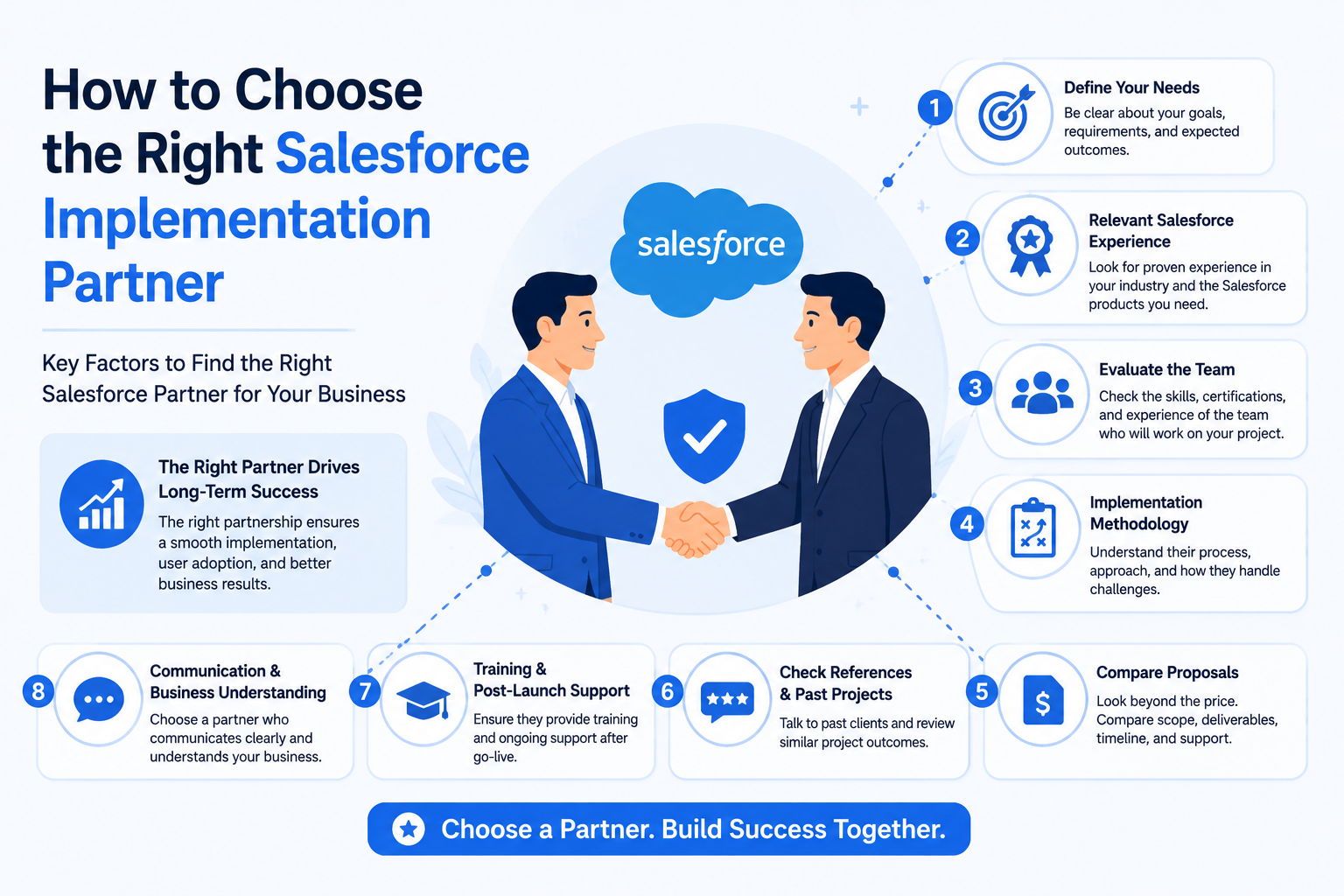
Choosing a Salesforce implementation partner is an important decision because the partner can influence much more than the initial setup. The right team can help translate business requirements into a practical Salesforce solution, while the wrong fit can lead to unnecessary customization, delayed timelines, poor adoption, and higher long-term costs.
Salesforce itself recommends evaluating implementation partners based on factors such as track record, technical skills, industry expertise, delivery model, resource availability, training capabilities, and cultural fit. The goal, therefore, should not be to find the biggest partner or the cheapest proposal. It should be to find a team that understands your business requirements and can implement Salesforce in a way that remains useful as your organization grows.
Start by Defining What You Need From Salesforce
Before comparing implementation partners, establish what you want Salesforce to accomplish. This could involve improving sales processes, managing customer service, automating marketing activities, integrating business systems, or replacing an existing CRM.
The more clearly these objectives are defined, the easier it becomes to evaluate proposals. You do not necessarily need a complete technical specification before approaching partners. However, having a clear understanding of your business problems, expected outcomes, users, existing systems, and approximate timeline gives potential partners enough context to provide meaningful recommendations.
Look for Relevant Salesforce Experience
Salesforce is a broad ecosystem, and not every implementation partner has the same expertise. One partner may specialize in Sales Cloud, while another may have deeper experience with Service Cloud, Marketing Cloud, Experience Cloud, integrations, or industry-specific solutions.
Ask potential partners about projects similar to yours. If your implementation involves multiple Salesforce products, make sure the team has experience with those specific products rather than relying on general Salesforce credentials.
It is also useful to review completed projects, certifications, Salesforce expertise, customer reviews, and the partner's experience with the particular Salesforce products you plan to implement.
Evaluate the Team, Not Just the Company
A recognizable company name does not necessarily tell you who will actually work on your project. Ask which consultants, architects, developers, and project managers will be assigned and how much relevant experience they have.
It is also worth asking whether the same core team will remain involved throughout implementation and what happens if a key resource becomes unavailable. Continuity can be particularly important for larger implementations where business requirements, integrations, and technical decisions accumulate over several months.
Understand Their Implementation Methodology
A good implementation partner should be able to explain how the project will move from discovery to deployment. Ask how they gather requirements, design the solution, configure Salesforce, handle development, conduct testing, manage data migration, train users, and prepare for go-live.
Be cautious if a proposal immediately focuses on customization without first understanding the business processes. Salesforce's standard functionality can often handle many requirements without extensive development, and unnecessary customization can increase complexity and make future maintenance more difficult.
A partner should be willing to explain why a particular customization is necessary rather than simply agreeing to every requested feature.
Compare Proposals Beyond the Price
Price is naturally an important consideration, but comparing proposals only by their final figure can create problems later.
Look closely at what each proposal actually includes. Check whether discovery, configuration, custom development, integrations, data migration, testing, training, deployment, documentation, and post-launch support are covered.
A lower initial quote may exclude activities that another partner has included. Once those requirements appear later, the overall project cost can increase.
It is also useful to ask how changes to the scope will be handled and whether additional work is billed hourly, through change requests, or under another arrangement.
Check References and Previous Projects
Case studies can provide useful information, but direct customer references can reveal more about the actual working relationship. Ask potential partners for examples of comparable projects and, where possible, speak with previous customers.
Pay attention to more than the final results. Ask how the partner handled changing requirements, technical problems, delays, data migration challenges, and user adoption.
A partner's response to challenges can be just as informative as its list of successful implementations.
Consider Training and Post-Launch Support
Salesforce implementation does not end when the system goes live. Employees need to understand the new processes, administrators may need additional knowledge, and the organization may discover improvements after real users begin working with the platform.
Ask what training the partner provides and whether it covers both administrators and end users. Also clarify what happens after deployment. Some businesses may need ongoing maintenance, while others may only require occasional assistance.
Post-launch support can be particularly useful during the first few weeks after deployment when users begin identifying issues or requesting adjustments to their workflows.
Look for Strong Communication and Business Understanding
Technical expertise is important, but communication can have an equally significant impact on an implementation project.
The partner should be able to explain technical decisions in business terms and communicate project risks clearly. You should also understand who will be responsible for project management, how frequently progress will be reported, and how decisions or changes will be documented.
A partner that understands your business processes is generally better positioned to recommend practical Salesforce solutions instead of simply reproducing existing processes inside a new system.
Choose a Partner That Fits Your Business
The best Salesforce implementation partner is not necessarily the one with the largest team, the most certifications, or the lowest proposal. It is the one whose experience, delivery approach, resources, communication style, and technical capabilities align with your specific requirements.
Consider shortlisting two or three suitable partners and evaluating them against the same criteria. This makes the comparison more objective and helps reveal differences that may not be obvious from sales presentations alone.
Ultimately, a Salesforce implementation should be viewed as a long-term business transformation rather than simply a software deployment. Choosing a partner that understands both the technology and the business problem can make the implementation easier to manage today and more adaptable to future requirements.