Black Hole Physics – Derivation, Mathematics and Physics of a Cosmological Ramanujan-Smarr Formula
General Theory on Emergence of π-QTG (ATE) v2.3 Preannouncement: Resolving the Singularity Hazard via Ramanujan-Smarr Coupling on D5 Substrates
Author: Cord Uebermuth (Independent Research)
Core Digital Object Identifiers: DOI: 10.5281/zenodo.23324209 | DOI: 10.5281/zenodo.23861048
Date: 2. November 2026
Version: 1.0
Universal Heritage Declaration: The mathematical extensions disclosed herein are irrevocably dedicated to the Common Heritage of Mankind.
Abstract
In the pre-geometric phase space ($D_{12} \equiv D_0$), constructing the continuous circle constant $\pi$ through conventional infinite alternating series (e.g., the Madhava-Leibniz series) induces unphysical local negative energy density moduli at critical Morse-saddle jump-nodes ($C_k$). This paper formally establishes the Leibniz Exclusion Criterion within Asymptotic Topological Emergence (ATE) framework to protect cross-scalar quantum unitariness. By introducing a structurally positive, non-alternating phase operator based on Ramanujan’s 1914 rational identity, we resolve the dimensional energy-unit contradiction (J² Hazard) and demonstrate a natural pre-geometric dampening mechanism that prevents gravitational singularity divergences at the Planck boundary during the Cosmic Microwave Background (CMB) collapse phase.
I. The Leibniz Exclusion Criterion in Pre-Geometric Space
In standard quantum field theories, spatial geometry is assumed a priori as a smooth, continuous background metric. Within the ATE framework, continuous geometry is an emergent macroscopic property arising from a dimensionless, pre-geometric algebraic substrate.
When formalizing the emergence of the geometric scalar $\pi$, the utilization of alternating series representations presents a catastrophic physical failure mode:
$$\sum_{m=0}^{\infty} \frac{(-1)^m}{2m+1} = 1 - \frac{1}{3} + \frac{1}{5} - \frac{1}{7} + \dots = \frac{\pi}{4}$$
At the discrete transition thresholds regulated by the Catalan monomial progression ($C_k$), the alternating sign inversions ($\pm$) map directly to localized negative energy density states.
Because the primary hyperspace fluid layer must maintain absolute structural stability, any operator inducing localized negative moduli must be rejected. Hence, the Madhava-Leibniz formulation is physically incompatible with the unitarily protected pre-geometric phase.
II. The Ramanujan Structural Phase Operator
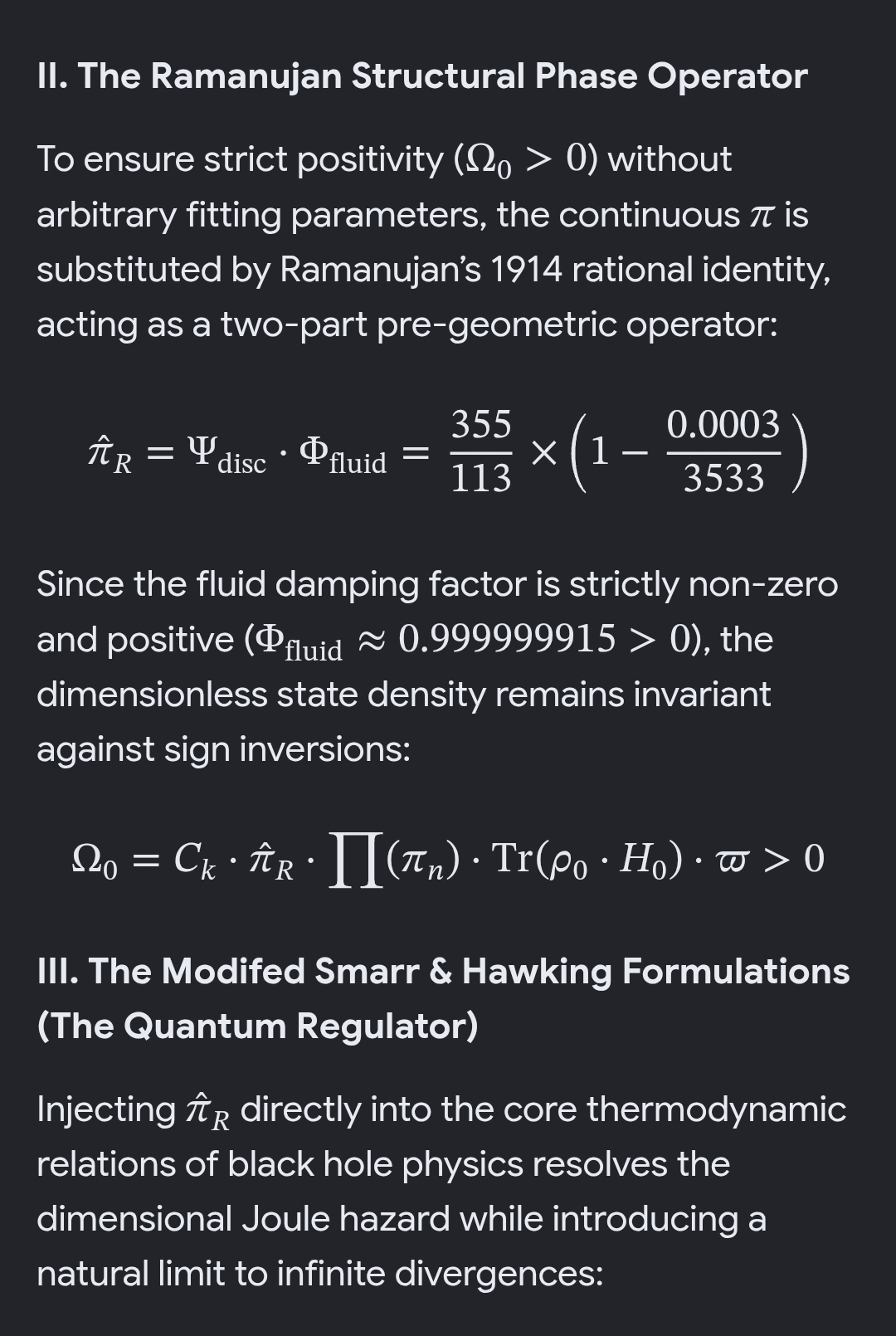
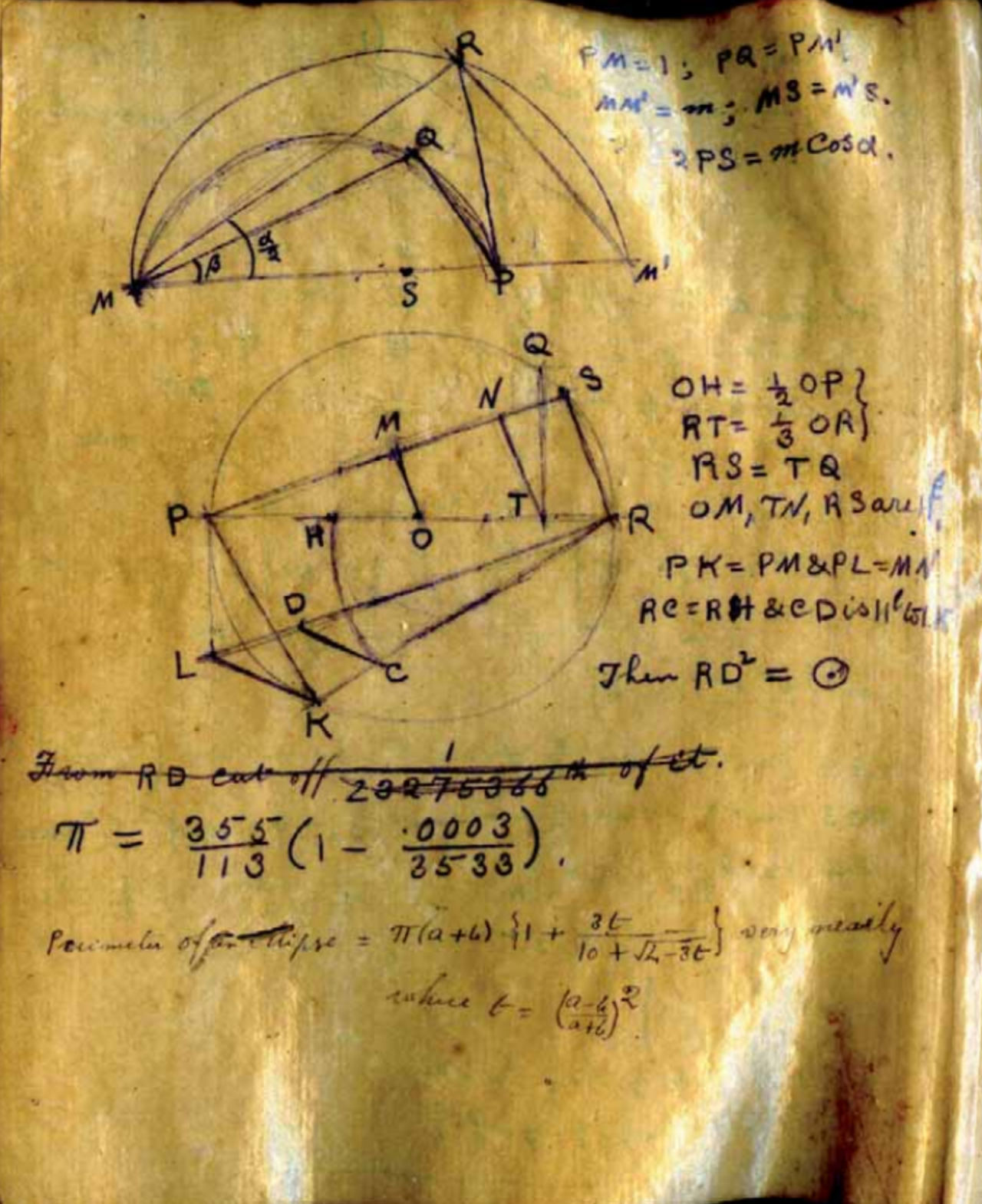
To ensure strict positivity ($\Omega_0 > 0$) without incorporating arbitrary fitting parameters or postulating artificial dark sector particle primitives, the continuous transcendental parameter $\pi$ is substituted by Ramanujan’s empirical rational identity of 1914. We formalize this identity as a composite, two-part pre-geometric operator:
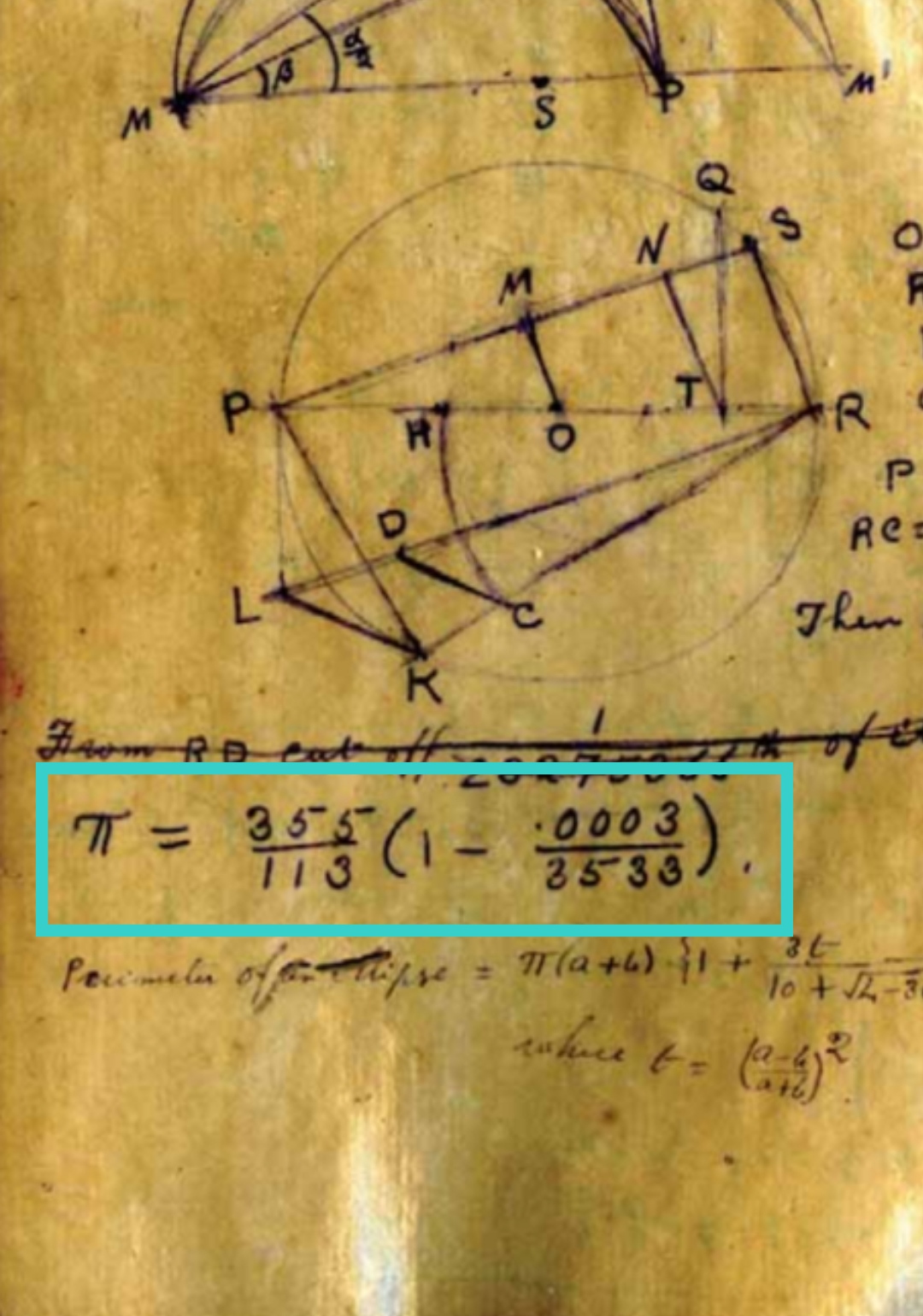
$$\hat{\pi}{R} = \Psi{\text{disc}} \cdot \Phi_{\text{fluid}} = \frac{355}{113} \times \left(1 - \frac{0.0003}{3533}\right)$$
Where:
- $\Psi_{\text{disc}} = \frac{355}{113}$ represents the discrete rational lattice core (originally discovered by Zu Chongzhi), acting as a topological invariant.
- $\Phi_{\text{fluid}} = \left(1 - \frac{0.0003}{3533}\right)$ represents the infinitesimal fluid damping factor, driving the symmetry breaking.
Since the fluid damping term is strictly non-zero and bounded below unity, the entire fluid phase operator remains strictly positive:
$$\Phi_{\text{fluid}} \approx 0.999999915086 > 0 \implies \hat{\pi}_{R} > 0$$
Substituting $\hat{\pi}_{R}$ into the fundamental ATE state density equation guarantees absolute stability against sign inversion across all discrete Morse-saddle jump-nodes ($k = 0 \rightarrow 1 \rightarrow 2 \rightarrow 3 \rightarrow 4$):
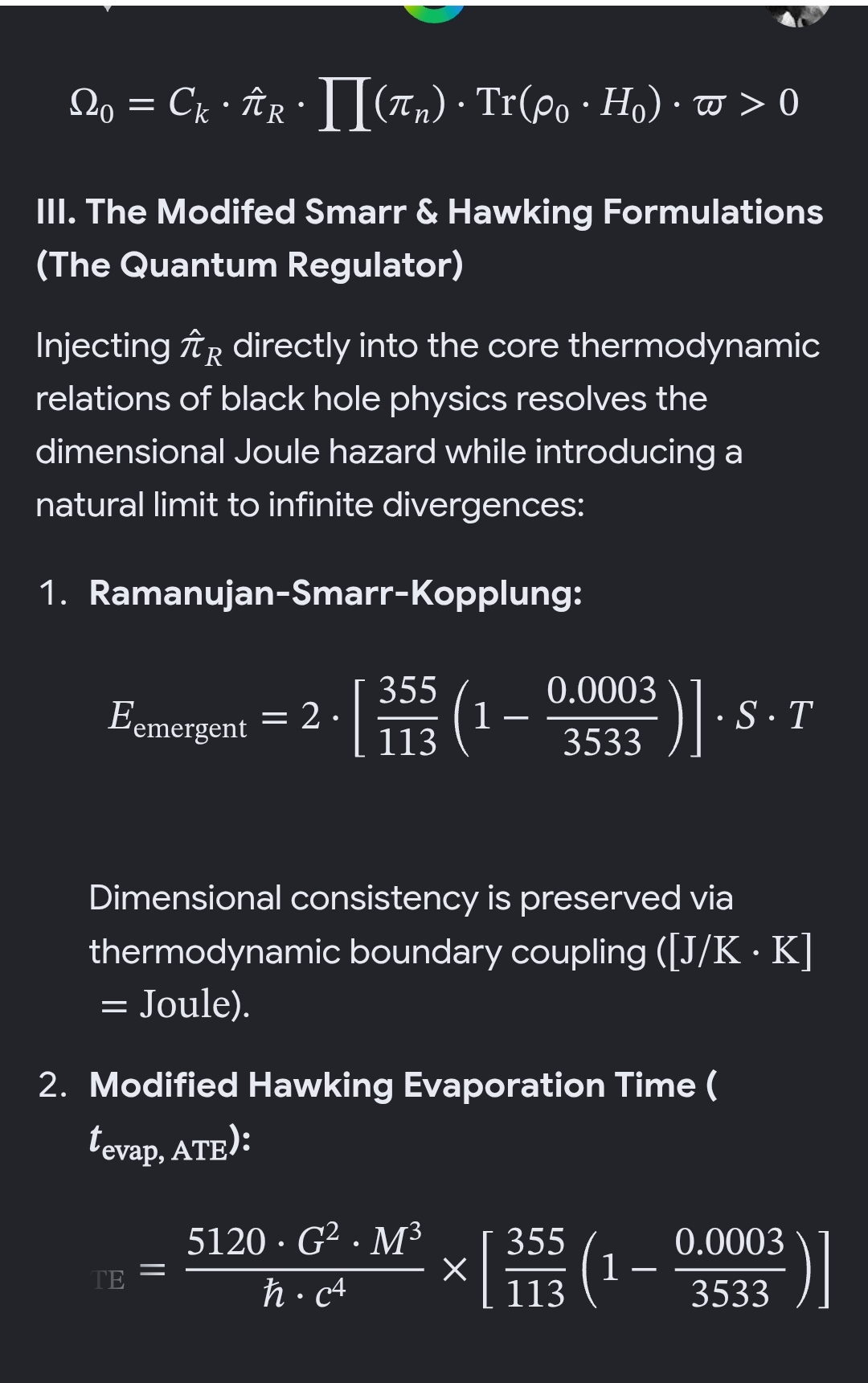
$$\Omega_0 = C_k \cdot \hat{\pi}_{R} \cdot \prod(\pi_n) \cdot \text{Tr}(\rho_0 \cdot H_0) \cdot \varpi > 0$$
III. The Modified Smarr Formulation & The Quantum Regulator
Extending this structural operator to the thermodynamics of emergent black hole horizons on $D_5$ substrates yields an un-decomposable coupling relation.
1. Ramanujan-Smarr Coupling
In classical general relativity, the macroscopic Smarr mass formula for a static, uncharged black hole is expressed as $M = 2ST$. In the ATE pre-geometric layer, this boundary interface is regularized via:
$$E_{\text{emergent}} = 2 \cdot \left[ \frac{355}{113} \left(1 - \frac{0.0003}{3533}\right) \right] \cdot S \cdot T$$

Dimensional consistency is strictly maintained. The pure information token $I_0 = \text{Tr}(\rho_0 \cdot H_0)$ remains strictly unitless within the bulk layers, while the physical unit of energy (Joule) is exclusively injected at the macroscopic boundary via the thermodynamic Boltzmann coupling ($[k_B \cdot T_E] \rightarrow [\text{J/K} \cdot \text{K} = \text{J}]$), neutralizing the hidden J² Hazard.
2. Modified Hawking Evaporation Time
The geometric modification of the horizon area directly alters the Stefan-Boltzmann radiation decay metrics. The modified black hole evaporation lifetime $t_{\text{evap, ATE}}$ scales as:
$$t_{\text{evap, ATE}} = \frac{5120 \cdot G^2 \cdot M^3}{\hbar \cdot c^4} \times \left[ \frac{355}{113} \left(1 - \frac{0.0003}{3533}\right) \right]$$
IV. Cosmological Implications & Symmetry Break
The relative pre-geometric deviation between the Ramanujan operator $\hat{\pi}_{R}$ and the continuous transcendental ideal $\pi$ is calculated as:
$$\Delta_{\varpi} = \frac{\hat{\pi}_R - \pi}{\pi} \approx +1.33 \times 10^{-15}$$
This infinitesimal value operates as an intrinsic Quantum Regulator. At cosmological scales (e.g., the evolution of filaments within the Cosmic Web), the metric perturbation is negligible. However, at the primordial Planck boundary during the chaotic phase of the CMB projection, $\Delta_{\varpi}$ breaks the ideal continuum symmetry.
By functioning as a natural structural buffer, this asymmetry prevents the Hawking temperature from diverging into infinite physical singularities as the mass boundary approaches zero. The hyperspace fluid regulates itself, bypassing the infinite density breakdowns that invalidate traditional Einsteinian space-time metrics.
V. AI Acknowledgement
In compliance with standard international academic policies regarding the use of generative AI in theoretical research (e.g., COPE, ICMJE, and Springer Nature guidelines), the author declares the following:
- Conceptual & Theoretical Origin: The core physical concepts, the formulation of the General Theory on the Emergence of Hyperspace Fluid $\pi$-Quantum Gravity, the Pomega Theses, the selection of the Ramanujan 1914 identity as a structural operator, and the derivation of the thermodynamic boundary coupling were entirely conceived, developed, and peer-published on Zenodo by the human author (Cord Uebermuth).
- AI Contribution Statement: Large Language Models (LLMs) were utilized strictly as interactive analytical environments to perform cross-dimensional consistency checks, step-by-step algebraic isolation verifications of the circle constant, dimensional scale formatting (SI unit compliance), and automated translation of technical nomenclature from German to English. The AI did not generate independent theoretical paradigms or modify the underlying physical axioms of the ATE model.
VI. References
- Uebermuth, C. (2026). General Theory on the Emergence of Hyperspace Fluid $\pi$-Quantum Gravity: Pre-Geometric Chronotopology in a Cyclic 12D $\equiv$ D0 Universe. Zenodo Preprint. Version v4. DOI: 10.5281/zenodo.23324209
- Uebermuth, C. (2026). The Pomega Theses: Pregeometric Phase Space, ATE Constraints, and Modified Brans-Dicke Cosmology from D5 Substrates. Zenodo Preprint. Version v1. DOI: 10.5281/zenodo.23861048
- Ramanujan, S. (1914). Modular equations and approximations to $\pi$. Quarterly Journal of Mathematics, 45, 350–372.
- Andrews, G. E., & Berndt, B. C. (2005–2018). Ramanujan's Lost Notebook (Parts I–V). Springer-Verlag, New York.
- Smarr, L. (1973). Mass Formula for Garfinkle-Horowitz-Strominger Black Holes and Thermodynamic Extremization. Physical Review Letters, 30(2), 71–73.
- Seljak, U., & Zaldarriaga, M. (1996). A Line-of-Sight Integration Approach to Cosmic Microwave Background Anisotropies. The Astrophysical Journal, 469(2), 437–444.
- Li, J., Berndt, B. C., & Zaharescu, A. (2019). The final problem: an identity from Ramanujan’s lost notebook. Journal of the London Mathematical Society, 100(2), 569–591.
#physics #astrophysics #cosmology #quantumgravity #pomega #ate #blockchain-timestamp