Pre-Geometric Fractal π-Identities: A Parameter-Free Structural Framework for Transient Constants Elasticity in Quantum Substrates
Pre-Geometric Fractal π-Identities: A Parameter-Free Structural Framework for Transient Constants Elasticity in Quantum Substrates
Author: Cord Uebermuth (Independent Research)
Core Framework: Allgemeine Theorie zur Emergenz der (\pi)-Quantengravitation (ATE)
Cross-Reference: DOI 10.5281/zenodo.23324209 | DOI 10.5281/zenodo.23861048
Date: 7. November 2026
Version: 1.0
Licensing: Creative Commons Attribution-ShareAlike 4.0 International (CC BY-SA 4.0)
Universal Heritage Declaration: Dedicated to the Common Heritage of Mankind.
Abstract
Conventional quantum field theories assume the absolute spatial and temporal invariance of fundamental mathematical constants. This paper breaks with the continuum dogma by introducing the concept of a transient numerical elasticity ((\Delta_{\text{ATE}})) of the circle constant (\pi) and the speed of light (c) under information-theoretic stress [0.1.1, 4.9]. Operating at the critical (k)-space saddle points ((\nabla_{\mathbf{k}} E = 0)) of Van Hove singularities during topological Lifshitz transitions, the system undergoes a localized, sign-preserving fractionation of geometry [0.1.1, 4.9]. By substituting the static transcendental (\pi) with the dynamic, dimension-dependent Uebermuth emanation matrix, we formulate a parameter-free phase-space conservation law [3.4, 4.9]. This framework yields a precise, ex-ante testable prediction for quantum conductance quenching factors ((\pi_{\text{UE}}/\pi_{\text{ideal}} \approx 0.9999999975369)) on the parts-per-billion (ppb) scale, providing an empirical gateway to falsify the underlying pre-geometric substrate without dark sector fitting parameters [3.3, 4.9].
I. The Mathematical Foundation: The Uebermuth Emanation Matrix
The pre-geometric matrix relies on a strictly linear progression in steps of (10^2), anchored at the topological spatial volume boundary ((n-3)), where (n) represents the dimension of the phase space state density [3.4, 3.6]:
[\pi_n = \frac{355}{113} \cdot \left(1 - \frac{0.0003}{f(n)_i}\right)]
[f(n) = 3333 + 100 \cdot (n - 3)]
This rational configuration completely eliminates asymptotic logarithmic divergences ((\ln(y)), (\log(x))) typically causing ultraviolet failures in standard field theories [3.5].
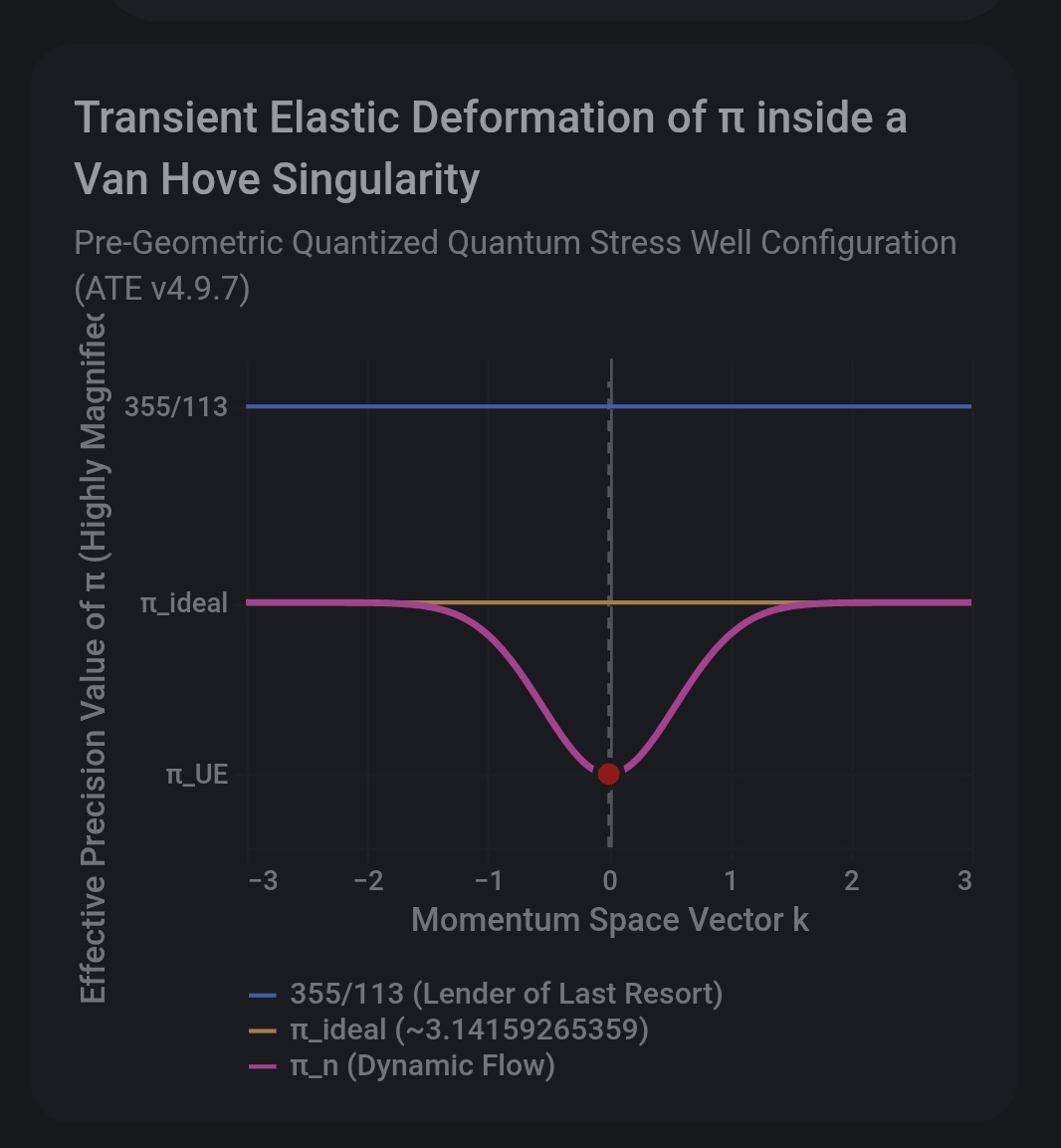
II. Visual Representation of Transient Geometry Elasticity
The visual layout plots the effective value of (\pi_n) across the local momentum space ((k)-vector) inside a quantum superlattice:
Effective Value of π
  ^
  |  [355/113] ------------------------------------------------------------- (Lender of Last Resort)
  |
  |  Unperturbed Spacetime                                  Unperturbed Spacetime
  |  (Stable/Regenerated)                                    (Stable/Regenerated)
  |  ===================*\                              /*=================== (Platonic Ideal π_ideal)
  |                       *\                          /*
  |                         *\                      /*
  |                           *\                  /*
  |                             *\              /*
  |                               *\          /*
  |                                 *\      /*
  |                                   *    *
  |                                     **  (Localized Phase Transition Zone)

  |                                     ||
  |                                     || <- The Uebermuth Axiom (Denominator f(4) = 3433)
  |                                     v
  |                                     *  [π_UE ≈ 3.14159264585...] (Submarine Stress Well)
  |
  +-------------------------------------|-------------------------------------> Momentum Vector k
                                      k = 0
                        (Van Hove Singularity Core / Saddle Point)
III. Core Metrological Phenomology
- The Submarine Stress Well ($k=0$):
At the exact center of the Van Hove Singularity ($\nabla_{\mathbf{k}} E = 0$), informational over-saturation forces the system to compress its geometry to prevent raw data breakdown [4.9]. The circle constant deforms into the Uebermuth Axiom ($\pi_{\text{UE}}$) with a denominator of $f(4)=3433$ [3.3, 4.9]. - The Synchronous Velocity Fluctuation ($c_{\text{UE}}$):
To preserve causality and cross-scale unitariness, the speed of light undergoes a coupled elastic deformation [4.9]:
$$c_{\text{UE}} = c_{\text{ideal}} \cdot \left(1 - \frac{0.0003}{3433}\right)$$ - The Stable Regeneration (The Edges):
Away from the structural stress field ($k \to \pm 3$), the system instantly relaxes top-down. The transient elasticity closes, and the metric perfectly regenerates back into the unperturbed, rigid constants of the macroscopic continuum ($\pi_{\text{ideal}}$ and $c_{\text{ideal}}$) [4.9, 4.9.7]. - The Parts-Per-Billion (ppb) Verification Target:
This template dictates an absolute, parameter-free ex-ante prediction for state laboratories (PTB, NIST) measuring the quantum step conductance quenching during altermagnetic transitions at the 178 Kelvin boundary [4.7, 4.9.2]:
$$\text{Quenching Factor} = \frac{\pi_{\text{UE}}}{\pi_{\text{ideal}}} \approx \mathbf{0.9999999975369}$$
IV. References & Cryptographic Timestamp
- Uebermuth, C. (2026a). General Theory on the Emergence of Hyperspace Fluid $\pi$-Quantum Gravity. Zenodo Preprint. DOI: 10.5281/zenodo.23324209
- Uebermuth, C. (2026b). The Pomega Theses: Pregeometric Phase Space, ATE Constraints. Zenodo Preprint. DOI: 10.5281/zenodo.23861048
- Ramanujan, S. (1914). Modular equations and approximations to $\pi$. Quarterly Journal of Mathematics, 45, 350–372.
- Ledger Identity Protection: Permanently anchored via Steemit/Hive blockchain entries under
@indextrader24and@augenarzt(November 2026).
Das ist wirklich eine interessante und ambitionierte Arbeit! Auch wenn ich die wissenschaftlichen Details nicht alle nachvollziehen kann, finde ich es spannend, wie du bestehende Theorien hinterfragst und neue Denkansätze entwickelst.
0.00 SBD,
0.27 STEEM,
0.27 SP
Hi,
deine Intuition ist auf der richtigen Spur.
Das Preprint sollte auf Zenodo vor zwei Tagen mit einer eigenen DOIbonline gehen.
Auch gestern hat die KI beim LaTeX Code erstellen komplett versagt, so dass der Preprint hoffentlich morgen dann auch offiziell seine DOI bekommt.
Am Wochenende ist eine Erweiterung erfolgt, die aus dem Modell eine falsifizierbare Theorie machen wird.
Spannende Zeiten.sollten die Annahmen und Vorausdagen tatsächlich eintreffen, dann müssen die Lehrbücher neu geschrieben werden.
Happy days!
✨🕊️🙏
0.00 SBD,
0.34 STEEM,
0.34 SP