The Domain That Almost Cost Me a Connected Wallet
It was a Tuesday night, and I was half scrolling a Discord server for a project I'd followed for months. Then a pinned message: "URGENT: Snapshot closes in 47 minutes, claim your allocation now." A link underneath it, logo looked right, colors matched, even the little countdown timer in the corner felt legit.
My thumb was already moving toward it.
Here's the thing about "47 minutes" and "URGENT." That's not information, that's pressure. And pressure is the one ingredient every scam needs, because it stops you from doing the one thing that actually protects you: pausing.
So I paused. Opened a new tab instead of the link. Pasted the domain into a WHOIS lookup. Ten seconds later I had my answer.
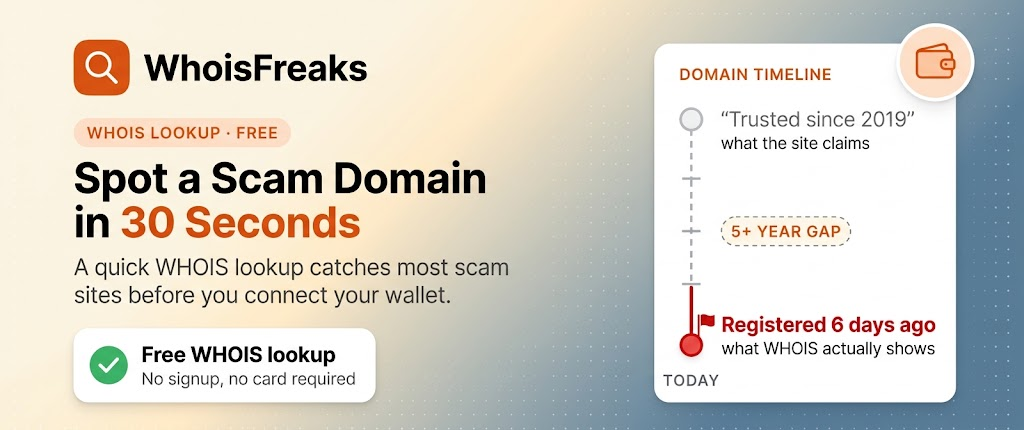
The domain was six days old.
Six days. Not six years, not six months. Six days, for a project that had supposedly been building a community for the better part of a year. Somebody had registered a fresh domain, cloned the front end, and timed the "urgent" message to catch people scrolling late at night when they're least likely to stop and check anything.
I'd read the number before but it hit different in that moment: the FBI's Internet Crime Complaint Center recorded $11.36 billion in crypto fraud losses in 2025, up 22% from the year before. Most of that didn't start with some elaborate hack. It started with a link that looked fine at a glance, from someone who didn't take the ten seconds I just did.
I closed the tab, posted a warning in the server, and within an hour a mod had pulled the message down. A few people thanked me. One admitted they'd already had the wallet connect popup open.
Why the date matters more than anything else on the page
A domain's age is the single fastest tell you have, and almost nobody checks it. Real projects, real exchanges, real companies, they have a paper trail. Years of it, usually. Scam sites don't, because they can't. They get reported and taken down fast, so there's no upside to registering early, and every upside to registering the week of the campaign.
That's not the only thing worth glancing at either. I've gotten into the habit of checking a domain's full ownership history too, not just its current registration, because age alone can lie in the other direction. A domain can be five years old and still have quietly changed hands three weeks ago, which matters a lot if someone's reusing an old, semi-trusted domain that used to belong to something else entirely. Age tells you when it started. History tells you if it's still the same story.
The time I almost called something a scam and was wrong
I want to be honest about the limits here too, because I've gotten this wrong before. A few months back I flagged a domain to a friend as suspicious purely because it was two weeks old, only to find out it belonged to a genuinely new, genuinely legitimate project that had simply launched recently. New isn't proof of anything by itself. It's a reason to look closer, not a verdict. WHOIS privacy protection trips people up the same way, plenty of completely honest site owners use it, so a masked registrant on its own means nothing either. The domain check is one input. These days I run it through WhoisFreaks' Domain Reputation API too, it pulls DNS, SSL, WHOIS age, and threat intel matches into one verdict, so I'm not leaning on a single signal like age or privacy status by itself anymore." Stack it with checking the project's actual social channels, looking for a verified contract address, and staying skeptical of anything built around a countdown clock.
What I reach for now
I use WhoisFreaks for this, mostly because it's fast enough to run mid scroll without breaking my train of thought. Their free lookup tool handles the current record with no signup, and their WHOIS History API covers the ownership timeline, with a free tier of 500 credits and no card required, more than enough for someone just screening links before clicking, not running a business on it.
(Quick disclosure since I'm naming a tool I'm connected to: I work with WhoisFreaks. Take that as you will, though the underlying habit, checking age and history before you trust a domain, works with whatever WHOIS tool you already reach for.)
That six day old domain never got my wallet. Next time something in your feed says "urgent," give it the ten seconds it's specifically trying to deny you. Paste the domain somewhere first. Read the date before you read the countdown.