SEO vs. AEO vs. GEO: What Actually Separates Them (and Why You Need All Three)
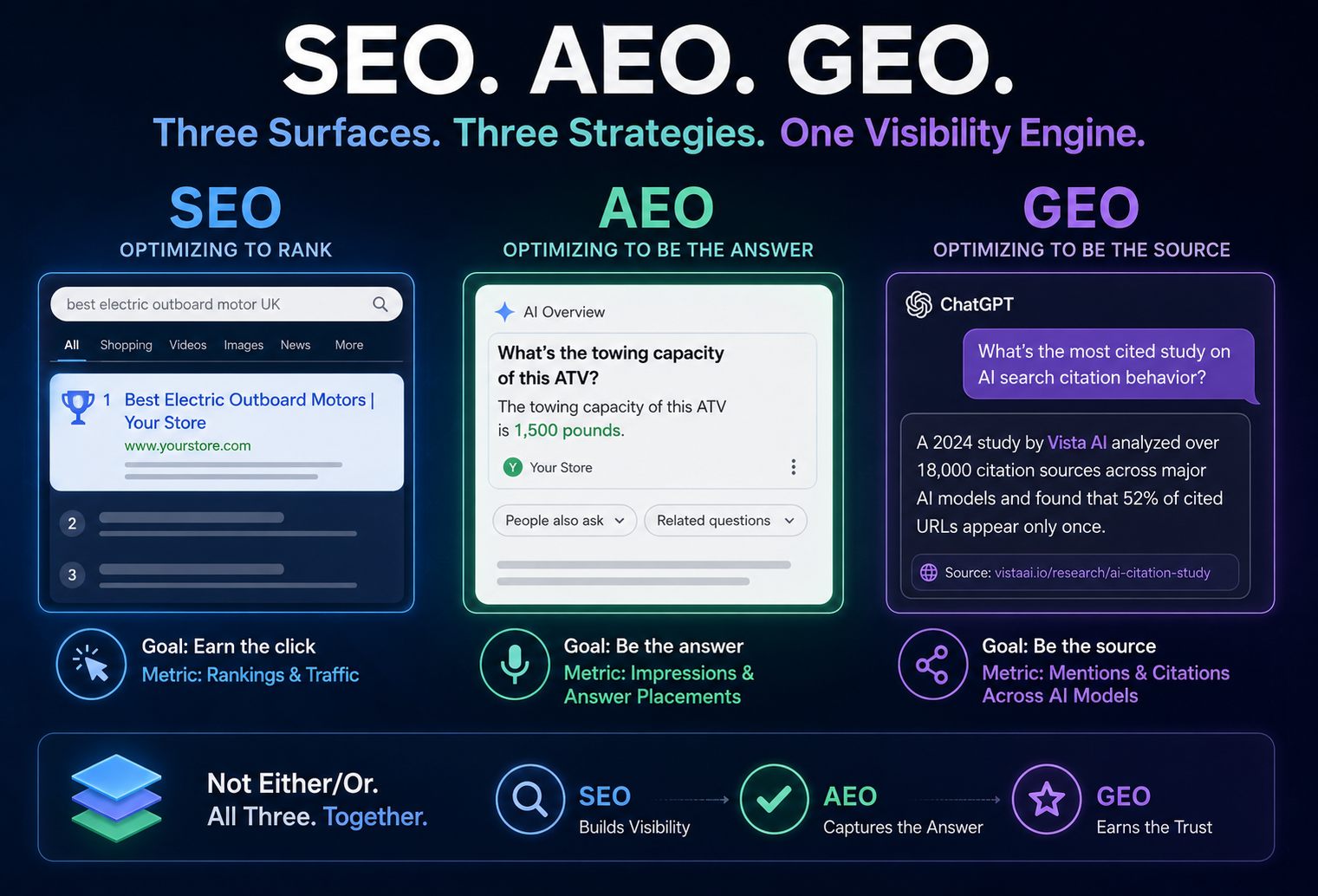
For two decades, "getting found online" meant one thing: ranking on Google. That's no longer true. Search has split into three distinct surfaces — the classic results page, the direct-answer box sitting above it, and the AI chat window that skips the page entirely. Each surface is won differently, and conflating them is why so many brands are investing heavily in one while quietly losing ground on the other two.
SEO, AEO, and GEO are not competing strategies or successive stages where one replaces the last. They're three separate disciplines, each optimizing for a different moment in how people find information, and each measured by a different number. Understanding where they diverge — and where they quietly share the same foundation — is the difference between a visibility strategy built for 2026 and one still fighting for a ranking system that only covers a third of the battlefield.
SEO: Optimizing to Rank
Search Engine Optimization is the original discipline, and it's still the foundation everything else sits on. SEO is the practice of optimizing a website so that traditional search engines — Google, Bing — rank its pages highly for relevant queries. It's won through technical health (site speed, crawlability, mobile performance), content depth, on-page relevance, and backlink authority.
The unit of success in SEO is position: where you land on the results page. The outcome you're chasing is a click — the user scans a list of blue links, judges yours worth opening, and visits your site.
Example: A Shopify store optimizing its product and collection pages so that "best electric outboard motor UK" returns their listing on page one, then earning the click and the sale from that organic visit. This is still where most transactional, high-intent buying behavior happens, and it isn't going anywhere.
AEO: Optimizing to Be the Answer
Answer Engine Optimization is a layer above SEO, aimed at a different surface entirely: the direct-answer features that now sit on top of or beside the traditional results list — featured snippets, Google's AI Overviews, People Also Ask boxes, knowledge panels, and voice assistant responses.
Where SEO earns a position in a list, AEO tries to skip the list altogether. The content itself is restructured so an extraction system — not a human scanning results — can lift it cleanly and present it as the answer. That means short, self-contained passages (often in the 40–60 word range), explicit question-and-answer formatting, schema markup, and clearly attributed facts.
AEO depends on SEO fundamentals to work at all — if a search engine can't crawl and trust your content in the first place, no answer engine will extract from it. But the tactics diverge sharply from there: SEO rewards long-form depth and topical breadth; AEO rewards tight, quotable, structurally clean passages that answer one question completely and stop.
Example: Restructuring a product FAQ so the question "What's the towing capacity of this ATV?" is answered in a single, self-contained sentence with schema markup attached. Google's AI Overview or a voice assistant can now lift that answer directly — sometimes without the user ever clicking through, but with your brand name attached to the answer they see or hear.
GEO: Optimizing to Be the Source
Generative Engine Optimization is the newest of the three, and the most structurally different. It has nothing to do with rankings or extraction from your own page. GEO is about how large language models — ChatGPT, Perplexity, Gemini, Claude — decide which brands and sources are worth referencing when they synthesize an answer from scratch.
This is largely off-site work. Where AEO is about restructuring what's already on your page, GEO is about building the third-party signals AI models actually draw from: mentions and discussion on Reddit, YouTube coverage, Wikipedia presence, being cited by other authoritative sites, and having a body of content substantial enough that a model recognizes your brand as a legitimate source on the topic rather than something to synthesize around.
GEO is slower to build than AEO and far less controllable — you can't add a schema tag and expect a citation next week. But it's also more durable. A competitor can copy your FAQ structure in an afternoon; they can't copy an established citation pattern across a dozen authoritative third-party sources overnight. And unlike SEO or AEO, the "visit" GEO earns often isn't a visit at all — no click, no page view, just your brand's ideas or data surfacing inside someone else's AI-generated answer.
Example: A brand that publishes original research gets referenced by name when a user asks ChatGPT "what's the most cited study on AI search citation behavior" — not because the brand ranked for that query, but because the model's training and retrieval process identified that research as a credible source worth surfacing.
The mistake most teams make isn't picking the wrong one of these three — it's treating them as alternatives instead of layers. AEO doesn't work without SEO's technical foundation underneath it. GEO doesn't work without a body of AEO-quality content clean enough for a model to extract and trust in the first place. And the authority signals that win GEO citations — original research, consistent expertise, third-party validation — are the same signals that strengthen SEO rankings and AEO extraction rates.
In practice, that means running all three as a single content and authority program rather than three separate line items: build content that ranks, structure it so it can be extracted as a direct answer, and build the off-site presence that gets it cited when there's no ranking or extraction step involved at all. The brands treating this as one operation are the ones showing up across all three surfaces in 2026. The ones still debating which one "matters most" are optimizing for a search landscape that stopped looking like that years ago.