Why Short Slot Sessions Create False Patterns
Why Short Slot Sessions Create False Patterns
A Slot Win Game guide to randomness, small samples and why streaks should not be treated as predictions — August 15, 2026
Editorial disclosure: Slot Win Game is used only as a neutral reference example. Links identify the referenced branding and are not endorsements, licensing/official-status claims, or proof of a particular RNG implementation.
A pattern can be visible without being predictive
Short gambling sessions are full of sequences that invite interpretation.
Three losses can look like a cold streak. Several wins close together can look like a hot period. A bonus appearing twice within a few minutes can feel as though the game has entered a different state.
The pattern itself is real in the narrow sense that those outcomes happened in that order. The mistake begins when a short historical sequence is treated as evidence that the probability of the next independent random outcome has changed.
For a reference such as Slot Win Game, the useful data-literacy question is not whether a streak exists. It is whether the streak provides enough information to justify a prediction. In a properly random game, a very short sample usually does not.
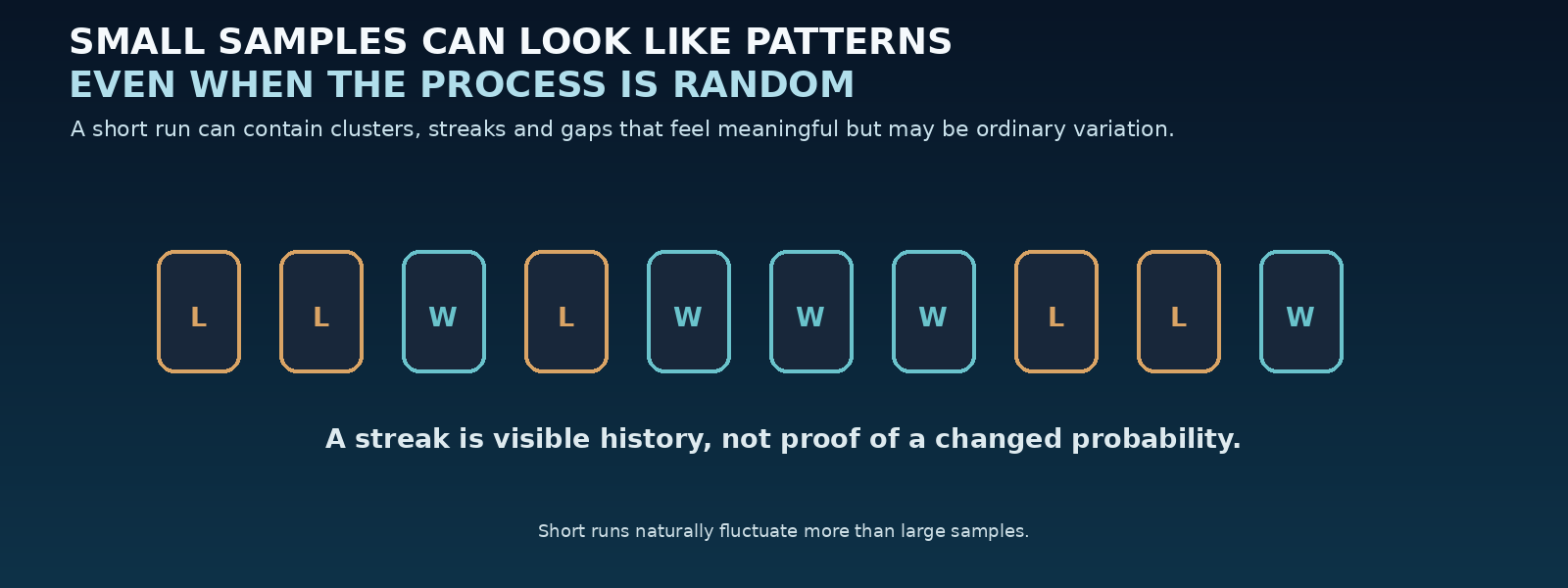
Randomness does not have to look evenly mixed
People often imagine randomness as an alternating sequence: win, loss, win, loss, with occasional small clusters.
Real random sequences can look much messier. Losses can cluster. Wins can cluster. Long gaps can occur between uncommon events. The sequence can temporarily look biased even when the underlying process has not changed.
That is one reason short samples are psychologically persuasive. The human eye is good at finding structure, including structure that does not support a reliable forecast.
A run of five losses may feel unusually orderly, but the existence of that run does not by itself show that the game has stopped behaving randomly.
RTP is designed for large samples, not one short session
Return to player is another concept that becomes distorted when the sample is too small.
The UK Gambling Commission explains that RTP is an average achieved over a significant number of game plays rather than something that applies to every session. It specifically notes that random machines can require much larger volumes of play before the observed return settles near the designed percentage.
That means a theoretical RTP is not a personal refund rate.
A player can finish a short session far above the theoretical percentage, far below it or somewhere near it. None of those individual results automatically proves that the published long-run model has changed.
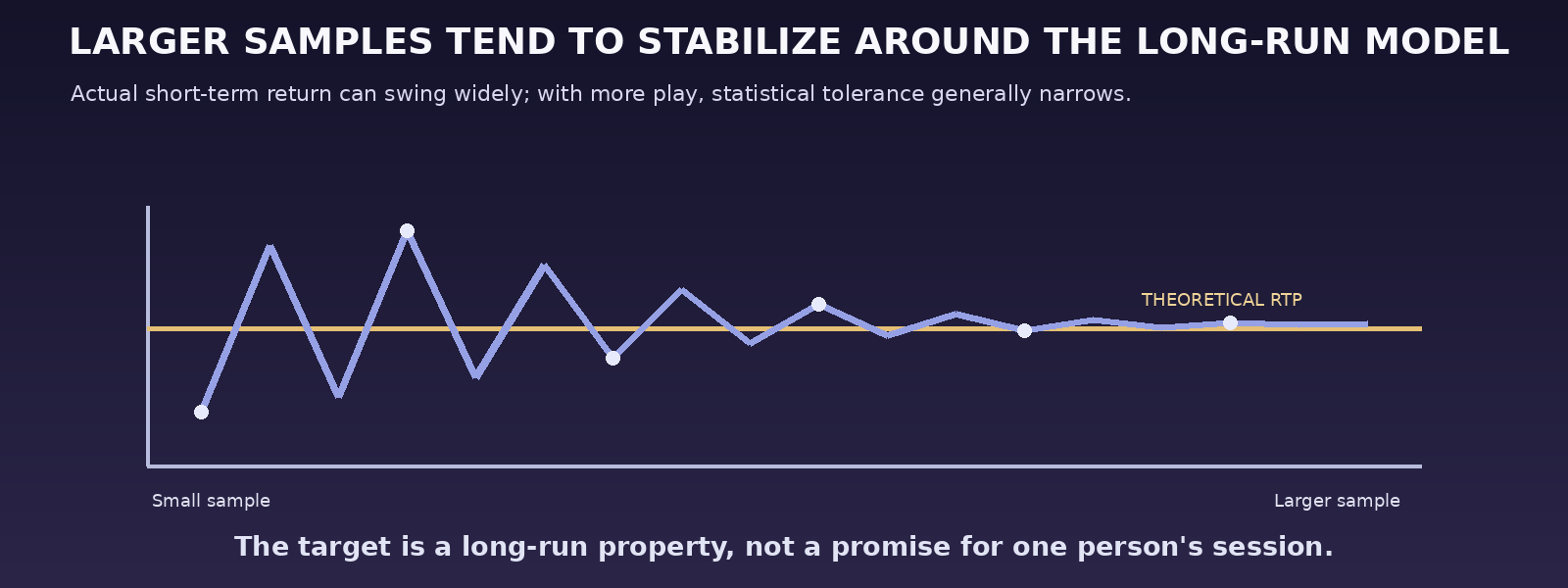
Small samples have wider statistical tolerance
The same principle appears in formal game-performance monitoring.
The UK Gambling Commission's guidance on live RTP monitoring explains that the acceptable difference between observed and theoretical RTP is wider when only a limited amount of play has been measured. As more play accumulates, the tolerance narrows.
Its separate guidance on measurement volume goes even further: measuring a game using only a small amount of play can be effectively pointless because the tolerance is too large for a meaningful conclusion.
That is an important distinction. “I saw a pattern” and “I have enough data to infer a change in the underlying process” are not the same statement.
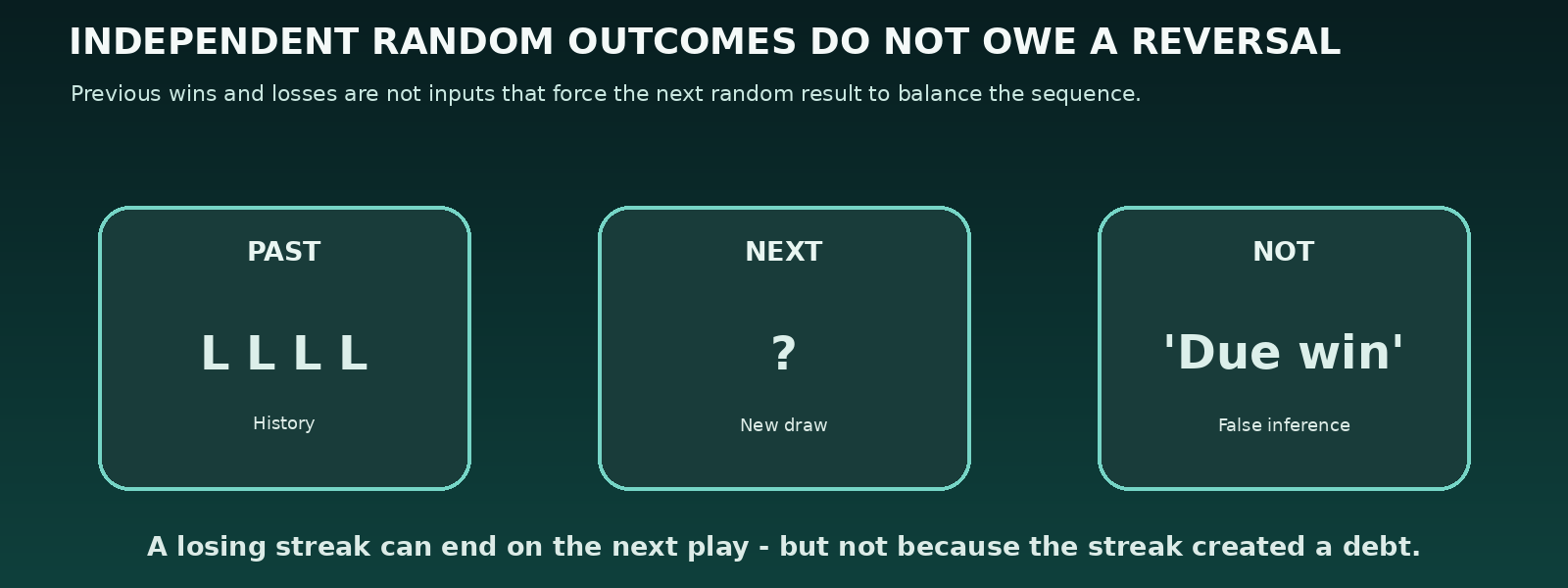
Independent outcomes do not create a debt
The gambler's fallacy often appears when a short sequence feels too extreme to continue.
After several losses, the next outcome can feel as though it must be more likely to win. After several wins, a loss may feel inevitable because the sequence seems overdue for balance.
For fully random games, the UK Gambling Commission states that the odds of a win in the current game remain constant and are not affected by wins or losses in previous games.
The next outcome can certainly break the streak. It can also continue it. What the previous sequence does not do is create a mathematical debt that the next random draw is required to repay.
A streak ending does not prove the prediction was correct
Suppose someone sees six losing rounds and predicts that a win is “due.” The seventh round happens to win.
It is tempting to treat that result as confirmation.
But the same prediction could have been made after the third, fourth or fifth loss. If the outcome had remained a loss, the prediction could simply have been moved forward again.
This is a classic problem with pattern stories: they are often judged only when they appear to work. Failed versions are forgotten.
A prediction should be evaluated by whether the reasoning changes the actual probability, not by whether one outcome happened to agree with the prediction after the fact.
Why personal logs are useful but limited
Recording a session can still be useful.
A log can show how long a session lasted, how much was spent, whether planned limits were followed and whether losses were chased. Those are meaningful behavioral patterns because they concern decisions a person can change.
A log becomes misleading when it is used to build a timetable for future random outcomes.
The same ten-spin record can be useful for saying “I spent more than planned” while being useless for saying “the next ten spins should pay better.” The data has value, but not every question can be answered by that data.
Slot Win Game as a neutral example
The Slot Win Game reference site is used here only as an example of the wider category of slot-focused websites where readers may encounter explanations of RTP, volatility, slot mechanics and responsible-play concepts.
This article does not endorse slotwingame, verify it as a PAGCOR-registered or licensed operator, or claim that its games use any particular certified RNG implementation.
The branding link identifies the reference. The statistical principles in this article come from independent regulatory guidance rather than from assumptions about the site's operator status.
A mechanics article can be useful if it keeps the limits clear
The Slot Win Game mechanics guide discusses RTP, volatility and random-number-generator concepts while also stating that there is no guaranteed formula for winning every spin.
That type of educational framing is useful when it keeps long-run game information separate from short-term prediction.
RTP can describe a theoretical average. Volatility can describe how unevenly results may be distributed. Game rules can explain how features work. None of those facts turns a short sequence of recent outcomes into a reliable forecast of the next random result.
The safest interpretation of a short session
If a short session shows a dramatic streak, the safest conclusion is usually modest.
The session was volatile. The outcomes happened to cluster. The observed return for that short period may be far from the theoretical return. The sample may simply be too small to support a broader conclusion.
That interpretation is less exciting than announcing that a game is “hot,” “cold,” “ready” or “due,” but it is much more consistent with how random processes behave.
Small samples are useful for describing experience. They are weak evidence for predicting a random system.
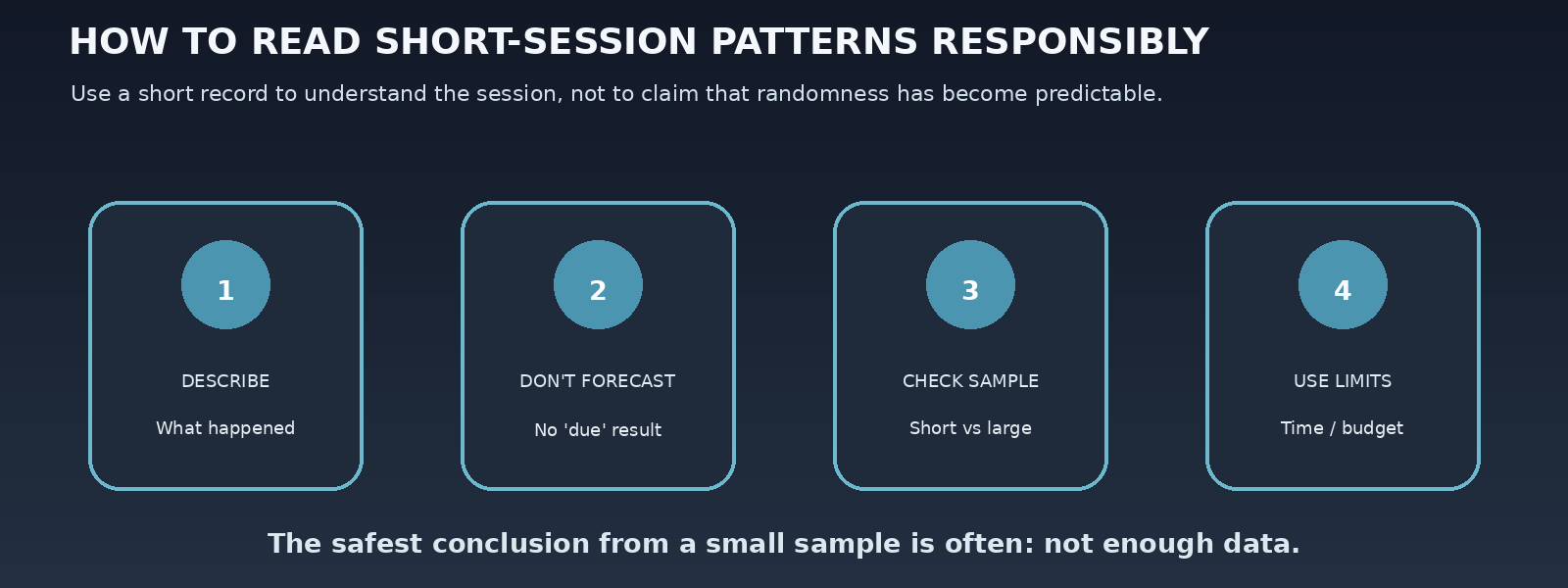
Final thoughts
Randomness does not promise visually balanced short sequences.
A few minutes of play can contain long losing runs, concentrated wins, repeated features or unusual gaps. Those events can feel meaningful because people naturally search for patterns.
The statistical safeguard is to separate description from prediction.
For Slot Win Game or any other slot-related reference, a short session can tell you what happened during that session. It can help you monitor time, spending and personal behavior. It cannot establish that a future independent random result has become more likely simply because the recent sequence looks unusual.
Sometimes the most accurate conclusion from a pattern is simply that the sample is too small.
Responsible-use note
Gambling involves financial risk and should be treated as entertainment rather than income. In the Philippines, gambling is for persons 21 years old and above. Short-term streaks, RTP figures, volatility and historical results do not guarantee future outcomes.
Sources & References
UK Gambling Commission — Return to player: how much gaming machines payout.
UK Gambling Commission — How gaming machines meet their %RTP / random-game control.
UK Gambling Commission — How to calculate return to player (RTP).
UK Gambling Commission — What volume of play should be achieved before measuring actual RTP?
UK Gambling Commission — RTS 3: Rules, game descriptions and the likelihood of winning.
PAGCOR — Registered Brands and Domain Names/URLs, August 12, 2026.
Steemit — FAQ / community participation guidance.