Why “Hot” and “Cold” Slots Don’t Change Randomness: A Slot Win Game Data-Literacy Guide
Why “Hot” and “Cold” Slots Don’t Change Randomness: A Slot Win Game Data-Literacy Guide
How RNGs, independent spins and the gambler’s fallacy explain why recent results do not control the next outcome — August 14, 2026
Independent data-literacy editorial on slot randomness, RNGs and the limits of streak-based prediction.
Randomness can produce streaks without becoming predictable
People are very good at noticing patterns. A few wins close together can make a game look “hot.” A long run without a prize can make it feel “cold.” The pattern is real in the sense that those outcomes actually happened, but the interpretation can go too far.
In a properly random game, a streak does not automatically indicate that the underlying probability has changed. The UK Gambling Commission’s technical standard for random outcomes requires RNG-generated game results to be acceptably random and prohibits adaptive behavior in remote random games. That means the system should not secretly make a particular outcome more or less likely simply because a recent run looks unusual.
For readers encountering terms such as Slot Win Game, hot slot win, cold slots or winning patterns, the useful distinction is between describing the past and predicting the future. A history can contain streaks. That does not give the streak control over the next random draw.
Each independent event starts with the same uncertainty
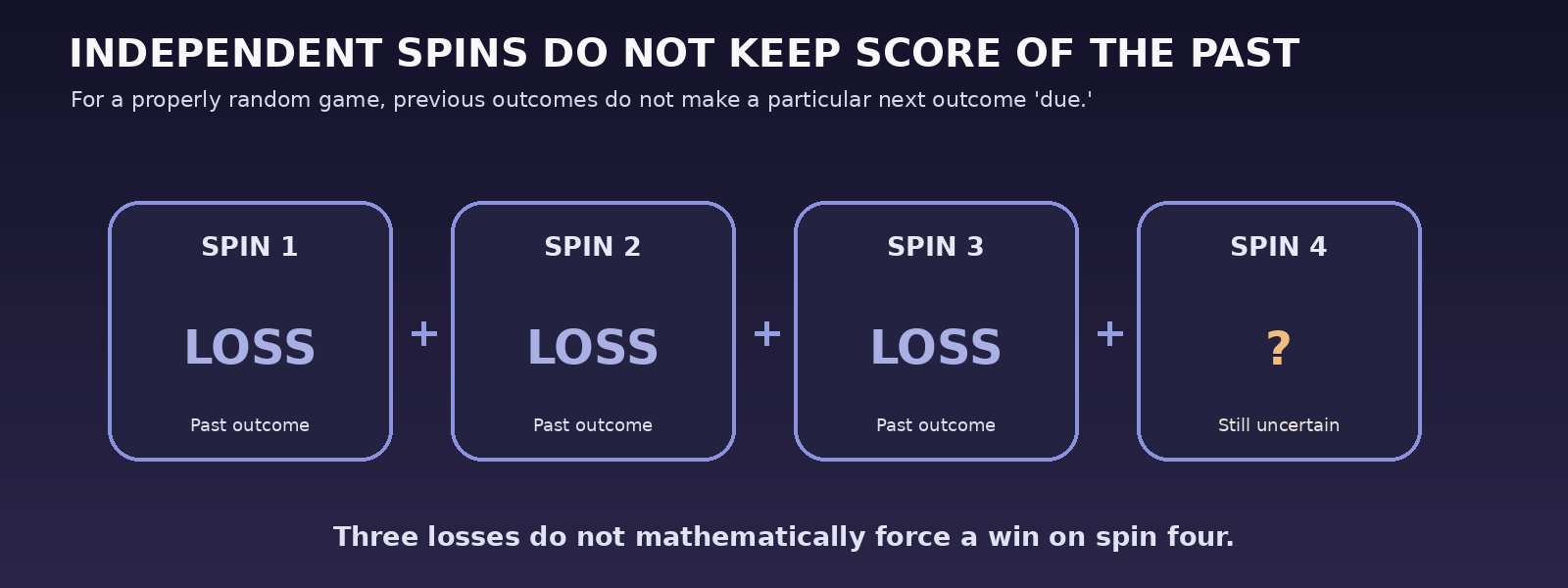
The Responsible Gambling Council defines the gambler’s fallacy as the mistaken belief that a future random event becomes more likely because a particular outcome has not appeared recently. Its simple dice example captures the problem: several rolls without a four do not make a four “due” on the next roll.
The same reasoning applies to independent slot outcomes. If spins are generated independently according to the game’s rules, the previous screen is history, not an instruction to the RNG.
This is why statements such as “it has been cold long enough, so it should pay soon” are mathematically weak. They replace uncertainty with a story about balance. Random processes do not have to make short sequences look balanced.
Why a random sequence can look surprisingly non-random
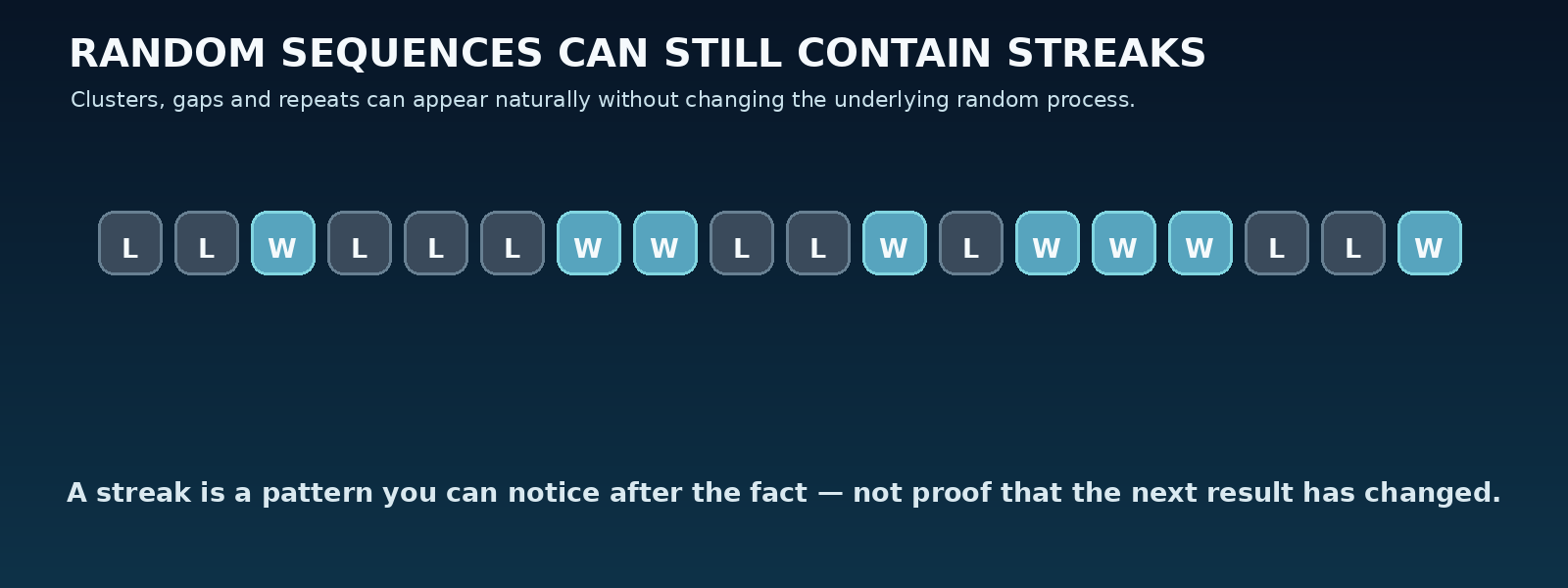
A common intuition is that randomness should alternate neatly: win, loss, win, loss, with no long clusters. Real random sequences often look messier.
Repeated outcomes, gaps and clusters are not evidence against randomness by themselves. If you generate a long enough random sequence, some portions will look unusually streaky simply because many possible arrangements can occur.
That is why a Slot Win Game discussion of recent slot patterns should be read carefully. A chart showing several wins or several losses can accurately summarize what happened. It becomes misleading only when that history is presented as a reliable signal about what must happen next.
“Hot” and “cold” are backward-looking labels
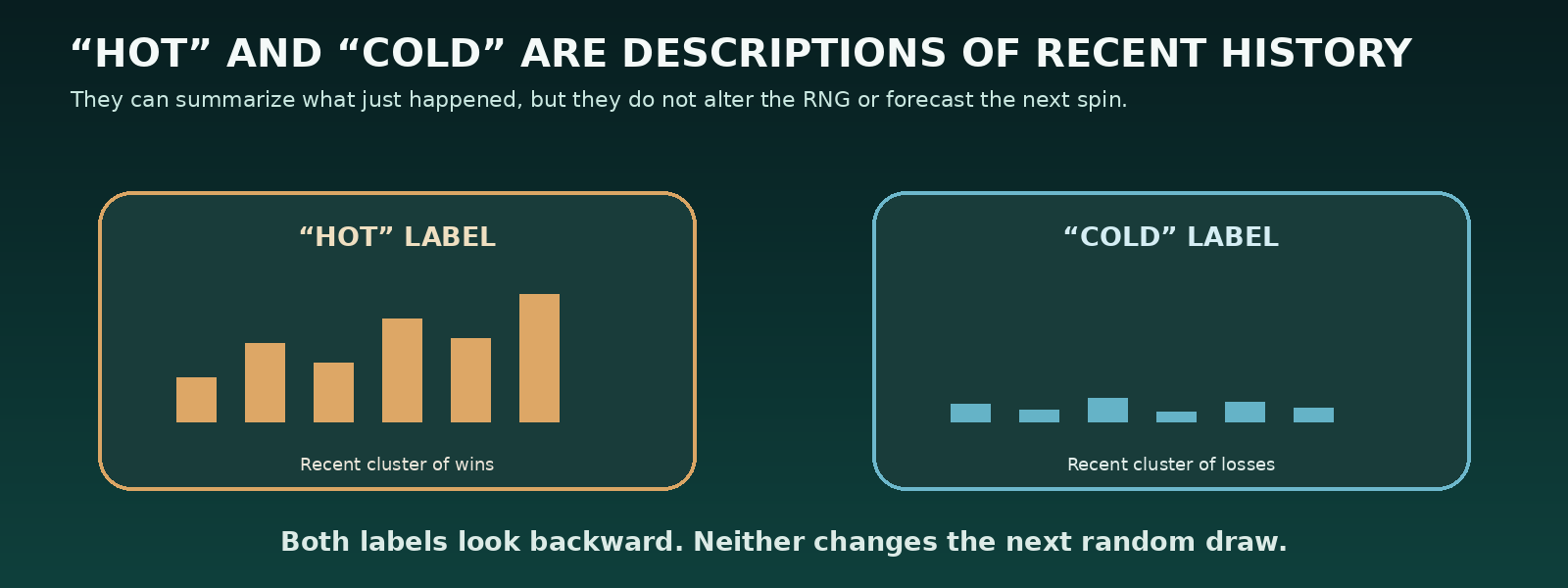
Calling a slot “hot” usually means it has produced several favorable outcomes recently. Calling it “cold” usually means the opposite.
Those labels can function as informal summaries, much like saying a basketball player has been shooting well over the last few games. But a label does not change the mechanism producing the next random result.
A page on Slot Win Game uses terms such as hot slot win, monitoring and slot-win patterns. Those phrases may describe topics readers search for, but they should not be interpreted as proof that past results can forecast a properly random next spin. The site’s own pages also acknowledge that slot outcomes are generated by RNGs and that individual spins are unpredictable.
The gambler’s fallacy turns history into an imaginary debt
The most dangerous version of the hot-and-cold idea is the belief that randomness owes the player a correction.
After a losing streak, someone may think the system must compensate with a win. After several wins, another person may think a loss is now inevitable. Both ideas assume that short-term randomness has a memory and a need to balance itself immediately.
The Responsible Gambling Council specifically identifies this reasoning as the gambler’s fallacy. Independence means previous outcomes do not alter the probability of the next event merely because they occurred.
This does not mean probabilities never change in any game or system. Game rules, bonus states or explicitly defined mechanics can change probabilities. The point is narrower: past random outcomes alone are not evidence that the next independent outcome has become due.
RTP does not rescue the “due for a win” argument
Return to player is another statistic that can be misunderstood when people look at short streaks.
RTP is a long-run theoretical average, not a schedule telling the game when to return value to one particular player. A session can run far above or below the published rate without creating a debt that the next spin must repay.
That is why combining “cold slot” language with RTP can create a false conclusion: “I have lost for a while, so the RTP means the game has to catch up now.” The averaging effect belongs to a large statistical sample, not to a personal timetable.
Monitoring tools record outcomes; they do not control them
Tracking can still have legitimate uses. A session record can show spending, time played, wins, losses or other history. It can help a person stay within limits and see how much activity has accumulated.
What it cannot legitimately do is convert past results into a guaranteed next-spin signal.
The Slot Win Game article on slot mechanics discusses RTP, volatility and game understanding. The safer way to use information like that is as slot game mechanics education, not as a prediction system. A monitor can observe. It does not reach backward into past spins and instruct a compliant RNG to create the next result.
A better way to read a streak
When a streak appears, separate three questions.
First: What happened? That is the historical record.
Second: What does the game specification say? That includes published rules, RTP, volatility and any explicit feature that changes the game state.
Third: What can the history predict? For independent random outcomes, the answer is much less than pattern-seeking intuition suggests.
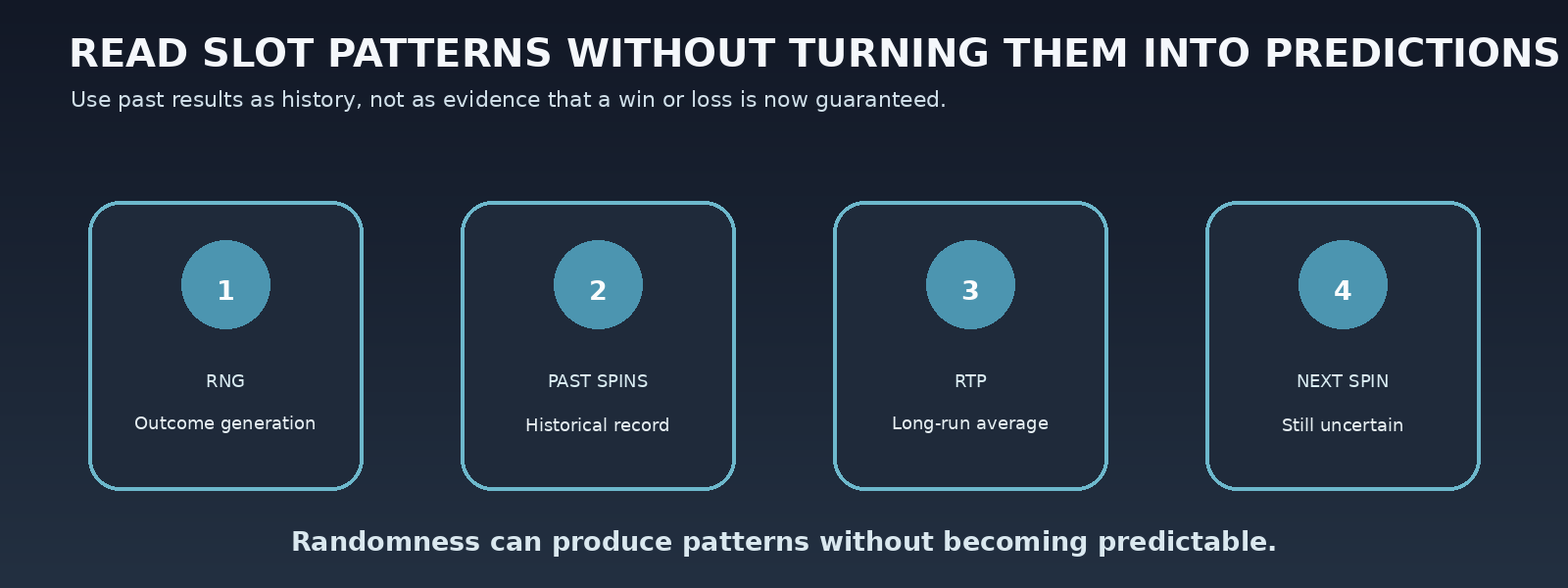
This framework allows a reader to discuss slot randomness, slot RNG, past spins, RTP and slot game patterns without turning them into a promise of a future result.
Why this matters for responsible play
The gambler’s fallacy becomes more than a statistics mistake when it encourages chasing.
If someone believes a win is overdue, a losing sequence can become a reason to continue spending rather than a reason to stop. That creates a direct pathway from a false probability belief to financial harm.
PAGCOR’s current responsible-gaming guidance states that gambling is for people aged 21 and above and warns that gambling can be addictive. Treating random games as entertainment rather than as an income source is consistent with the mathematical reality: short-term outcomes remain uncertain, and no streak creates a guaranteed recovery.
Final thoughts
A slot can look hot. It can look cold. A short sequence can contain striking runs, repeated symbols or long gaps.
Those observations describe history. They do not, by themselves, rewrite the RNG.
The most useful Slot Win Game takeaway is therefore a data-literacy one: understand what RNG, RTP and volatility actually describe; recognize the gambler’s fallacy when a past streak starts to feel like a prediction; and keep the next spin in the category where it belongs — uncertain.
Responsible-use note
Gaming is for persons 21 years old and above in the Philippines. Gambling involves financial risk and should be treated as entertainment, not income. Randomness, RTP and volatility do not guarantee a particular result.
Sources & References
UK Gambling Commission — RTS 7: Generation of random outcomes.
UK Gambling Commission — How gaming machines meet their RTP / RNG and long-run averaging guidance.
Responsible Gambling Council — Gambling Dictionary: Gambler’s Fallacy and Independence of Events.
Responsible Gambling Council — The Science Behind Gambling.
PAGCOR — Responsible Gaming.
PAGCOR — List of Accredited Gaming System Administrators and Registered Brands and Domain Names/URLs, August 12, 2026.