The David vs. Goliath Shift: How AI Levelled the Playing Field for Small Business Marketing
A Comprehensive Guide to Democratized Enterprise Capabilities, Predictive Intelligence, Hyper-Personalization, and Scalable Growth
1.Introduction: The Historic Asymmetry in Marketing
For decades, corporate marketing was defined by a single, unyielding law: scale wins. Fortune 500 conglomerates operated with an insurmountable structural advantage. They commanded multi-million-dollar retainers with Madison Avenue agencies, maintained internal armies of data scientists, and deployed high-six-figure enterprise software suites such as Adobe Experience Cloud or Salesforce Marketing Cloud. These platforms allowed corporate giants to map customer journeys down to the micro-interaction, run complex multivariate tests, and automate omni-channel campaigns across globally segmented audiences.
In stark contrast, small and medium-sized businesses (SMBs) operated in a state of perpetual resource scarcity. The average small business owner or micro-marketing team of two wore every hat simultaneously—copywriter, graphic designer, media buyer, email strategist, and data analyst. SMB marketing was fundamentally reactive, constrained by tight budgets, limited time, and severe skill bottlenecks. While a enterprise brand could deploy a localized ad campaign backed by proprietary consumer sentiment models, a local boutique or B2B data provider was left relying on gut intuition, static templates, and broad-brush local print or basic social media ads.
This dynamic created an aggressive market asymmetry—a classic David vs. Goliath landscape. Enterprise brands possessed the capital to buy precision, frequency, and personalization, effectively crowding out smaller competitors from digital ad auctions and high-intent search engine visibility.
Enter generative and predictive artificial intelligence. Over the past several years, the rapid advancement and commercial democratization of AI tools have fundamentally dismantled these historical barriers to entry. Advanced machine learning models, natural language processing (NLP), and automated creative platforms have condensed what used to require an entire agency department into accessible, intuitive software interfaces. Today, a solo entrepreneur or a lean three-person marketing team can execute sophisticated, hyper-targeted, and data-driven marketing campaigns that mirror—and frequently outperform—the outputs of legacy enterprise operations. The playing field is no longer just being leveled; it is being systematically rewritten.
CORE PARADIGM SHIFT: Artificial intelligence acts as the ultimate equalizer in modern business, transforming capital-intensive marketing workflows into scalable software processes that any agile business can harness.
2.Democratization of Enterprise-Grade Capabilities
The primary mechanism driving the David vs. Goliath shift is the democratization of sophisticated technology. Capabilities that were once locked behind paywalls of $100,000+ annual software licenses and enterprise implementation consultancies are now accessible as cloud-based, subscription SaaS products costing a fraction of the price.
Dismantling the Enterprise Tech Stack Barrier
Historically, enterprise brands dominated because they possessed unified customer data platforms (CDPs) and automated execution engines. Setting up these stacks required specialized IT infrastructure, months of integration, and dedicated system administrators. AI-native tools have eliminated this friction by integrating high-level compute directly into plug-and-play interfaces.
• Accessible SaaS Ecosystems: Modern AI tools integrate seamlessly with standard SMB platforms like Shopify, WordPress, HubSpot, and Mailchimp, providing instant enterprise capabilities without complex custom code.
• Zero-Code Intelligence: Small business teams no longer need in-house developers or data engineers to configure complex trigger workflows; conversational AI interfaces allow marketers to build multi-step automated journeys using natural language prompts.
Agency-Level Output with Lean In-House Teams
Retaining a full-service marketing agency traditionally required monthly retainers ranging from $5,000 to $50,000+. These agencies provided specialists across multiple disciplines: creative directors, copywriters, media buyers, and SEO analysts. Today, generative AI serves as a force multiplier for internal SMB staff:
• Creative Asset Generation: Tools like Midjourney, DALL-E 3, and Canva's Magic Studio allow small teams to generate high-resolution visual assets, ad creative variations, and brand graphics in seconds.
• Strategic & Technical Copywriting: Advanced LLMs assist lean teams in producing high-converting ad copy, comprehensive long-form blog content, email nurture sequences, and video scripts optimized for specific audience personas.
• Rapid Iteration: Instead of waiting weeks for an agency to deliver campaign drafts, small businesses can conceive, draft, design, and launch full-scale campaigns within a single business day.
- Hyper-Personalization at Scale
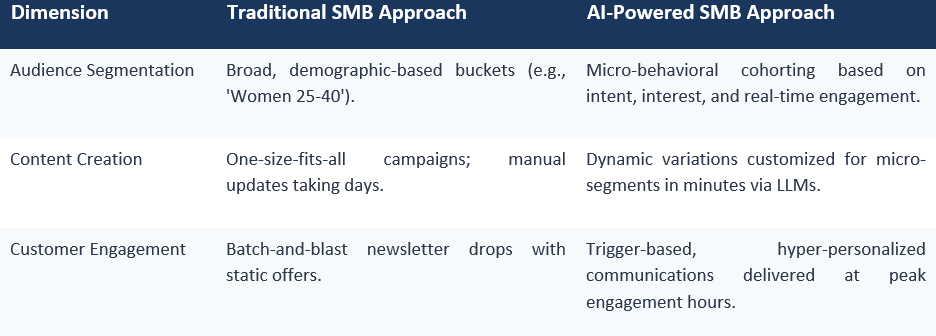
Personalization has shifted from a competitive advantage to a fundamental consumer expectation. However, executing true dynamic personalization historically required massive databases, complex conditional logic, and continuous manual oversight. For a small business, 'personalization' rarely extended beyond inserting a recipient's first name into an email subject line.
Dynamic Content Generation Beyond First-Name Tags
AI enables small businesses to implement deep contextual personalization that adapts to individual customer behaviors, preferences, and intent signals in real time. Rather than sending broad broadcast messages, SMBs can dynamically tailor content at scale:
• Behavioral Email Workflows: AI platforms analyze real-time website browsing habits, past purchase velocity, and content interaction to automatically generate custom email product recommendations and individualized narrative copy.
• Real-Time Website Personalization: AI-driven site overlays and dynamic landing pages alter headlines, hero imagery, and call-to-action (CTA) buttons based on the visitor's referral source, geographic location, or industry vertical.
Micro-Segmentation Strategies for Lean Budgets
Enterprise brands traditionally dominated micro-segmentation because they could afford to write bespoke creative for fifty different customer cohorts. AI collapses the marginal cost of content creation to near zero, allowing small teams to target ultra-niche audience segments without exhausting their creative resources.
- Predictive Analytics and Smart Decision-Making
Historically, business intelligence (BI) and predictive modeling were exclusive luxuries enjoyed by market leaders. Enterprises employed data scientists to build custom regression models forecasting customer lifetime value (LTV), churn risk, and seasonal demand. Small businesses, conversely, relied on lag indicators—looking at last month's balance sheet to decide next month's marketing budget.
Democratizing Big Data: From Hindsight to Foresight
Machine learning algorithms integrated into modern SMB analytics platforms automatically synthesize thousands of disparate data points into actionable growth insights. This shifts small business strategy from reactive decision-making to proactive execution.
• Predictive Lead Scoring: Instead of treating every sales lead equally, AI models evaluate historical conversion patterns, firmographic data, and digital intent signals to rank leads by conversion probability, enabling lean sales teams to focus exclusively on high-value opportunities.
• Proactive Churn Prevention: AI algorithms detect subtle drops in product usage, email engagement, or customer service sentiment, automatically alerting account managers or triggering automated re-engagement workflows before the customer officially cancels.
Budget Allocation and ROI Forecasting
Small businesses operate with tight financial margins where a misallocated ad budget can severely impact monthly revenue. AI-driven predictive tools analyze market trends, ad platform dynamics, and historical campaign performance to recommend optimal budget distribution across channels. By accurately projecting return on ad spend (ROAS) prior to full campaign rollout, small business owners can eliminate wasteful ad expenditures and double down on proven, high-yielding acquisition channels. - Large-Scale Ad Optimization on Small Budgets
Digital advertising across platforms like Google Ads, Meta Ads Manager, and TikTok Ads has become increasingly complex. In the past, managing high-performing ad accounts required dedicated media buyers continuously monitoring bid strategies, audience overlap, creative fatigue, and placement performance. Small businesses attempting manual ad management often lost money competing in auctions against automated enterprise bidding engines.
Automated Bidding, Budget Reallocation, and Creative Testing
Modern AI ad tech has democratized media buying by placing enterprise-grade algorithmic optimization directly into the hands of SMBs:
• Algorithmic Bidding: AI models analyze real-time auction variables—including device type, user intent, time of day, and browser history—adjusting bids in milliseconds to maximize conversions while preserving target acquisition costs.
• Dynamic Creative Optimization (DCO): Rather than manually designing and testing two ad variants, SMBs can upload multiple headlines, images, body text options, and calls-to-action into AI platforms. The system automatically combines, tests, and deploys hundreds of permutations, identifying winning creative combinations in real time.
• Cross-Channel Budget Fluidity: Smart management tools monitor performance across Meta, Google, and LinkedIn simultaneously, automatically shifting daily spend away from underperforming channels toward those delivering the lowest cost-per-acquisition (CPA).
Eliminating Ad Waste with Micro-Targeting
Ad waste is the primary killer of small business marketing budgets. Through lookalike modeling, predictive intent analysis, and automated exclusion lists, AI ensures that small business ad dollars are spent exclusively on high-intent prospective buyers. This eliminates broad, unqualified impression spend and dramatically boosts overall campaign efficiency. - Practical Implementation Roadmap for SMBs
While AI offers unprecedented power, adopting it without a strategic roadmap can lead to tool sprawl, fragmented data, and wasted operational effort. Small businesses must approach AI integration with a disciplined, high-ROI framework.
Step 1: Conduct an Operational Audit and Identify Bottlenecks
Begin by auditing your current marketing operations. Identify repetitive, manual tasks that consume valuable staff hours—such as writing social media posts, reformatting blog content, manually tagging leads, or pulling weekly reporting metrics. These high-friction, low-creativity tasks represent prime candidates for immediate AI automation.
Step 2: Assemble a Pragmatic, Stackable AI Toolkit
Avoid the temptation to subscribe to dozens of niche AI applications. Instead, build a core, interoperable tech stack focused on high-impact areas:
• Content & Copy Generation: Deploy foundational LLMs (e.g., ChatGPT Plus, Claude Pro) alongside specialized copy assistants (e.g., Jasper, Copy.ai) for rapid content expansion.
• Visual & Video Production: Utilize platforms like Midjourney, Canva Magic Studio, or Synthesia to maintain high visual presentation standards without hiring external design agencies.
• CRM & Email Intelligence: Leverage native AI features within modern platforms like HubSpot, ActiveCampaign, or Klaviyo to automate segmentation and predictive sending times.
Step 3: Establish Strong Human-in-the-Loop Safeguards
AI should function as a copilot, not an unsupervised pilot. Establish strict editorial and quality control protocols to protect brand identity:
• Brand Voice Alignment: Feed AI platforms comprehensive brand guidelines, tone-of-voice documentation, and past successful campaigns to ensure generated output reflects your authentic voice.
• Fact-Checking & Compliance: Mandate human review for all AI-generated statistics, claims, and technical advice to prevent hallucinations and maintain trust. - SEO Best Practices for AI-Generated and AI-Assisted Content
As AI tools democratize content production, digital search channels are being flooded with generic, low-quality text. Search engines, led by Google's helpful content systems, have evolved to penalize programmatic spam while rewarding deeply informative, human-centric content. Small businesses using AI for content marketing must adhere to rigorous SEO standards to maintain organic visibility.
Aligning with Google's E-E-A-T Framework
Google evaluates content quality through the lens of E-E-A-T: Experience, Expertise, Authoritativeness, and Trustworthiness. Pure AI output often lacks genuine personal experience and real-world perspective.
• Injecting First-Hand Experience: Enhance AI drafts with proprietary business case studies, founder quotes, real customer success stories, and unique operational data that machine learning models cannot replicate.
• Demonstrating Domain Expertise: Ensure subject matter experts (SMEs) review, refine, and sign off on technical content to guarantee accuracy and structural depth.
Structuring Content for Semantic Search and Intent
Modern search algorithms rely on natural language understanding and entity recognition rather than simple keyword density. SMBs should structure content logically:
• Clear Heading Hierarchy: Utilize single H1 tags for document titles, logical H2s for primary topic divisions, and H3s for supporting details or lists.
• Direct Intent Satisfaction: Answer primary user search queries concisely within the first 200 words, followed by comprehensive contextual expansion. - Conclusion and Future Outlook
The shift in marketing dynamics between small businesses and corporate Goliaths represents a permanent evolution in commerce. Artificial intelligence has broken the monopoly on enterprise-grade capabilities, giving agile, innovative small teams the tools to compete—and win—on a global stage.
However, as access to advanced technology becomes fully democratized, software alone will no longer serve as a durable moat. The ultimate competitive advantage for small businesses will lie in how effectively they pair AI efficiency with genuine human authenticity, strategic speed, and deep customer relationships. Navigating this shift requires clear direction from IT decision makers from EprofileTech who understand how to seamlessly integrate advanced infrastructure with human strategy. Ultimately, the small businesses that thrive in this new landscape will be those that embrace AI not as a replacement for human ingenuity, but as an amplifier of brand value, agility, and customer connection. - Enterprise Research & Reference Links
For further reading on enterprise marketing trends, predictive technologies, and strategic AI implementation frameworks, consult leading industry authorities:
• MarketingProfs - B2B Marketing Insights & Strategy: https://www.marketingprofs.com/
• Gartner - Marketing & Strategic Technology Research: https://www.gartner.com/
• Forrester - Customer Experience & Technology Trends: https://www.forrester.com/